

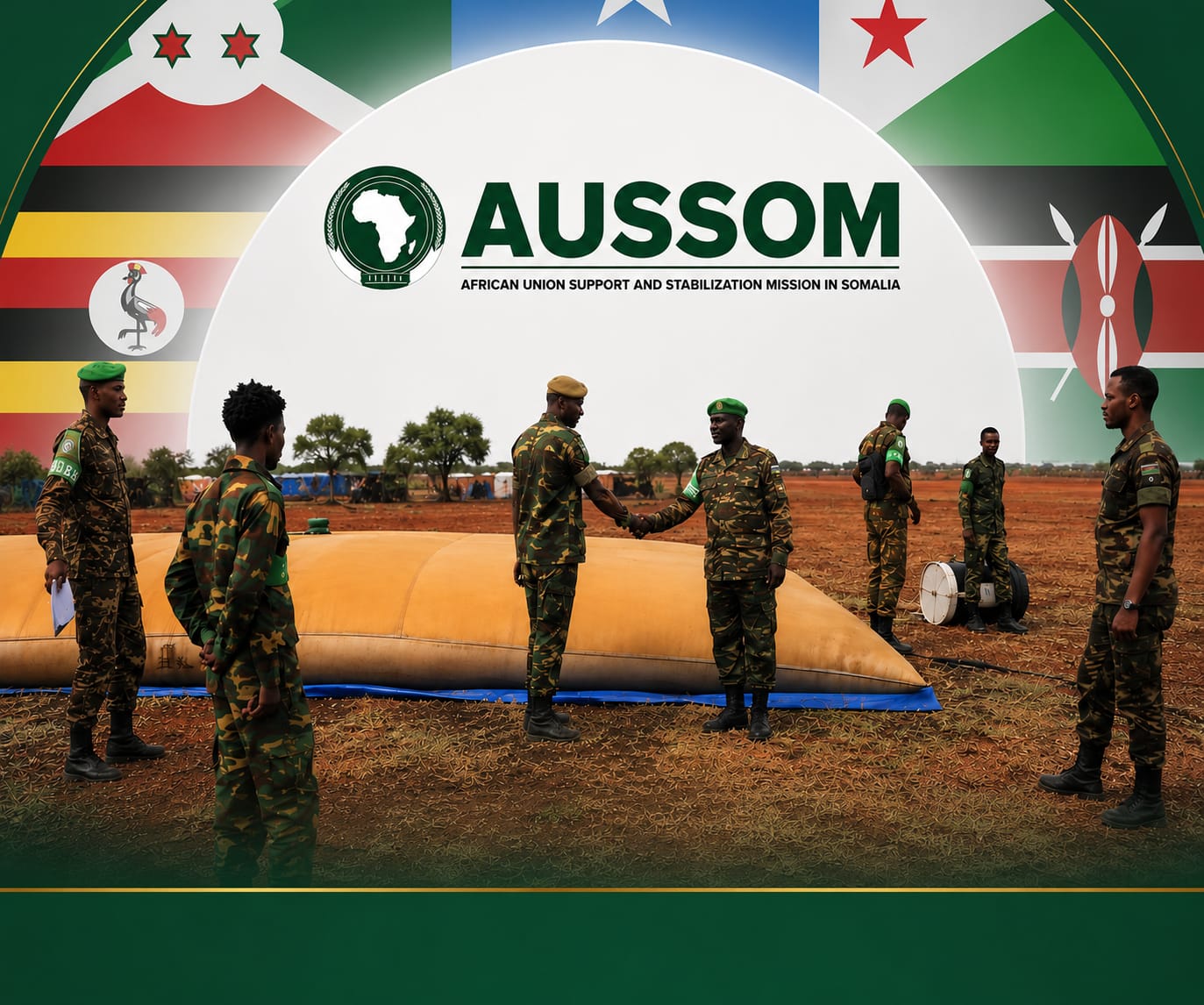
The future of the African Union Support and Stabilization Mission in Somalia is still being debated in diplomatic rooms, but on the ground, the transition of security responsibilities is already becoming visible.
The latest sign came from Buurhakaba in Somalia’s Bay region, where Ethiopian forces serving under AUSSOM handed over their forward operating base to Somalia’s 60th Division after nearly 12 years of deployment. The handover, reportedly completed on August 8, marks another significant moment in Somalia’s long-running effort to move from dependence on foreign security forces toward full national ownership of its security.
The timing is particularly important.
The transfer comes barely days after African Union troop-contributing countries and the Federal Government of Somalia met in Kampala to determine the future of AUSSOM. The summit called for an orderly, coordinated and phased transition and backed continued UN-mandated support for between 18 and 24 months to allow Somalia to strengthen its security institutions and assume greater responsibility. At the same time, however, the summit acknowledged serious financing difficulties facing the mission and called for a diplomatic push to secure sustainable funding.
That makes the Buurhakaba handover more than a local military development. It is an early test of the central question now facing Somalia and its international partners: Can Somali forces take over security responsibilities at the same time that the international system supporting AUSSOM is becoming increasingly uncertain?
Buurhakaba provides a particularly important case study because the withdrawal is taking place in an area where Al-Shabaab remains an active security threat. The Ethiopian contingent’s departure does not appear to represent an abandonment of the town. Rather, the position has been formally transferred to Somali forces, making the development consistent with the broader concept of an organized transition of security responsibilities.
But a formal handover is only the beginning of the test.
The real question is what happens after the foreign troops leave.
For years, African Union forces have provided a security umbrella while Somali forces gradually developed their own capabilities. The objective of the transition has always been to create a point at which Somali forces can not only occupy former foreign military positions but also independently defend them, gather intelligence, respond to attacks, protect surrounding communities and prevent armed groups from exploiting security gaps.
Buurhakaba will therefore provide an important measure of whether that objective is being achieved.
If Somalia’s 60th Division can maintain security and prevent Al-Shabaab from exploiting the transition, the handover could become an important example for further AUSSOM transfers. It would strengthen the argument that Somali forces are increasingly capable of taking over responsibilities previously carried by international forces.
If the opposite happens, however, the consequences would extend beyond Buurhakaba. Any significant deterioration in security following a handover could reinforce concerns that the transition is moving faster than Somalia’s security institutions can realistically sustain.
That is why the Kampala communiqué is so significant.
The summit did not call for an abrupt departure of AUSSOM. Instead, it explicitly stressed the need for an “orderly, coordinated and phased exit” and called for continued UN-mandated support for 18 to 24 months. The proposed period was intended to provide Somalia with additional time to meet agreed security milestones, strengthen its institutions and gradually transfer responsibilities.
The Buurhakaba handover can therefore be seen as an example of what that phased transition might look like in practice.
But it also exposes the tension at the heart of Somalia’s security transition.
Somalia wants to assume full responsibility for its national security. Its government has consistently pushed for greater national ownership and has sought to build the Somali National Armed Forces into a professional force capable of protecting the country without permanent dependence on foreign troops.
Yet Somalia still requires substantial external assistance to make that ambition possible.
The Kampala communiqué itself acknowledged the financial shortfalls facing AUSSOM and called for predictable and sustainable financing. The summit mandated the foreign ministers of troop-contributing countries, working with Somalia and the African Union, to pursue diplomatic efforts to secure funding and organize a donors’ conference.
That financing question has become even more urgent after the United States notified the African Union that it would not provide funding for the UN Support Office in Somalia beyond December 2026. The decision matters because UNSOS provides critical logistical and operational support to the mission, meaning the loss of that funding could have consequences far beyond the availability of foreign troops themselves.
This creates an uncomfortable paradox.
Somalia is being asked to assume more responsibility for its security at precisely the moment when the international financial architecture supporting the transition is under pressure.
The danger is not necessarily that AUSSOM will suddenly disappear. The greater concern is that the mission could become increasingly constrained by financial and logistical limitations, forcing troop withdrawals or reductions in support before Somalia has fully developed the capabilities required to replace them.
That is why Buurhakaba matters.
The handover offers a glimpse into what the next stage of Somalia’s security landscape could look like: foreign forces gradually leaving strategic positions while Somali forces take over. The success of that model will depend not simply on whether Somali soldiers can occupy former AUSSOM bases, but whether they have the resources and institutional support required to sustain security after the handover.
The Kampala communiqué itself identified some of those gaps. African leaders called for increased air capabilities and intelligence, surveillance and reconnaissance assets, alongside continued training and development of an integrated military doctrine. They also called for sustained regional and international partnership, mentorship and capacity-building until the Somali National Armed Forces are capable of assuming national security responsibilities.
That language is revealing.
It suggests that the regional leadership does not believe Somalia has reached the final stage of the transition. Instead, it sees the country as moving through a process in which responsibility can gradually shift to Somali forces while external partners continue to provide essential support.
The challenge is ensuring that the process remains genuinely conditions-based.
A phased withdrawal should not simply mean foreign forces leave one position after another according to a timetable. It should mean Somali forces are ready to take over each responsibility before the international force departs.
That requires more than manpower. It requires command structures, logistics, intelligence, mobility, equipment, reliable financing and political coordination between the Federal Government, Federal Member States and local communities.
It also requires the ability to hold territory after it has been recovered.
This is particularly important in the fight against Al-Shabaab. The group’s strength has historically not depended solely on its ability to seize towns. Its resilience has also been linked to its ability to exploit weaknesses in governance and security, operate in rural areas and return to locations where state forces struggle to maintain a sustained presence.
For Somalia, therefore, the ultimate measure of the transition will not be the number of AUSSOM bases handed over. It will be whether Somali forces can maintain security once those bases are no longer protected by foreign troops.
The Ethiopian withdrawal also carries a broader regional significance.
Ethiopia has been one of the most important military actors in Somalia for years, and Ethiopian troops have played a significant role in countering Al-Shabaab. Their departure from Buurhakaba represents a change in the security architecture of a strategically important part of southern Somalia. But it should not automatically be interpreted as Ethiopia abandoning its broader security role in Somalia. The distinction between an AUSSOM handover and any wider Ethiopian military posture is important.
For now, the immediate test belongs to Somalia’s 60th Division.
Can it hold the position? Can it maintain security around Buurhakaba? Can it respond effectively to emerging threats? And can the Somali government provide the logistical and institutional support required to make the handover sustainable?
The answers will matter well beyond Bay region.
They will help determine whether the transition envisaged in Kampala is moving at the right pace.
There is also a larger question hanging over AUSSOM itself. The mission’s political future may still require further decisions, its financing remains uncertain and the international support architecture faces pressure. Yet security responsibilities are already moving, piece by piece, from African Union forces toward Somali institutions.
That means the debate over AUSSOM is no longer simply about whether the mission should remain or leave. It is increasingly about how Somalia can inherit the security responsibilities of a mission that has been part of the country’s security architecture for years without creating a vacuum that Al-Shabaab can exploit.
Buurhakaba is now one of the places where that question will be answered.
The Ethiopian handover may ultimately be remembered as a successful example of Somalia taking ownership of its security. But that outcome cannot be determined on the day the flag changes over a military base. It will be determined in the months that follow, when Somali forces must demonstrate that they can do what AUSSOM and its predecessor missions have spent years doing: hold territory, protect communities and prevent Al-Shabaab from turning a transition into an opportunity.
For the Somali government, the message is therefore clear. The transition is no longer an abstract diplomatic objective. It is becoming a practical responsibility, one base at a time.
And for AUSSOM’s international partners, Buurhakaba offers an equally important warning: a phased withdrawal can succeed only if the forces replacing the departing contingents are given the capabilities and resources to succeed.
The Kampala summit may not have resolved every question surrounding AUSSOM’s future. But developments in Buurhakaba suggest that the next phase of Somalia’s security transition will not wait for every diplomatic question to be settled.
The transition is already taking shape on the ground.
Now comes the harder test: whether Somalia is ready to carry it.