

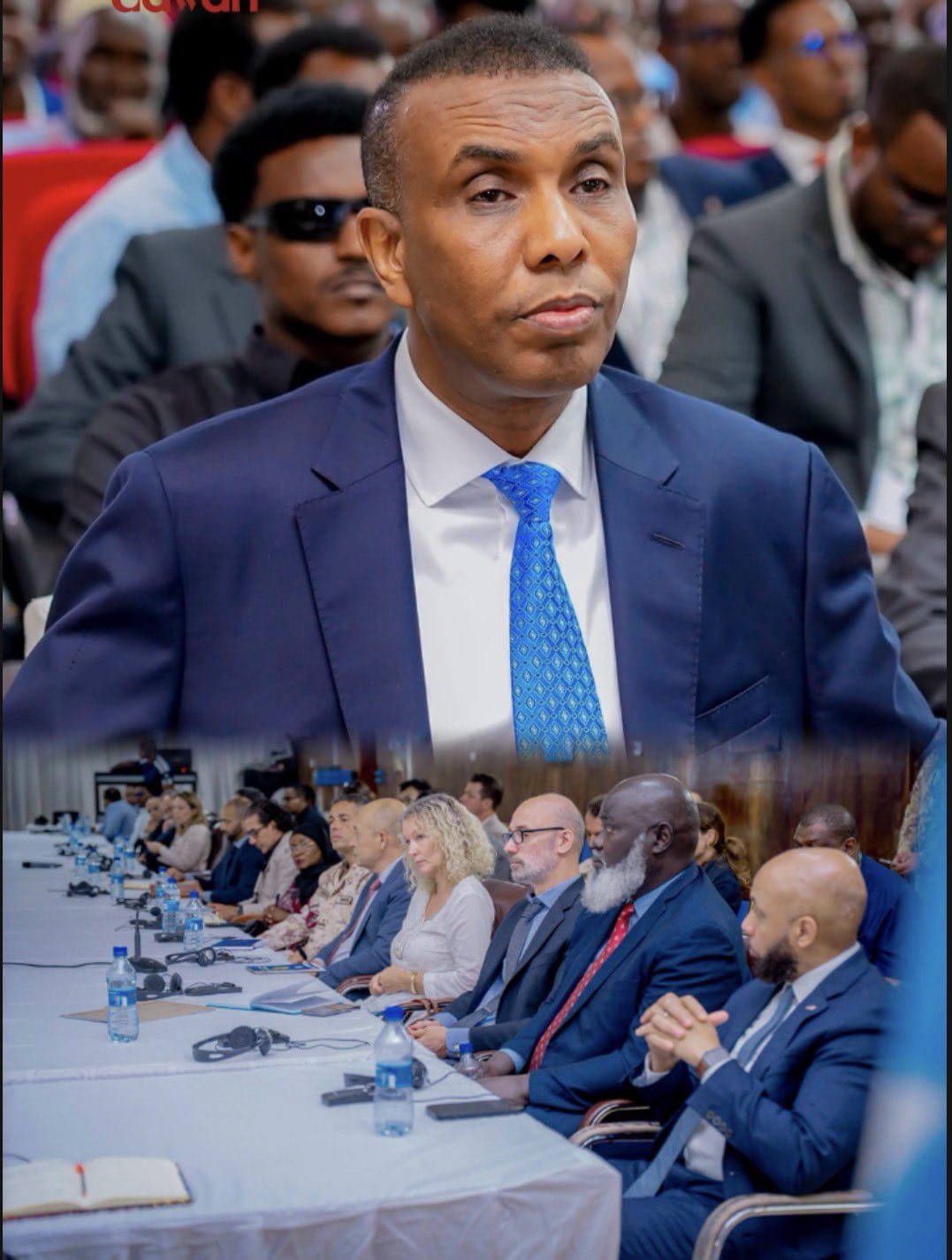
Somalia’s Prime Minister Hamza Abdi Barre has delivered one of his strongest messages yet to the country’s international partners, accusing elements of the international community of continuing to view Somalia through the lens of its darkest years when the country lacked functioning national institutions and depended heavily on external actors to manage its affairs.
Speaking in Mogadishu during the opening of the National Agri-Food Investment Summit, NAFIS 2026, Prime Minister Barre challenged what he described as an outdated mindset towards Somalia, arguing that the country has undergone significant political and institutional transformation and should increasingly be treated as a sovereign state capable of determining its own priorities and making decisions in its national interest.
“They tell us, ‘You cannot do everything yourselves.’ We will no longer accept that. They must change this mindset,” Barre declared.
His remarks amount to a direct political challenge to the way some international partners continue to approach Somalia, particularly in areas where foreign governments, international organisations and development institutions have historically played an influential role.
Barre argued that Somalia today cannot be judged by the standards of the past. The country, he said, has moved beyond the period when Somalia was frequently characterised by the absence of effective central authority, weak national institutions and prolonged political transition.
“These individuals in the international community still have the same attitude they used to treat Somalia when it was a stateless country,” the Prime Minister said, insisting that those perceptions no longer reflect the Somalia that exists today.
The significance of Barre’s remarks lies not only in their tone but also in the setting in which they were delivered. The Prime Minister was speaking at an agricultural investment summit centred on strengthening domestic production, expanding Somalia’s agricultural economy and attracting investment into the country’s food sector.
That backdrop gave his message a broader meaning: Somalia’s push for self-reliance is not being framed solely as a political ambition, but increasingly as an economic one.
For Barre, the development of productive sectors such as agriculture is part of a wider effort to build a country that can increasingly finance its own priorities, strengthen domestic institutions and reduce dependence on external assistance.
The Federal Government has increasingly placed economic transformation and institutional development at the centre of its national agenda. Its National Transformation Plan for 2025–2029 identifies governance, economic growth, service delivery and institutional strengthening as central components of Somalia’s long-term development strategy.
The Prime Minister’s argument is therefore rooted in a broader political narrative: that Somalia should not permanently remain defined by the circumstances that followed the collapse of the central government in 1991.
For decades, Somalia’s relationship with the international community was heavily shaped by humanitarian crises, conflict, state fragility and the need for international intervention. Transitional administrations were established as part of efforts to rebuild national institutions, with the Transitional Federal Government eventually giving way to the Federal Government of Somalia in 2012.
But Barre’s message suggests that Mogadishu now wants a different relationship with its international partners one based less on dependency and more on partnership between sovereign institutions.
That does not necessarily mean Somalia is rejecting international cooperation. In fact, the country continues to work with international organisations, development partners and foreign governments across security, humanitarian assistance, economic development and institution-building.
Rather, the Prime Minister’s remarks point towards a demand for a change in the balance of that relationship.
Somalia wants international partners to recognise the authority of its institutions while supporting national priorities instead of approaching the country primarily through the framework of fragility.
The message also comes at a time when Somalia is seeking to expand domestic economic capacity. The government has been promoting agricultural investment and food production as important components of economic recovery and food security. In 2025, Barre inaugurated the National Agri-Food Investment Summit, while the government has also moved to strengthen agricultural research and national food-production capacity.
The Prime Minister’s latest intervention therefore places economic sovereignty alongside political sovereignty.
His argument is essentially that a country cannot be expected to become self-reliant while international actors continue to assume that it is incapable of managing its own affairs.
For Somalia, the challenge now is turning that political declaration into measurable institutional and economic strength.
The country still faces serious challenges, including insecurity, political disagreements, limited domestic revenue, poverty, climate shocks and dependence on external support. Those realities mean that Somalia’s transition towards greater self-reliance remains a process rather than a completed achievement.
But Barre’s statement makes clear that the government wants the international community to recognise the progress that has already been made.
The message from Mogadishu is increasingly direct: Somalia does not want to remain permanently defined by its past.
It wants to be seen as a country rebuilding its institutions, strengthening its economy, developing its own productive capacity and making its own national decisions.
And in delivering that message at a summit dedicated to investment and food production, Prime Minister Hamza Abdi Barre linked Somalia’s political independence to perhaps its most important long-term test whether the country can build an economy capable of sustaining the state and its people.
The argument coming from Mogadishu is no longer simply that Somalia needs help to rebuild.
It is that Somalia wants its international partners to recognise that the country is rebuilding on its own terms.