

As Kenya moves toward the 2027 General Election, the country’s emerging electoral arithmetic is beginning to reveal an important story: the regions with the largest voter populations are getting larger, but so are the smaller blocs that can become decisive in a closely contested presidential race. Nowhere is this tension more visible than in North Eastern, Kenya’s smallest traditional electoral region by registered voters.
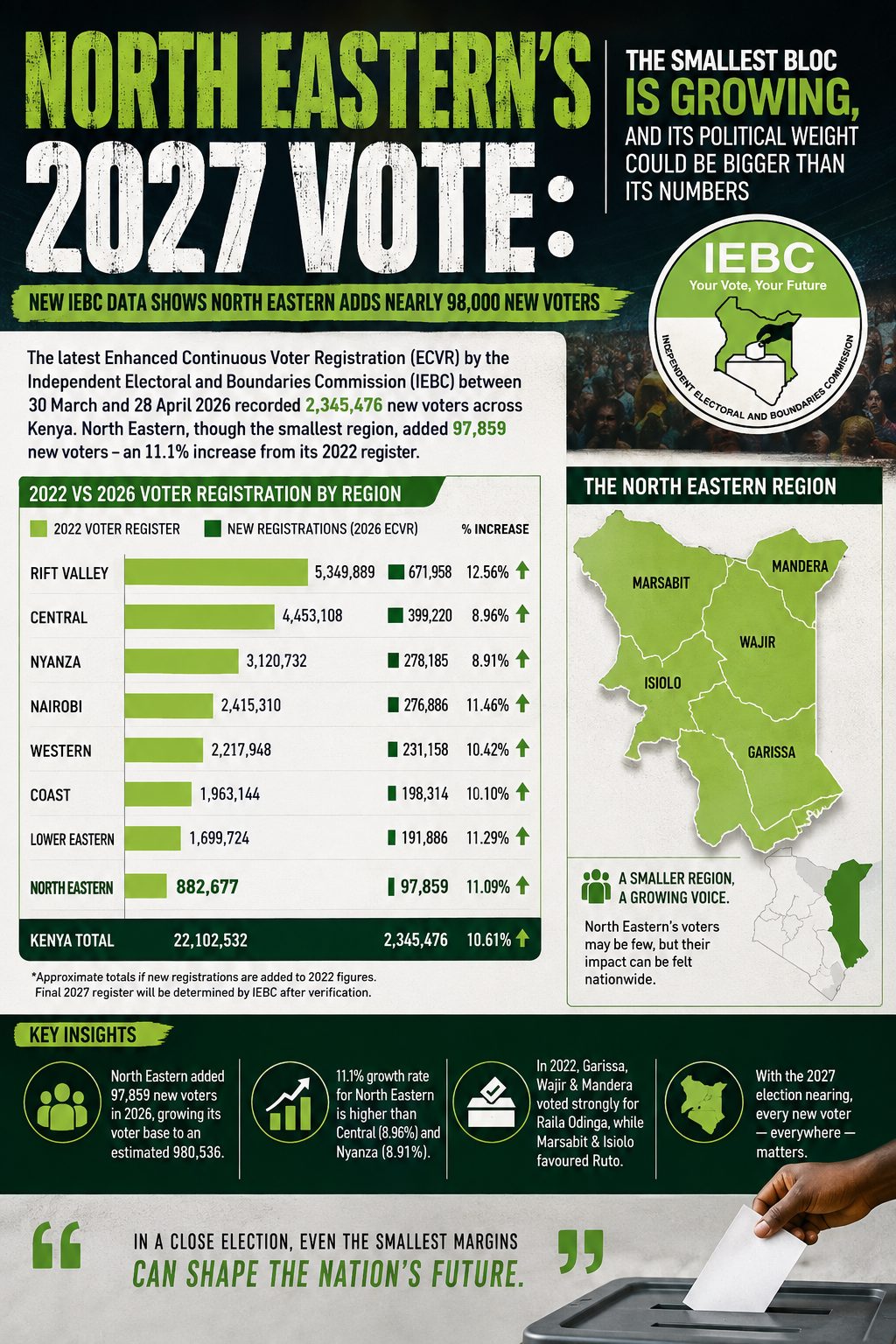
New voter-registration figures from the Independent Electoral and Boundaries Commission (IEBC) show that North Eastern has added 97,859 voters during the latest Enhanced Continuous Voter Registration (ECVR) phase, taking its potential voter base from 882,677 in 2022 to about 980,536 if the new registrations are simply added to the earlier register.
The number may appear modest beside the 671,958 new voters registered in Rift Valley or the 399,220 recorded in Central, but reducing North Eastern’s political importance to its raw numbers would miss the larger story. The region’s significance has historically rested not only on the size of its electorate but also on its ability to vote in relatively concentrated patterns, making its political leadership and coalition choices important in the national numbers game.
In the 2022 presidential election, Raila Odinga dominated the three core North Eastern counties of Garissa, Wajir and Mandera, while William Ruto carried Marsabit and Isiolo. In Garissa, Odinga received 81,376 votes against Ruto’s 28,111; in Wajir, he received 83,486 against Ruto’s 49,062; and in Mandera, he secured 106,279 against Ruto’s 28,351.
That 2022 pattern provides the starting point for understanding what the new registration numbers could mean for 2027. North Eastern did not enter the last election as a politically neutral region. Its three predominantly Somali counties delivered substantial margins to the Azimio candidate, helping demonstrate that even a region with fewer than one million registered voters can produce a concentrated block of votes.
The question now is whether that political alignment will survive into 2027, particularly as the national coalition landscape has changed considerably since 2022.
The numbers tell a bigger national story
IEBC’s latest registration exercise provides a useful snapshot of how Kenya’s electorate is expanding ahead of the next presidential contest. Between March 30 and April 28, 2026, the commission registered 2,345,476 new voters nationally, bringing the cumulative number registered since the exercise resumed in September 2025 to 2,612,725. The new registrations were spread across all eight regions, although the scale varied sharply.
Rift Valley recorded the largest increase, adding 671,958 voters, followed by Central with 399,220. Nyanza added 278,185, Nairobi 276,886, Western 231,158, Coast 198,314, Lower Eastern 191,886, while North Eastern registered 97,859. The distribution demonstrates that the country’s electoral centre of gravity remains heavily concentrated in the larger regions, but it also shows that voter registration is expanding across virtually the entire country.
When these figures are compared with the 2022 regional register, the difference becomes even more revealing. North Eastern’s 97,859 new voters represent an increase of roughly 11.1 per cent over its 882,677 registered voters in 2022.
That percentage growth is actually higher than the increase recorded by Central, at about 9 per cent, and Nyanza, at roughly 8.9 per cent. Nairobi’s increase is about 11.5 per cent, while Western stands at approximately 10.4 per cent. Rift Valley’s enormous numerical gain translates to about 12.6 per cent of its 2022 base.
This distinction between absolute growth and percentage growth matters. North Eastern may remain the smallest region numerically, but its voter base is not standing still. If the 2026 additions were simply placed on top of the 2022 register, the region would approach the one-million-voter threshold. That would represent a significant expansion of its potential influence, even though it would still account for only around four per cent of the national electorate.
The national picture is equally significant. The eight-region figures supplied from the 2022 register total about 22.10 million voters. Adding the latest 2.345 million new registrations would produce a purely arithmetic total of approximately 24.45 million, although that should not be treated as IEBC’s final 2027 register because the electoral roll can also change through transfers, verification, deaths, removals and other updates.
IEBC’s official 2022 constituency data provide the baseline for the previous register, while the latest ECVR figures show the direction of movement rather than a final 2027 electoral roll.
For political parties and presidential campaigns, that expansion creates two different calculations. The first is the size of the electorate; the second is how efficiently a candidate can convert new registrations into actual votes. A region can have millions of registered voters but produce a lower electoral return if turnout is weak or the vote is divided. Conversely, a smaller region with strong turnout and concentrated support can deliver a disproportionately valuable margin.
That is precisely where North Eastern enters the 2027 equation.
The region’s political history suggests that its electoral behaviour cannot simply be interpreted through national population rankings. In 2022, the three core Somali counties produced clear presidential preferences. Garissa, Wajir and Mandera all gave Odinga sizeable victories, while the contest in Marsabit and Isiolo was more favourable to Ruto.
This means that the central question for 2027 is not merely whether North Eastern will register another 100,000 voters. It is whether the additional voters, together with the existing electorate, will maintain the region’s previous voting pattern or respond to a new political alignment.
That question is particularly important because the national political environment has changed since 2022. Alliances, personalities and relationships between national and regional leaders have shifted, while parties are already positioning themselves for the next contest.
The latest IEBC numbers therefore arrive at a moment when political actors are trying to determine where the next marginal votes will come from. The Star has similarly described the new registration figures as an early indicator of the regions likely to shape coalition calculations ahead of 2027.
For North Eastern, the lesson is straightforward: numbers alone do not tell the entire political story. The region has fewer voters than every other traditional region in the comparison, but its voters have previously demonstrated the ability to move in sufficiently concentrated patterns to create substantial margins.
The additional 97,859 voters could therefore matter not because they suddenly transform North Eastern into a large electoral bloc, but because they enlarge an already politically significant pool at a time when the presidential race could again be decided by relatively narrow national margins.
Kenya’s 2027 election is still more than a year away, and voter registration remains an evolving process. IEBC has indicated that registration continues through constituency offices and Huduma Centres, meaning the numbers can change before the final register is published.
But the direction is already visible. North Eastern is growing, the national electorate is expanding, and the old assumption that the region’s political importance can be measured simply by its position at the bottom of the voter table is increasingly inadequate.
The real political question heading toward 2027 is therefore not whether North Eastern has enough voters to determine Kenya’s presidency on its own. It plainly does not. The more consequential question is which coalition can turn North Eastern’s growing electorate into a reliable voting margin while simultaneously assembling the much larger blocs required elsewhere in the country.
That is where the region’s story becomes bigger than its numbers. In a presidential contest where every vote matters, North Eastern does not need to be the biggest electoral bloc to become one of the most strategically valuable.