

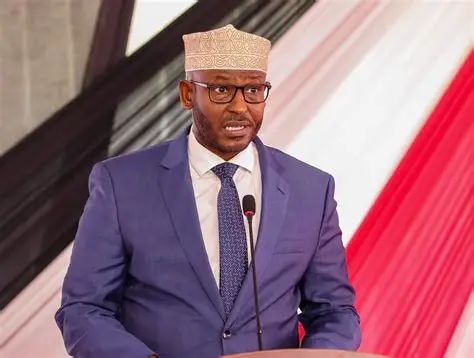
Four years after returning to office, Governor Ahmed Abdullahi’s administration can point to major investments in health, agriculture, water, education and social programmes but much of the county’s most visible transformation has also come through national-government projects, while Senate scrutiny over billions in liabilities continues to raise difficult questions about financial management.
On August 9, 2022, Ahmed Abdullahi returned to the Wajir governorship, nearly four years after leaving office. He won with 35,533 votes on an ODM ticket, defeating his closest challenger, Hassan Mohamed Adam of Jubilee, who garnered 27,224 votes a margin of 8,309 votes. Out of 132,854 valid votes, Abdullahi’s victory marked a political comeback and placed him at the centre of Wajir’s development story once again.
Four years later, the question facing Wajir is no longer whether Ahmed Abdullahi could win the seat again. He did. The bigger question is what his second and last administration has delivered, what belongs to the county government, what came from the national government, and whether the results match the expectations that accompanied his return.
The first years of the administration unfolded against a difficult backdrop. Wajir, like much of northern Kenya, was hit by the devastating Horn of Africa drought. Pastoral families lost livestock, water sources came under pressure and food insecurity deepened. Then, after the drought, came the heavy rains and flooding of late 2023, disrupting roads and livelihoods and cutting transport links, including sections of the Wajir-Mandera route.
It was against this difficult environment that the county government began pushing its development programme.
Health became one of the administration’s most prominent areas of investment. County records show that Wajir now has 167 operational health facilities, while the doctor-to-population ratio improved from 1:14,998 in 2023 to 1:10,700 in 2025, and the nurse ratio from 1:1,850 to 1:1,530. The county also reported 1,197 Community Health Promoters.
Maternal-health indicators also recorded improvement. First antenatal-care attendance increased from 75.4 per cent in 2022 to 80.4 per cent in 2025, while fourth ANC attendance rose from 37 per cent to 42 per cent. Skilled birth attendance increased from 46.1 per cent to 51 per cent, while maternal-death audit coverage reached 100 per cent.
The county says it also upgraded four Level-3 facilities to Level 4, two Level-2 facilities to Level 3, renovated Bute Sub-County Hospital, constructed a mortuary at Wajir County Referral Hospital and supplied medical equipment.
But the most visible healthcare milestone came later.
In June 2023, Abdullahi’s administration broke ground on the expansion of the Wajir County Teaching and Referral Hospital’s Accident and Emergency Unit. Three years later, President William Ruto officially opened the facility during the June 1, 2026 Madaraka Day celebrations in Wajir.
The expanded complex includes emergency and trauma-care facilities, triage and consultation areas, rapid-response laboratory services, a 12-bed ICU, 12-bed HDU and three modern operating theatres, alongside a 48-bed inpatient ward, four private amenity rooms and specialised medical systems. A rooftop water-purification system is designed to produce approximately 2,000 litres of medical-grade water per hour.
The facility is intended to help Wajir handle emergency and specialised treatment locally instead of sending patients to Garissa, Nairobi and other referral centres.
Then came another transformation agriculture.
In an environment better known for pastoralism than large-scale crop production, the county began investing in irrigation, mechanisation and commercial farming. Its 2024 records described plans for four farms of approximately 5,000 acres each, with a projected combined potential of 54,000 metric tonnes of cereals annually, valued at more than KSh300 million.
The county also reported excavating four mega water pans with a combined capacity of 240,000 cubic metres, solarising 65 shallow wells, drilling and solarising two irrigation boreholes and purchasing four tractors and farm implements. More than 3,500 acres were reportedly being prepared annually through mechanisation, while more than 120 extension officers and 7,000 farmers had received training.
The agriculture budget increased from KSh45 million in FY2022/23 to KSh300 million in FY2023/24, while the county reported approximately KSh1.6 billion worth of agricultural production in 2023.
Livestock, however, remained at the heart of Wajir’s economy. The county invested in fodder production, livestock insurance, improved breeds, rangeland management and drought response. Its plans included a KSh200 million livestock-insurance programme targeting 60,000 Tropical Livestock Units, with 32,000 units reported as achieved.
Education and social programmes also expanded. ECDE enrolment increased from 19,071 learners in 2022 to 28,686 in 2025, with 376 ECDE centres and 521 caregivers reported. The county also supported school feeding, bursaries and construction of child-friendly classrooms and sanitation facilities.
For women and girls, the county reported support to 32,000 school-going girls through sanitary pads and undergarments, while women received equipment such as sewing machines, baking equipment, umbrella shades and refrigerators to support income-generating activities.
The administration also introduced youth and social programmes, including Kazi Mtaan, which engaged more than 500 young people for short-term work in Wajir town, while sports programmes such as the Governor’s Super Cup expanded opportunities for young people.
THE MADARAKA MOMENT AND THE QUESTION OF WHO DELIVERED WHAT
Nothing, however, changed Wajir’s national profile more dramatically than June 1, 2026.
For the first time, Kenya’s Madaraka Day celebrations were held in Wajir and the wider North Eastern region. President William Ruto presided over the celebrations at the newly constructed Ahmed Khalif Stadium, formerly Wajir Stadium.
The 10,000-seater stadium, built through national-government funding with construction overseen by the Kenya Defence Forces under the Ministry of Defence in collaboration with the Ministry of Sports and Wajir County Government, became the centrepiece of the historic occasion.
The stadium features a full-size football pitch, an eight-lane athletics track, changing rooms and VIP facilities. Construction was launched in February 2026 and completed ahead of the national celebrations.
But the Madaraka Day infrastructure programme also brought a major wave of road investment into Wajir town.
The national government said approximately KSh1.9 billion was invested through KURA in 25.1 kilometres of roads. The programme included the Furaha Girls–Wajir Stadium Road, A2 Manyalo Junction–Stadium Ring Road, Airport Gate–Basabra–Furaha School–Stadium Link Road, CAIPS Access Road, access roads to government facilities and drainage improvements along the B13 Moyale Road.
Inspection figures shortly before Madaraka Day showed some projects still under construction including the Furaha Girls-Stadium road at 55.2 per cent, Manyalo-Stadium Ring Road at 69.7 per cent, the government-facility access roads at 77.7 per cent, the Airport-Basabra-Stadium link at 61.5 per cent, CAIPS at 55 per cent and B13 drainage at 39.5 per cent. Subsequent government reporting described several of the roads as delivered or substantially upgraded.
And this distinction matters.
The Madaraka Day roads and Ahmed Khalif Stadium were national-government investments, not county-funded projects. The same applies to much of the infrastructure showcased during President Ruto’s visit. Abdullahi’s administration can legitimately claim political advocacy, facilitation and cooperation, but the funding and implementation must be attributed correctly.
The same year also saw Wajir host the Fourth Pastoralist Leadership Summit in December 2024, bringing leaders from more than 15 pastoralist counties, development partners and national-government officials. President Ruto later closed the summit, placing Wajir at the centre of national discussions on pastoralism and ASAL development.
The wider national road programme also gathered momentum. The Isiolo-Wajir-Mandera Northern Kenya Gateway Corridor, covering roughly 750 kilometres and estimated at about KSh100 billion, emerged as one of the largest infrastructure projects affecting the region.
But alongside development came scrutiny.
In May 2023, Abdullahi appeared before the Senate County Public Accounts Committee. Senators questioned him over Wajir’s financial liabilities, including pending bills and unremitted statutory deductions. He told the committee that liabilities had risen from about KSh1 billion at the June 2022 audit to KSh5.5 billion, while another KSh1.5 billion in statutory deductions had allegedly been deducted from employees but not remitted. His administration was also examining approximately KSh7.4 billion in questionable liabilities.
The Senate demanded answers.
In June 2023, Abdullahi appeared before the Senate County Public Investments and Special Funds Committee over WAJWASCO. The water company faced serious audit concerns, including disclaimer opinions and inadequate financial documentation. Senators also heard that non-revenue water stood at approximately 82 per cent, prompting demands for reforms in management, asset mapping, financial reporting and governance.
The Senate scrutiny returned in January 2026, when Wajir’s public entities again came under examination.
And in June 2026, Abdullahi faced CPAC again over Wajir’s FY2024/25 accounts. Senators scrutinised about KSh732.6 million in employee-related and statutory liabilities, including pension, NSSF, salary and gratuity obligations. The committee also questioned approximately KSh3.5 billion in pending bills, while an audit showed 216 drivers against a fleet of 149 vehicles, including 90 grounded vehicles.
The governor maintained that a substantial portion of the liabilities were inherited.
The financial scale of the administration is enormous. From FY2022/23 through FY2026/27, Wajir’s approved or projected budget envelopes amount to roughly KSh63.35 billion. The figures were approximately KSh11.66 billion in FY2022/23, KSh12.14 billion in FY2023/24, KSh13.52 billion in FY2024/25, KSh13.99 billion in FY2025/26 and KSh12.03 billion projected for FY2026/27.
But a budget is not the same as money actually received or spent. Wajir remains heavily dependent on national transfers, and the county has repeatedly faced delays in disbursements, limited own-source revenue and pending bills.
The verdict from the streets, therefore, is divided.
Yusuf Adan told Siyad Reports: “Ahmed Abdullahi was re-elected in August 2022, nearly four years now. He has fairly delivered tangible results that can be seen, from roads to healthcare, that new hospital wing, to hosting Madaraka Day that came with goodies like the Ahmed Khalif Stadium. He has done quite good.”
Aisha Mohammed offered an even stronger assessment: “Wajir County has never had this kind of maendeleo. Even comparing his predecessor, he has done well, and we hope in the remaining one year he will do more, InshaAllah.”
Mzee Adan, however, offered a more measured verdict: “You can see the roads, the stadium and the way he delivered. Yes, there are some obstacles, but he has tried. We want him to focus more on water projects and healthcare in the coming one year.”
Not everyone agrees.
Muhummed Adow argued that much of what residents see came from national-government intervention. “Most of the projects came as a result of national government intervention during Madaraka Day. He has not met the expectations we had during his campaign. I can say 70 per cent of his manifesto was not fulfilled.”
For Hussein Ibrahim, the biggest disappointment is youth employment.
“As youth, the governor has left us with no job creation. He promised during his campaign. Every year nurses who have graduated are denied chances of employment,” he said, arguing that the major infrastructure projects were largely national-government funded.
That is ultimately the central question of Ahmed Abdullahi’s second term.
His administration has delivered measurable programmes: 167 health facilities, improving health-worker ratios, rising maternal-health indicators, 28,686 ECDE learners, agricultural expansion, irrigation, livestock resilience, women and girls’ programmes, social protection, urban planning and institutional reforms.
But the most spectacular physical symbols of Wajir’s transformation in 2026 Ahmed Khalif Stadium, the Madaraka Day roads and major national-government infrastructure did not come from the county’s own development budget but it actually lobbied for it.
Four years after his political comeback, Ahmed Abdullahi’s record is therefore neither a simple success story nor a failure story.
It is a story of visible progress alongside unfinished promises; county-led development alongside national-government intervention; improved services alongside financial questions; and a governor whose administration has achieved tangible milestones while still facing demands from residents for jobs, water, healthcare and stronger financial accountability.
With roughly one year remaining before the next political contest, the final chapter is still unwritten.
For Wajir, the question is no longer simply what has Ahmed Abdullahi built?
It is whether, before the four-year story becomes a five-year political verdict, the achievements will outweigh the promises that remain unfinished.