

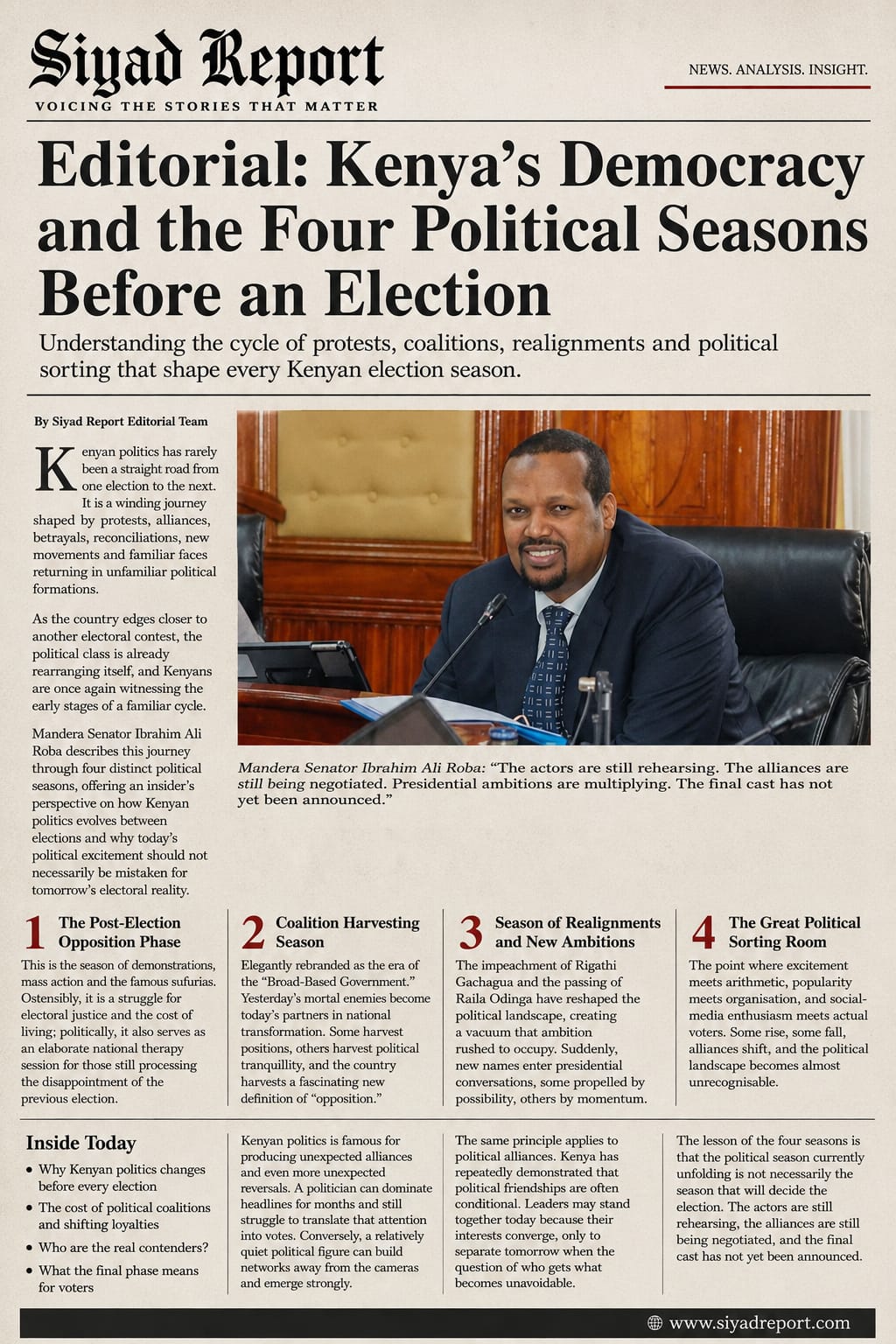
Kenyan politics has rarely been a straight road from one election to the next. It is a winding political journey shaped by protests, alliances, betrayals, reconciliations, new movements and familiar faces returning in unfamiliar political formations. As the country edges closer to another electoral contest, the political class is already rearranging itself, and Kenyans are once again witnessing the early stages of a familiar cycle.
In a thought-provoking script, Mandera Senator Ibrahim Ali Roba describes this journey through four distinct political seasons, offering an insider’s perspective on how Kenyan politics evolves between elections and why today’s political excitement should not necessarily be mistaken for tomorrow’s electoral reality.
At the heart of Roba’s argument is a simple but powerful observation: Kenyan politics changes dramatically around an election, but one feature has traditionally remained relatively stable the incumbent president seeking another term. Around that central figure, however, almost everything else can change.
Political parties can realign, former enemies can become allies, opposition leaders can join government, and politicians who appear politically unstoppable at one moment can become almost irrelevant at another. The electoral process therefore cannot be understood merely by looking at who is popular today. It must be examined as a continuing political cycle in which every season serves a different purpose.
The first season, as Roba describes it, is the Post-Election Opposition Phase. This is the period immediately following an election when political disappointment is still fresh and opposition forces mobilise around grievances. Demonstrations, mass action and the now-famous political symbolism of sufurias become instruments of protest. On the surface, these movements are often framed around electoral justice, economic hardship and the rising cost of living. Beneath the political rhetoric, however, there is also a deeply human element: the losing side is still processing defeat, while its supporters are demanding recognition of their grievances.
This phase is important because it establishes the political language of the opposition for the early part of the electoral cycle. Leaders who lost the previous contest seek to maintain relevance, supporters remain energised, and the government faces pressure to respond to both economic and political demands. It is also the stage when opposition politics can appear at its most uncompromising. Leaders speak strongly against the government, accuse it of failing citizens and promise to maintain pressure until change is achieved.
But Kenyan political history shows that such confrontation rarely remains permanent.
This leads to the second season: Coalition Harvesting Season, which Roba associates with the emergence of the Broad-Based Government. It is perhaps one of the most revealing features of Kenyan political culture that yesterday’s fiercest opponents can eventually find themselves sharing political platforms and government responsibilities. The language changes almost overnight. Leaders who previously described each other as fundamentally incompatible begin speaking about national unity, inclusivity and working together for the common good.
Roba’s description of this period as a “harvest” is particularly striking because political coalitions rarely involve only ideology. They are also about interests, influence and political survival. Some politicians harvest positions, others harvest access to government, while the government itself can harvest political stability. A government facing constant confrontation gains breathing room when previously hostile forces are brought into the political tent.
For the opposition, joining government can also create a difficult political paradox. Once a movement that built its identity around opposing government becomes part of that government, its definition of opposition becomes blurred. The public is left asking whether the political arrangement represents genuine national unity or simply another chapter in Kenya’s long history of elite bargaining.
Yet these arrangements are rarely the end of the story. They often create the conditions for the next political realignment.
Roba identifies the third season as a period shaped by two major political developments: the impeachment of former Deputy President Rigathi Gachagua and the subsequent effort to build a viable opposition platform, followed by the death of veteran opposition leader Raila Odinga. These developments, taken together, have the potential to significantly reshape Kenya’s political architecture.
Gachagua’s impeachment was not simply an institutional event. Politically, it created a new centre of gravity for a politician who had previously occupied one of the highest offices in the country. His subsequent efforts to establish himself within the opposition space demonstrate how quickly political circumstances can transform the position of an individual leader. A politician who was once part of the government’s inner circle can, within a relatively short period, become one of its most vocal critics.
The death of Raila Odinga, as Roba notes, represents an even larger political rupture. For decades, Raila was one of the most influential figures in Kenya’s opposition politics and a central character in the country’s democratic evolution. His absence inevitably creates a political vacuum, and political vacuums rarely remain empty for long. They attract new ambitions, new alliances and new attempts to inherit the political constituencies and influence left behind.
It is within this environment that Kenya has entered what could be described as the Season of Instant Presidential Candidates. Political names that previously occupied very different positions in the national conversation are suddenly being discussed as possible presidential contenders. David Sifuna, Rigathi Gachagua, Fred Matiang’i and others have increasingly featured in conversations about the country’s future leadership.
This phenomenon illustrates another characteristic of Kenyan politics: political momentum can develop extremely quickly. A popular speech, a large public gathering, a viral social-media moment or a successful political tour can create the impression that a politician is already on the path to State House. But visibility and electoral strength are not necessarily the same thing.
The difference between political excitement and electoral viability is precisely what Roba’s fourth and final phase seeks to explain.
The final season is the great political sorting room. This is the stage when political rhetoric encounters arithmetic. Popularity has to meet organisation. Presidential ambition has to meet coalition mathematics. Social-media enthusiasm has to be converted into actual votes at polling stations. Political parties must determine where they have genuine strength, candidates must negotiate alliances, and voters begin to distinguish between politicians who can generate excitement and those capable of building a national electoral coalition.
This is where today’s political landscape can change dramatically.
Some politicians who currently appear powerful may discover that their influence is narrower than expected. Others who are being dismissed today may quietly build networks, alliances and grassroots structures that eventually make them serious contenders. Political fortunes can rise or collapse with extraordinary speed, particularly in a country where ethnic, regional, generational, economic and party interests intersect in complex ways.
Roba’s warning, therefore, is not simply directed at politicians. It is also a reminder to political commentators, journalists and citizens not to confuse the present moment with the final electoral picture. Kenyan politics is famous for producing unexpected alliances and even more unexpected reversals. A politician can dominate headlines for months and still struggle to translate that attention into votes. Conversely, a relatively quiet political figure can spend months building networks away from the cameras and emerge strongly when the actual campaign begins.
The same principle applies to political alliances. Kenya has repeatedly demonstrated that political friendships are often conditional. Leaders may stand together today because their interests converge, only to separate tomorrow when the question of who gets what becomes unavoidable. Coalition politics is ultimately a negotiation over power, influence and electoral mathematics. When those interests change, alliances can change with them.
That is why the current political moment should be treated as a period of preparation rather than a final verdict. The political actors are positioning themselves, testing public reactions, measuring their popularity and exploring possible partnerships. Some are building genuine national movements; others may simply be enjoying a temporary moment of political visibility.
The most important lesson from Roba’s four-season framework is that Kenyan elections are not decided in a single moment. They are the product of a long political process in which alliances are formed, tested and sometimes abandoned; leaders rise and fall; governments absorb opponents; and new political formations emerge from old conflicts.
The Kenya of the next election will therefore not necessarily resemble the Kenya of today. Political actors who currently appear central may move to the margins, while those currently underestimated may become decisive. The alliances being celebrated today may be forgotten tomorrow, replaced by arrangements that currently seem impossible.
Kenyan politics has always had a talent for surprise. The lesson of the four seasons is that the political season currently unfolding is not necessarily the season that will decide the election.
The actors are still rehearsing. The alliances are still being negotiated. Presidential ambitions are multiplying. Political fortunes are being tested.
The final cast, as Senator Ibrahim Ali Roba aptly suggests, has not yet been announced.