

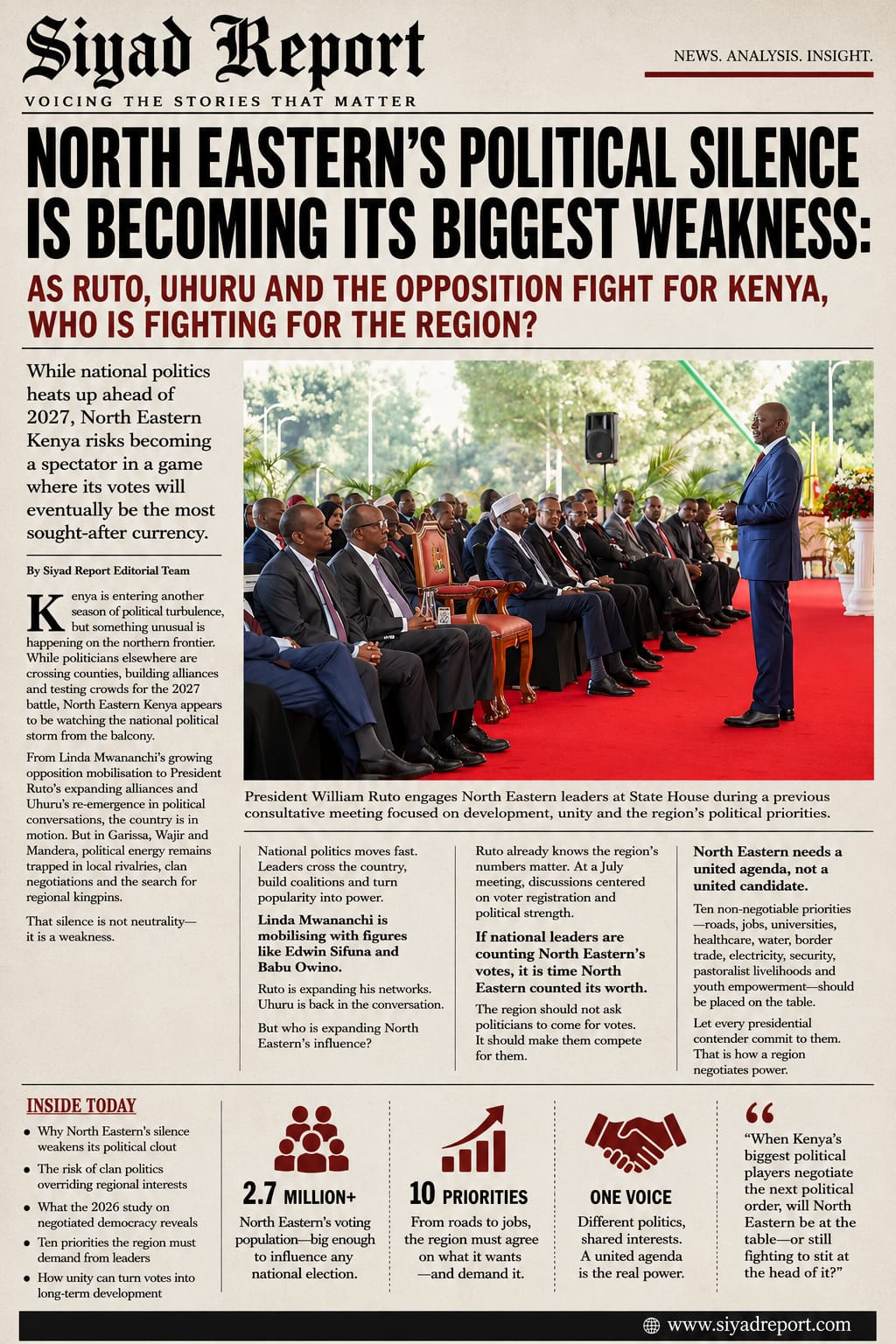
Kenya is entering another season of political turbulence, but something unusual is happening on the northern frontier. While politicians elsewhere are already crossing counties, building alliances, testing crowds and positioning themselves for the 2027 battle, North Eastern Kenya appears to be watching the national political storm from the balcony. Across the country, the temperature is rising.
The Linda Mwananchi movement has been taking its message from one region to another, with figures such as Edwin Sifuna and Babu Owino becoming increasingly visible in the opposition’s mobilisation efforts.
President William Ruto, meanwhile, is not merely defending his administration; he is increasingly engaged in a broader political struggle over who controls the alliances, narratives and networks that will define the next election.
Even former President Uhuru Kenyatta has been dragged into the political contest, with government and ODM-aligned figures accusing him of supporting forces seeking to weaken President Ruto. Uhuru’s camp and those associated with the opposition have rejected or disputed various allegations surrounding the movement.
And yet, somewhere between Garissa and Mandera, Wajir and the wider northern political landscape, the conversation often sounds remarkably different. Here, political energy is still heavily consumed by local calculations, clan negotiations, gubernatorial ambitions, parliamentary contests and the perennial question of who should be recognised as the region’s political kingpin. This is not necessarily evidence that North Eastern politicians do not care about national politics. It is evidence of something deeper: the region has not yet decided what it wants its collective political power to accomplish.
That distinction matters.
For decades, North Eastern Kenya has complained often legitimately about marginalisation, inadequate infrastructure, weak economic integration, insecurity, unemployment and political exclusion. Yet political marginalisation becomes difficult to overcome when a region that possesses a potentially powerful voting bloc speaks nationally through fragmented voices. A region cannot continuously complain about being ignored in Nairobi while spending most of its political energy deciding who should dominate its own backyard.
The national political arena is already moving at extraordinary speed. Linda Mwananchi has expanded its grassroots mobilisation beyond its traditional political spaces, with Sifuna increasingly presenting the movement as part of a broader effort to construct a united opposition. Babu Owino has also emerged as one of the movement’s prominent and outspoken figures. Sifuna has even generated speculation about a possible presidential ambition after telling supporters during a rally that some young people now address him as “His Excellency.”
Whatever one thinks of the movement, the important point is not whether Linda Mwananchi will eventually succeed. The important point is that its architects understand a fundamental rule of Kenyan politics: national influence is built by physically going to the people.
Politics does not wait for invitations.
That lesson should be particularly important to North Eastern leaders.
Western Kenya is discussing its political bargaining position. Nyanza is wrestling with the future of opposition politics. Central Kenya remains an important political battleground. The Rift Valley continues to matter enormously to President Ruto’s calculations. Coast politics is being courted. Across these regions, leaders are attempting to convert regional political strength into national bargaining power.
North Eastern, meanwhile, risks becoming a spectator to a game in which its own votes will eventually become valuable currency.
This is where negotiated democracy enters the conversation.
Negotiated democracy has traditionally been defended as a mechanism for reducing destructive competition within communities by encouraging clan elders and political actors to agree on candidates. In a region where clan structures remain socially influential, the system can prevent unnecessary political confrontation and sometimes promote peaceful coexistence. But peace and political effectiveness are not always the same thing.
A recent 2026 academic study examining negotiated democracy in Garissa, Wajir and Mandera argues that the model can produce serious democratic weaknesses, including elite capture, excessive dependence on clan networks, reduced political competition and the marginalisation of women, youth and minority groups.
That is the uncomfortable question North Eastern must now confront: has negotiated democracy helped the region become politically organised, or has it made the region politically predictable?
Because there is a difference.
If leaders negotiate among themselves who gets which position, who becomes governor, who becomes senator and who gets parliamentary support, they may successfully prevent internal political wars. But if those negotiations consume virtually all political attention, the region can lose sight of the bigger question: what does North Eastern want from the next government of Kenya?
That question should be at the centre of political meetings from Mandera to Garissa.
Instead of only asking who should be the next governor, why are regional leaders not asking which presidential candidate will commit to completing the Isiolo-Mandera highway? Who will guarantee stronger investment in border infrastructure? Who will address youth unemployment? Who will expand universities, technical institutions and digital opportunities? Who will protect pastoralist livelihoods? Who will strengthen the region’s economic relationship with Somalia and Ethiopia? Who will accelerate electricity connectivity and water infrastructure? Who will ensure that North Eastern’s strategic location becomes an economic advantage rather than merely a security concern?
These are national questions with regional consequences.
And President Ruto already appears to understand that North Eastern’s political numbers matter. During a July meeting with northern leaders, Garissa Governor Nathif Jama indicated that discussions at State House focused heavily on voter registration and political numbers in the region.
That should be a wake-up call. If national politicians are calculating North Eastern’s votes, North Eastern leaders should be calculating what those votes are worth.
The region should not simply ask politicians to come and seek votes. It should make politicians compete for those votes through a clear development and political agenda.
That is where the current silence becomes dangerous.
North Eastern does not necessarily need to produce a presidential candidate to become nationally influential. It does not need to speak with one voice on every political question. Political diversity is healthy. Garissa does not have to think exactly like Wajir, and Mandera does not have to surrender its interests to either county.
But the three counties can have different politicians while still pursuing common regional interests.
The tragedy would be allowing personal rivalries to become stronger than regional interests.
There is already evidence that North Eastern leaders are capable of engaging national questions. Regional politicians have publicly taken positions on major national developments, including the political changes surrounding former Deputy President Rigathi Gachagua, while simultaneously raising regional issues such as the Isiolo-Mandera highway, electricity connectivity and border infrastructure. The problem, therefore, is not an absence of political intelligence. It is the absence of a sufficiently coordinated regional political strategy.
And that is the real contest North Eastern should be preparing for.
The region has spent decades asking Nairobi to recognise it. Perhaps the next chapter requires North Eastern to recognise its own political power first.
A united regional agenda does not mean creating a single political party. It means creating a negotiating position.
Imagine Garissa, Wajir and Mandera leaders sitting around one table before the presidential campaigns intensify and agreeing on ten non-negotiable regional priorities.
Imagine inviting every presidential contender and asking them to sign commitments on infrastructure, education, healthcare, water, security, livestock, youth employment, border trade and constitutional development. Imagine the region telling every political coalition: These are our priorities. Tell us what you will deliver.
That would be politics with leverage.
Instead of politicians asking, “Who is the kingpin of North Eastern?”, the region should be asking, “What can North Eastern accomplish when its leaders stop competing for the title and start competing for results?”
Because the 2027 election will not simply be a contest between William Ruto and whoever eventually emerges as the strongest opposition candidate. It will also be a contest over regional bargaining power.
Kenya’s politicians will travel thousands of kilometres looking for votes, alliances and endorsements. They will promise roads, jobs, development and representation. They will remember regions that can deliver votes.
The danger is that North Eastern could once again become important only when its votes are needed.
Then, after the ballots are counted, the political caravans will disappear.
This is why the region’s current political moment deserves serious reflection. Its politicians are not necessarily doing nothing. They are fighting battles. But perhaps they are fighting battles that are too small for the moment confronting them.
The question is no longer whether North Eastern has politicians. It clearly does.
The question is whether those politicians can transform their individual influence into collective political power.
Because while Kenya’s political giants are already fighting over the future of State House, North Eastern risks remaining trapped in the much smaller argument over who controls the village, the constituency, the county or even the title of kingpin.
And perhaps the hardest question of all is this:
When Kenya’s biggest political players finally sit down to negotiate the country’s next political order in 2027, will North Eastern Kenya arrive at that table as a united region with demands or will its leaders still be fighting among themselves over who gets to sit at the head of it?