

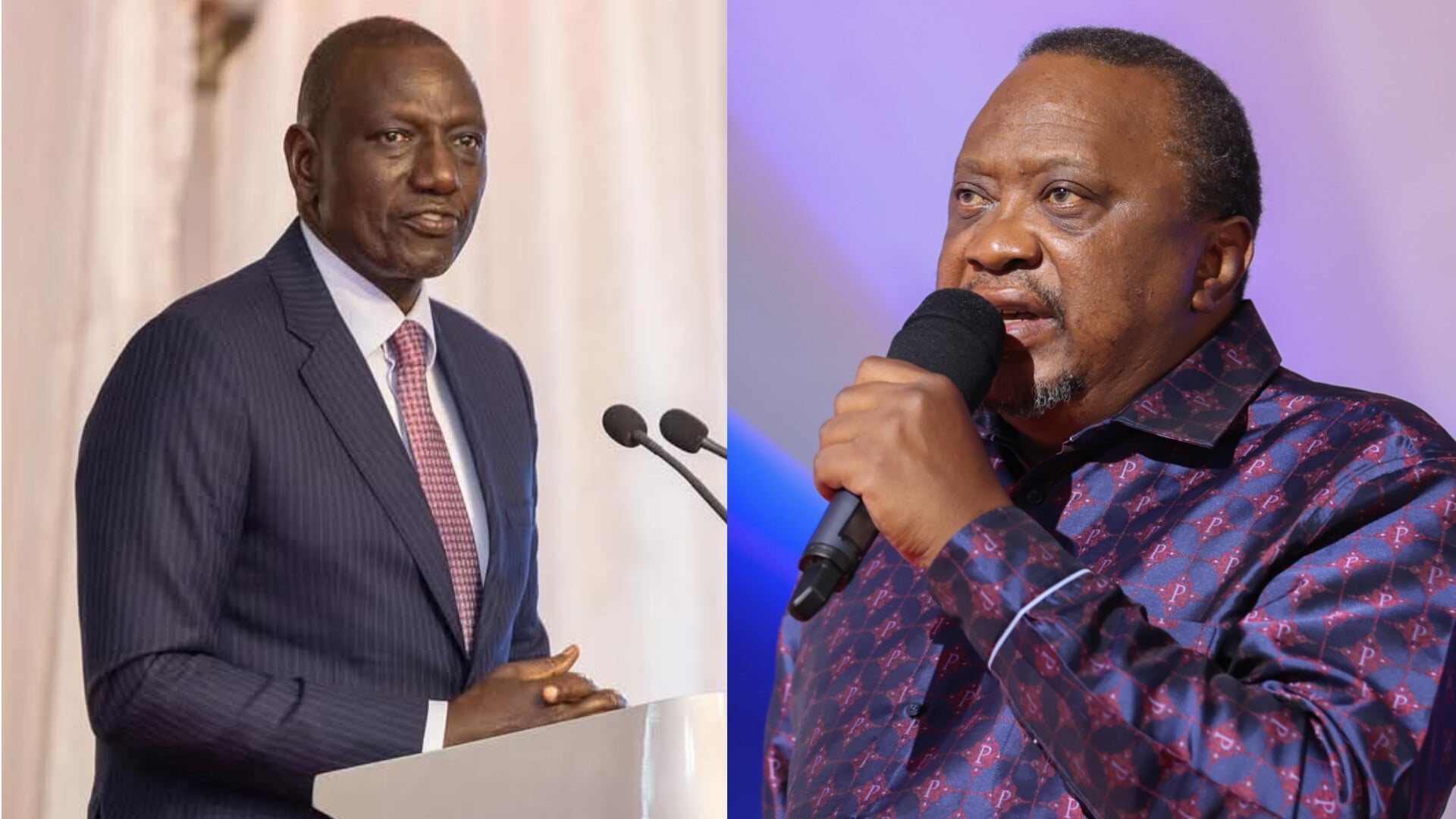
President William Ruto has offered his most detailed account yet of his troubled relationship with retired President Uhuru Kenyatta, revealing how repeated attempts at reconciliation failed and accusing his former boss of choosing opposition politics over the role of an elder statesman.
President William Ruto has opened up on one of Kenya’s most consequential political fallouts, giving a rare and deeply personal account of his relationship with his predecessor, Uhuru Kenyatta, and explaining why efforts to rebuild their once-powerful political alliance have repeatedly failed.
In an exclusive interview with the Sunday Nation at State House, Nairobi, on Friday, August 21, President Ruto described how he travelled to Mr Kenyatta’s rural home in Ichaweri, visited him at his office near State House and later hosted him at State House, all in an attempt to persuade the former President to help forge what he called a new national vision.
But according to Dr Ruto, the efforts did not produce the political reconciliation he had hoped for.
“I went to see him in Ichaweri and also at his office next door here and sought to persuade him that as a former head of state, the only one living now, please help us forge a new vision for the country, but he was reluctant,” President Ruto said.
“He wasn’t sure he wanted to do that. Well, those are choices people make. He chose to organise the opposition, sponsoring them…”
The President said his disappointment goes beyond the bitter 2022 presidential election, when Mr Kenyatta declined to support his former deputy and instead backed Azimio presidential candidate Raila Odinga.
Ruto now argues that his former boss had an opportunity to leave active politics and assume the role of a national elder.
“My predecessor had an option to become a statesman and rise above politics and become a unifying factor in our country,” he said.
“But he chose to climb down and become an opposition leader. He’s the chairperson of Azimio up to now. He’s busy organising the opposition against me.”
According to President Ruto, the idea of repairing relations between the country’s senior political figures did not initially come from Uhuru Kenyatta.
He says it was the late former Prime Minister Raila Odinga who first embraced the idea of bringing Kenya’s political leaders together and encouraging them to think beyond the next election.
“We are now the elders,” Ruto recalled telling Mr Odinga. “We are the leaders of this nation. Why don’t we work together, grow a bigger vision that then we can hand over to the next generation of leaders?”
Mr Odinga, according to Ruto, agreed with the proposal, after which the President says he went out of his way to reach Mr Kenyatta.
“I went out of my way and looked for him,” he said.
On December 9, 2024, Ruto travelled to Mr Kenyatta’s Ichaweri home in Gatundu, Kiambu County, in what was seen as a major attempt to reopen communication between the two former political allies.
The visit was followed by further signs of rapprochement, including the appointment of individuals perceived to be close to the former President to Ruto’s Cabinet.
Months later, in August 2025, Kenyatta returned to State House for private discussions that included the Democratic Republic of Congo peace process.
Ruto recalled personally showing his predecessor around the State House compound, a striking moment considering the collapse of their relationship after the 2018 handshake between Kenyatta and Odinga.
Yet despite those gestures, Ruto says the political distance remained.
His request, he insists, was not about securing Uhuru’s support for the 2027 election.
“It was about national leadership,” he said.
Perhaps the sharpest part of Ruto’s interview was his claim that Uhuru Kenyatta predicted his administration would collapse within three months because of the economic problems Kenya faced when he took office.
According to Ruto, Kenyatta knew the country was experiencing serious foreign-exchange pressures, high inflation, expensive credit and concerns over its ability to meet external obligations.
“William Ruto was going to fail, within three months,” Ruto said, recounting the alleged prediction.
“He knew about the default, he knew about the state of the economy.”
Ruto said the prediction has become an important part of his defence of his administration’s economic record.
“I am sure he has a problem that… well, I managed the country and we did not default,” he said.
The President argues that the fact his government survived the economic difficulties it inherited is evidence that those who expected an early collapse were wrong.
On Kenya’s rising public debt, Ruto acknowledged that the country’s debt has increased but argued that the figure must be considered against the size of the economy and the borrowing undertaken by previous administrations.
He said former President Daniel arap Moi left office in 2002 with debt of about Sh630 billion, while Mwai Kibaki left with approximately Sh1.8 trillion. Kenyatta, he said, left office with about Sh10.3 trillion, while the figure is now approaching Sh13 trillion.
“If debt grew at the rate at which Uhuru’s administration grew debt, we would be at Sh25 trillion today,” Ruto said. “We are not at 25 trillion.”
The President, however, stopped short of condemning Kenyatta’s borrowing, acknowledging that much of it went into infrastructure.
“Uhuru’s administration did not invest in the wrong things,” he said.
Ruto instead argued that his administration is pursuing alternative financing models to reduce reliance on sovereign borrowing.
The interview also confronted one of the central criticisms of the Ruto administration: his promise to put more money in the pockets of ordinary Kenyans.
Asked where the money was when many Kenyans say life remains unbearable, Ruto defended his record by pointing to jobs, lower consumer costs and increased agricultural earnings.
“It depends on who you’re talking to,” he said.
“If you talk to two million Kenyans who didn’t have a job before 2022 and now do, they have money in their pockets.”
He cited the price of unga, saying: “When I came into office, unga was retaining at Sh250, today it’s at Sh150-Sh140, a Sh100 saving.”
Ruto also pointed to the dairy sector, saying interventions had reduced the cost of fertiliser and semen while increasing milk production from 4.6 billion litres to 5.5 billion litres.
“We have put in the pockets of dairy farmers an extra Sh50 billion a year,” he said.
But he acknowledged that the benefits of his administration’s policies have not reached everyone.
“I’m not saying we have gotten to everybody, there’s still work cut out for us to do but we’re somewhere,” he said.
With the 2027 election approaching and opposition forces seeking to build a united front against his re-election, Ruto dismissed suggestions that he is worried about becoming a one-term president.
Asked whether the growing opposition mobilisation could deny him a second term, he responded bluntly:
“I’m not scared at all.”
He questioned the opposition’s plans, accusing its leaders of lacking a coherent agenda.
“In your own assessment, these people in the opposition, do they look like they have any idea where they are going?” he asked.
“Can you explain how people who’re supposed to be intelligent have no plan, no vision, no agenda?”
Ruto attacked proposals to abolish the Social Health Authority and housing programme without providing alternatives, before mocking another opposition criticism by asking:
“The other one’s only problem is that chicken cannot limb the stairs, how absurd!”
He then questioned the independence of the opposition.
“Don’t they look sponsored; don’t they look like stooges or puppets?”
Asked directly for evidence that Uhuru Kenyatta was sponsoring the opposition, Ruto referred journalists to a Sunday Nation headline published on August 2: “Uhuru super coalition against Ruto.”
“You answered yourselves,” he said.
The bitterness is striking because Ruto and Kenyatta were once among Kenya’s most powerful political partnerships.
They campaigned together in 2013 and 2017 under the Jubilee banner, presenting themselves as a new political generation challenging the old establishment.
Their alliance was forged in the aftermath of the 2007-2008 post-election violence and the International Criminal Court cases at The Hague. Together, they built a formidable political movement around claims of political persecution, economic empowerment and generational change.
But their relationship deteriorated during Kenyatta’s second term.
The 2018 handshake between Kenyatta and Odinga dramatically altered the political landscape and increasingly isolated Ruto within the government.
By 2022, the political marriage had collapsed completely.
Kenyatta declined to support his deputy and instead backed Odinga for the presidency. Ruto won the election and succeeded the man who had once been his political boss.
Four years later, the two men remain on opposite sides of Kenya’s political battlefield.
Ruto also defended his government’s push for a development framework beyond Vision 2030, rejecting claims that the timing is designed primarily to support his re-election campaign.
He argued that Kenya needs to begin planning for the period after Vision 2030 before the current Medium-Term Plan ends.
“Kenyans must answer the question about what kind of country they want to have after Vision 2030,” he said.
“If we don’t do this now, the current Medium-Term Plan Five which ends next year will hang.”
He insisted that the proposed long-term framework is not about his presidency.
“Elections will come and go. Kenyans will make their decision and the country will move on,” Ruto said.
“Vision 2030 was not about Mwai Kibaki. It wasn’t about an administration. Beyond Vision 2030 is not about William Ruto and it’s not about my administration.”
The interview paints a picture of a President determined to defend both his economic record and his political legacy while confronting a former mentor who has become one of the most influential figures in the opposition.
For Ruto, the central grievance appears no longer to be simply that Uhuru Kenyatta backed another candidate in 2022. It is that, after a decade in which the two men stood together at the centre of Kenyan politics, his former boss did not step away from political combat when Ruto became President.
For Uhuru, whose position has increasingly placed him at the heart of efforts to unite opposition forces ahead of 2027, the political contest appears far from over.
The former allies who once campaigned side by side are now preparing for another political confrontation this time with Ruto in State House and Kenyatta helping shape the forces seeking to remove him.
And as the 2027 election approaches, Ruto’s latest remarks make one thing clear: the political divorce between the two former Jubilee partners remains one of the defining battles shaping Kenya’s next presidential contest.