

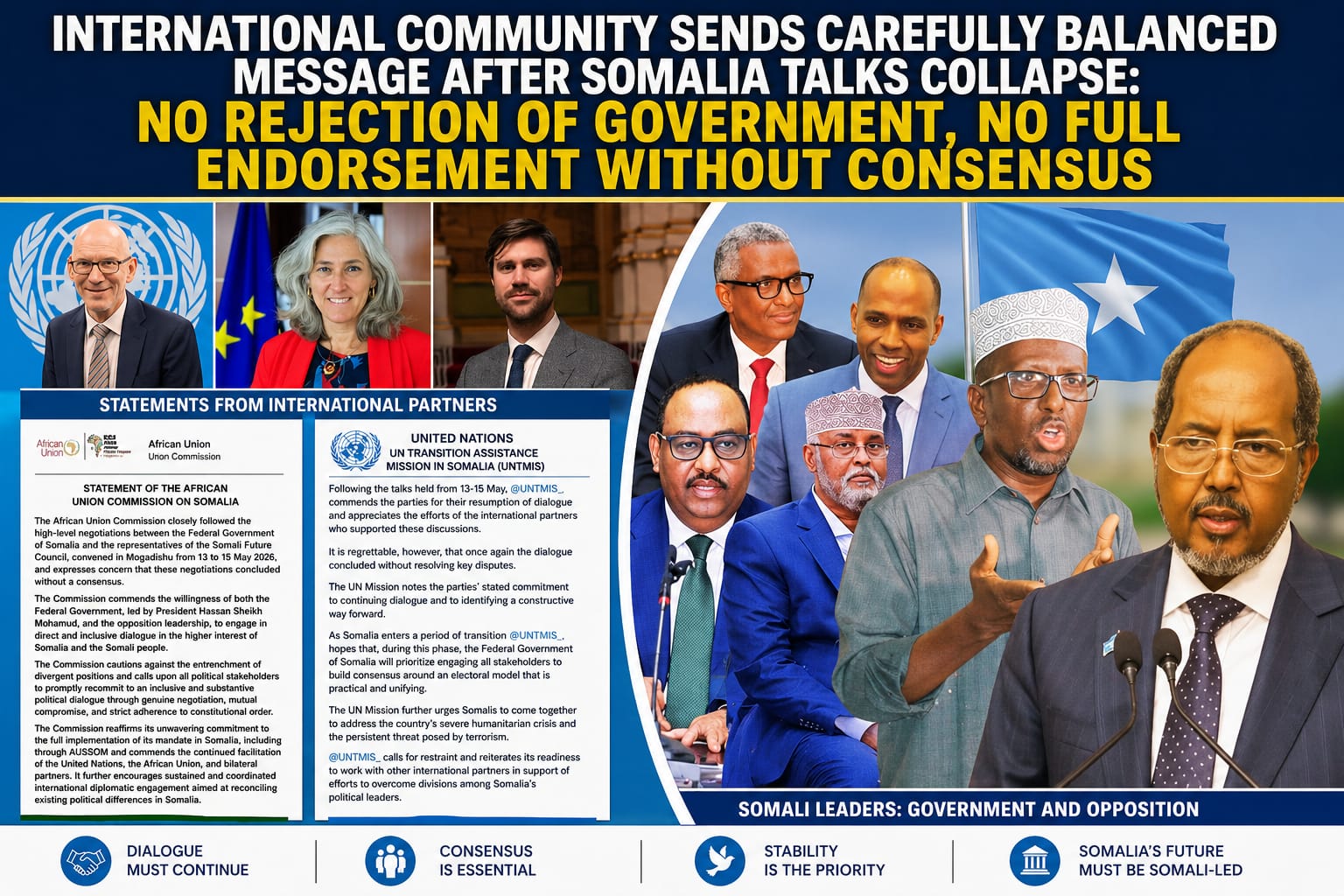
As Somalia’s highly anticipated political negotiations in Mogadishu ended without agreement, attention immediately shifted from the negotiation room itself to something equally powerful in Somali politics: the diplomatic language of the international community.
For days, political observers, opposition supporters, government allies, diplomats, and ordinary Somalis waited for one thing the official reactions from the international partners commonly referred to in Somalia as “Beesha Caalamka.”
When the statements finally came from United Nations Transition Mission in Somalia and the African Union Commission, they were carefully written in the measured language of diplomacy. Yet behind the cautious wording, every sentence carried political significance.
The mediated talks between the Somalia Federal Government and opposition figures under the umbrella of the Somali Future Council had been viewed as a decisive moment in Somalia’s constitutional and electoral crisis.
At the center of the dispute lies a fundamental political question: whether Somalia should proceed toward a one-person-one-vote electoral system under the newly amended constitutional framework, or continue with the clan-based indirect electoral model that has governed previous transitions.
The government of Hassan Sheikh Mohamud argues that parliament legally amended the constitutional framework and extended institutional mandates from four years to five years, meaning the current administration remains constitutionally valid until May 2027.
The opposition, led by figures including Sharif Sheikh Ahmed and Said Abdullahi Deni, rejects that interpretation, arguing that the constitutional changes lacked consensus and that the current mandate expired under the previous arrangement.
Despite two days of negotiations inside Halane in Mogadishu, no breakthrough was reached.
Yet the diplomatic statements released afterward revealed something important: while international actors are clearly concerned about Somalia’s political polarization, they are equally unwilling to delegitimize the current federal government or endorse immediate confrontation.
The UNTMIS statement opened with diplomatic restraint, commending the parties for resuming dialogue while expressing regret that key disputes remained unresolved. However, the most politically important line came later:
“As Somalia enters a period of transition…”
That phrase immediately drew attention across Somali political circles.
In diplomatic language, such wording matters enormously. The statement did not say the Somali government’s mandate had expired. It did not declare the constitutional amendments invalid. Nor did it question Hassan Sheikh Mohamud’s legitimacy as president.
Instead, the UN referred normally to the “Federal Government of Somalia,” a significant signal that international institutions still recognize Villa Somalia as the functioning authority of the state.
This point is politically crucial because one of the opposition’s central objectives during the negotiations was to push for broader international recognition of its argument that the government had exceeded its mandate.
That did not happen.
At the same time, however, the UN statement also avoided endorsing unilateral implementation of the government’s electoral vision.
The statement urged the Federal Government to “prioritize engaging all stakeholders to build consensus around an electoral model that is practical and unifying.”
Those words were carefully selected.
The phrase “practical and unifying” reflects underlying international concern regarding the technical and political feasibility of implementing immediate nationwide one-person-one-vote elections under Somalia’s current security and institutional conditions.
Somalia continues to face:
- severe insecurity from extremist threats,
- unresolved federal tensions,
- limited electoral infrastructure,
- and constitutional disagreements among political elites.
By emphasizing “consensus,” the UN was effectively sending a dual message.
To the government, the message was: You remain recognized internationally, but you cannot move alone.
To the opposition, the message was: Your concerns remain politically relevant, and negotiations are still necessary.
The diplomatic balance was unmistakable.
The UN statement did not give Hassan Sheikh Mohamud full victory, but neither did it hand the opposition the international legitimacy crisis it had hoped to create.
The African Union statement followed a similar pattern but carried its own distinct institutional tone.
Unlike the UN, the African Union has direct security responsibilities in Somalia through African Union Support and Stabilization Mission in Somalia and broader continental stabilization efforts. Because of that, the AU’s statement was even more focused on preserving constitutional continuity and preventing institutional fragmentation.
One sentence stood out above all others:
“strict adherence to constitutional order.”
Again, this wording was politically loaded.
Both sides in the Somali dispute currently claim they are defending constitutional legality.
The government insists parliament legally amended the constitutional framework and that the transition toward direct elections is lawful.
The opposition argues the amendments lacked inclusive consensus and therefore violated the spirit of Somalia’s constitutional process.
The AU intentionally avoided siding openly with either interpretation.
Instead, it called for:
- “genuine negotiation,”
- “mutual compromise,”
- and avoidance of “the entrenchment of divergent positions.”
Diplomatically, that phrase “entrenchment of divergent positions” was directed at both camps.
It suggested mediators believe political rigidity is becoming dangerous and that neither side can realistically impose a unilateral final outcome.
Yet once again, the AU referred directly to “the Federal Government, led by President Hassan Sheikh Mohamud.”
That language matters enormously in African diplomacy.
If the AU intended to signal that Somalia’s federal authority had lost legitimacy, the wording would have been far more confrontational or institutionally neutral.
Instead, the AU continued formal recognition of the current administration while simultaneously pressuring it toward broader consultation and compromise.
Taken together, the UN and AU statements reveal a consistent diplomatic pattern.
International actors are not endorsing immediate unilateral implementation of one-person-one-vote elections without national consensus.
But they are also not accepting the opposition’s claim that the government ceased to exist constitutionally after the expiration date under the previous framework.
That distinction is perhaps the most important political development to emerge from the failed talks.
In reality, the statements suggest that major international actors increasingly see Somalia as already entering a transitional political phase under the amended constitutional order even while disagreements remain unresolved regarding implementation and inclusivity.
This explains why neither the UN nor the AU framed the situation as a constitutional vacuum.
Instead, both organizations focused on:
- Dialogue,
- De-escalation,
- Consensus-building,
- and political continuity.
For Hassan Sheikh Mohamud, the statements likely provide significant political relief.
The international community did not isolate his administration, did not reject the constitutional transition outright, and did not publicly side with the opposition’s core legal argument regarding mandate expiration.
That gives Villa Somalia room to continue functioning diplomatically and institutionally.
However, the government also failed to secure explicit international endorsement for immediate implementation of its electoral roadmap.
The repeated emphasis on inclusivity and practicality indicates clear international pressure against unilateral political action.
For the opposition, the outcome is mixed.
While opposition leaders failed to obtain international recognition of their legitimacy claims against the government, they succeeded in ensuring that the electoral dispute remains internationally acknowledged as unresolved.
The diplomatic insistence on consensus and compromise prevents the government from claiming full international backing for its political agenda.
As a result, Somalia now appears to be entering not a period of immediate resolution, but a prolonged negotiation phase.
Behind closed doors, diplomatic engagement is likely to intensify further.
International mediators appear determined to avoid:
political fragmentation,
constitutional collapse,
federal rupture,
or instability in Mogadishu.
That explains why both the UN and AU statements focused heavily on restraint and continued dialogue rather than confrontation.
The deeper diplomatic reading is becoming increasingly clear.
The international community appears to be saying: Somalia’s political transition is moving forward, but it must be negotiated, inclusive, gradual, and broadly accepted if it is to remain stable.
Neither side achieved total victory in Mogadishu.
But neither side suffered decisive defeat either.
And in Somalia’s fragile political landscape, that reality alone may be what keeps the door to future negotiations still open.