

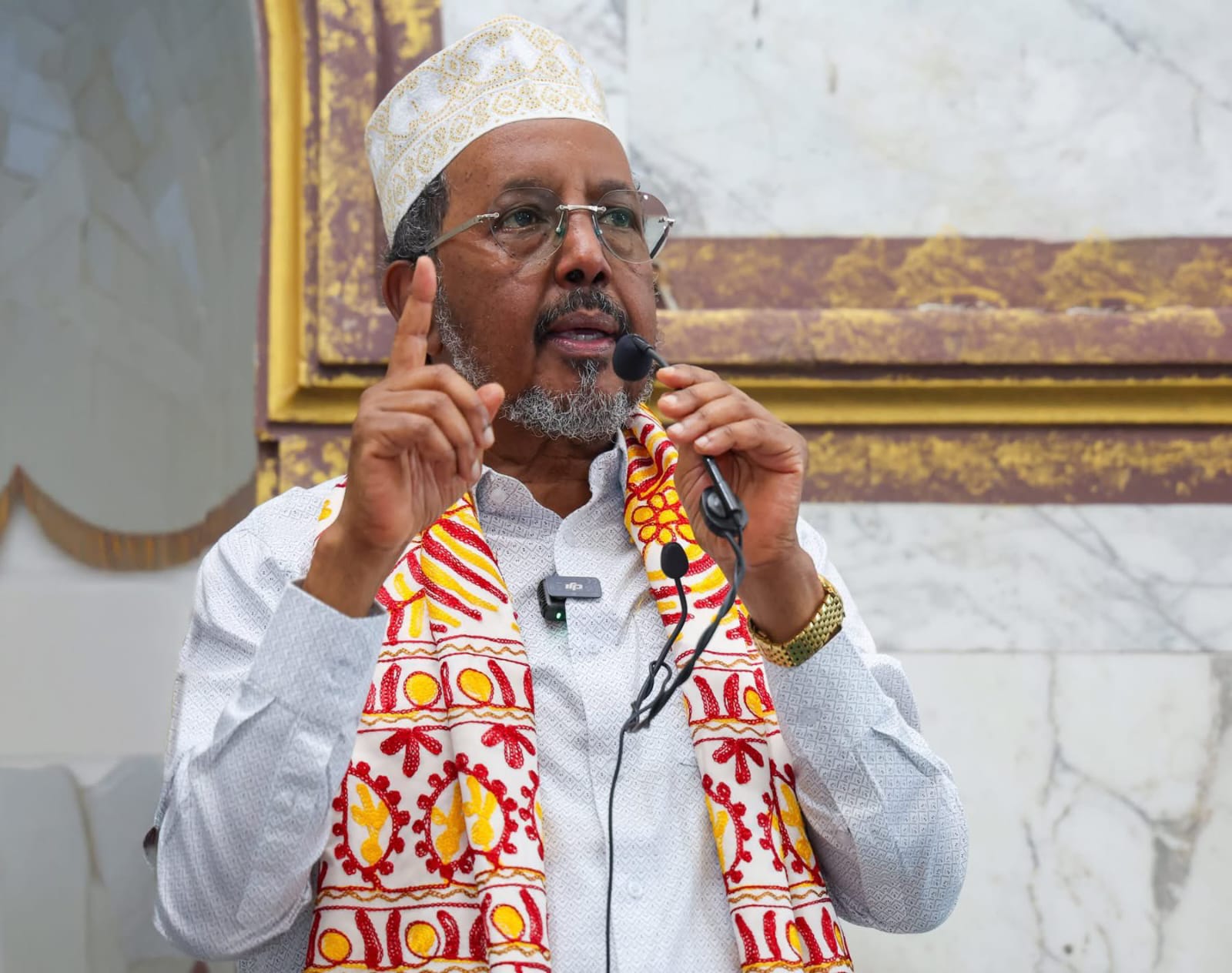
Somalia’s political tensions dramatically escalated on Wednesday as Hassan Sheikh Mohamud used his Eid al-Adha address in Mogadishu to launch one of his strongest verbal attacks yet against opposition leaders, warning that the federal government would not tolerate insecurity, political disruption, or what he described as attempts to drag the country backwards.
Speaking shortly after Eid prayers attended by government officials, religious leaders, security commanders and members of the public, the Somali president delivered an emotionally charged speech that mixed religious messaging with sharp political criticism. His remarks came at a time when Somalia is facing increasing political uncertainty over elections, constitutional disputes, and growing accusations from opposition groups who claim the federal government is overstaying its mandate and failing to build consensus on the country’s political future.
The president’s speech appeared carefully designed to send multiple messages at once reassurance to supporters, warning to opponents, and a declaration that his administration remains firmly in control of the country’s security institutions despite rising political pressure.
“The armed militias who took up weapons and came out onto the streets the other day are known. We know the houses they came from and who sent them. But we are a government, and we will not allow any disruption of security. It will be prevented, and anyone who causes chaos will be dealt with,” President Hassan Sheikh declared in one of the most explosive moments of the address.
The statement was widely interpreted as a direct warning to opposition figures accused by the government of fueling instability in Mogadishu amid recent political tensions. Although the president did not mention names directly, many observers viewed the remarks as an indirect attack on former Somali leaders including Sharif Sheikh Ahmed, whose political alliance has increasingly criticized the federal government’s handling of elections and governance.
The president’s repeated use of the phrase “we are a government” carried a powerful political undertone, emphasizing state authority and portraying the administration as the sole legitimate force responsible for maintaining law and order in Somalia. Analysts say the language reflected growing frustration inside Villa Somalia over continued opposition criticism and public warnings about possible political unrest.
In another striking section of the speech, President Hassan Sheikh attempted to calm fears surrounding security concerns and political uncertainty, dismissing what he described as exaggerated claims of impending violence.
“Do not be intimidated or frightened that disaster will happen, or that armed men from another place will suddenly attack. Every man is responsible for protecting his own village,” he said.
The statement immediately sparked debate across Somali political circles and social media platforms. Supporters of the president interpreted the message as an attempt to reassure citizens that the government remains in control of national security. Critics however argued that the remarks were dangerous and could deepen clan-based fears and political polarization during an already sensitive period in the country’s politics.
The president further intensified his criticism by suggesting that some opposition politicians were intentionally spreading fear among the population for political gain.
“It is unfortunate that a leader seeking to govern the country would think in such a manner,” he stated, in what many analysts described as another veiled jab directed at opposition figures warning of political collapse or instability.
Throughout the speech, Hassan Sheikh repeatedly portrayed his administration as a force of stability and national progress while presenting the opposition as politicians attempting to reverse Somalia’s recovery process after years of conflict and insecurity.
“Brothers, do not let yourselves be intimidated. Security must be protected and we must not go backwards. A true politician is one who promotes good. Let us reflect today on the mistakes we made yesterday,” the president said while addressing worshippers inside the mosque compound.
The president’s choice to deliver such strongly political remarks during Eid prayers drew significant public attention. Eid al-Adha is traditionally viewed as a moment of unity, reconciliation and peace among Muslims, yet the Somali leader used the occasion to send one of the clearest political warnings of his presidency.
Observers noted that Hassan Sheikh appeared visibly emotional and frustrated during portions of the speech, raising his tone several times as he defended his administration and attacked critics. His repeated references to “moving forward” and refusing to “go backwards” reflected a central theme throughout the address that Somalia’s political future should not be determined by threats, intimidation or armed pressure.
Political analysts believe the president’s speech reflected mounting pressure on his administration as opposition groups intensify demands for a clear electoral roadmap and broader political dialogue. In recent months, Somali opposition leaders have accused the government of delaying elections, centralizing power, and failing to build consensus on constitutional reforms.
The government however continues to reject those accusations, insisting that ongoing political reforms are necessary for Somalia’s long-term stability and democratic transition.
Some observers interpreted the president’s repeated emphasis on military strength and state authority as a signal that the administration is prepared to take a tougher stance against political unrest or armed mobilization in the capital. Others warned that such rhetoric risks escalating tensions even further between the federal government and opposition groups.
Critics argue that invoking state security institutions in political disputes could deepen mistrust among rival political actors and create fears of further instability in Mogadishu. Supporters of the president however insist that the government has a constitutional responsibility to maintain public order and prevent armed confrontations from threatening national security.
Despite the controversy surrounding the speech, one message remained consistent throughout Hassan Sheikh’s address that his administration intends to remain firmly in control and will resist any political pressure it views as destabilizing or unconstitutional.
As Somalia continues grappling with disputes over elections, constitutional reforms and power-sharing arrangements, Wednesday’s Eid speech may mark a significant turning point in the country’s political climate. The sharp tone adopted by the president has already triggered intense debate among politicians, analysts and ordinary citizens, many of whom fear that the widening divide between the government and opposition could further complicate Somalia’s fragile political transition.
For now, the president’s words have made one thing unmistakably clear: Somalia’s political confrontation is no longer unfolding quietly behind closed doors. It is now being fought openly in public speeches, mosques, political gatherings and across the national conversation with both sides appearing increasingly unwilling to back down.