

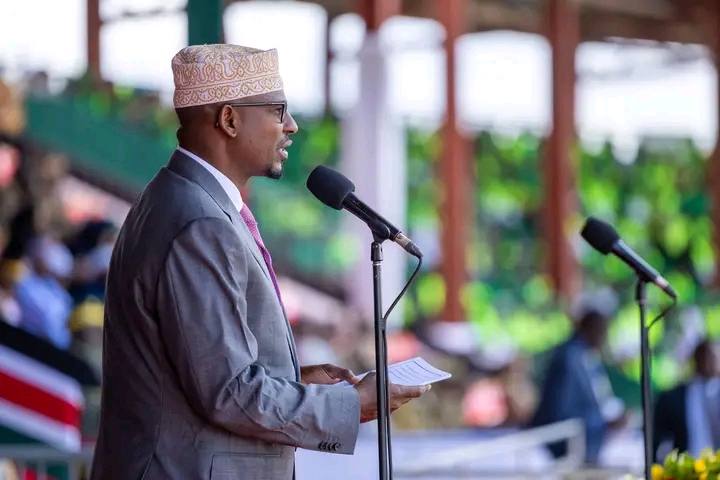
In a deeply emotional and historic moment for Northern Kenya, Wajir Governor Ahmed Abdullahi delivered a powerful address during the Madaraka Day celebrations held at Wajir Stadium, expressing gratitude to President William Ruto for what he described as a transformative shift in the region’s sense of belonging and national identity.
The celebrations, which brought thousands of residents to the stadium, marked a symbolic milestone as Madaraka Day was hosted in Wajir County for the first time, elevating the region’s national visibility and reinforcing the government’s ongoing narrative of inclusive development.
Governor Abdullahi, visibly emotional throughout his speech, said the decision to bring the national celebrations to Wajir carried profound meaning for a region that has long felt marginalized in the national conversation.
“We express our profound gratitude to President Ruto for according Wajir County an opportunity to host this year’s Madaraka Day celebrations,” he said, adding, “For a long time, the people of Northern Kenya have agonised silently about the question of belonging and identity.”
His remarks drew applause from the crowd, especially when he directly addressed what he described as decades of exclusion and bureaucratic discrimination faced by residents of the North Eastern region during national identity registration processes.
Governor Abdullahi praised President William Ruto for ending the long-standing vetting system that had been applied in the issuance of national identity cards in the region, calling it a courageous and historic political decision.
“You did more than issue identity cards that Kenyan citizens were entitled to; you restored our dignity, our honor, and gave us a sense of fully belonging to this nation,” the governor said, emphasizing that the policy shift had fundamentally changed how residents of the region perceive their place within the Republic.
In another emotional moment, Abdullahi revealed the personal weight of the occasion as he delivered his speech, describing how overwhelmed he felt while addressing the gathering.
“As I was reading this speech, I was shaking, and as I sat back down, Senator Cheruiyot can attest that I was crying,” he said, momentarily pausing as the crowd responded in silence and applause. “Thank you once again, and Happy Madaraka Day.”
The governor further highlighted the historical and cultural significance of Wajir, seeking to reposition the county not as a peripheral region, but as an integral part of Kenya’s national story. He reminded the audience that Wajir holds a unique place in Kenya’s history, including its early educational and colonial-era experiences.
“They say Wajir is no longer remote,” he noted. “Wajir is the only place in Kenya that was, for two years, under Italian rule and is home to one of the pioneer schools established in the 1940s and 1960s.”
His remarks were aimed at reframing long-standing perceptions of marginalization, instead highlighting Wajir’s historical depth and contribution to Kenya’s national evolution.
The governor also emphasized the significance of recent presidential actions in the region, particularly the lifting of discriminatory vetting procedures for national identity cards, which had for decades been a source of frustration and exclusion for residents.
“The spirit of inclusion has been deeply felt, especially when you recently came to Wajir and made a presidential proclamation on the registration and issuance of identity cards, as well as the lifting of discriminatory vetting of IDs, which was an act of political courage,” Abdullahi said.
He added that the policy change represented more than administrative reform, describing it as a restoration of dignity for thousands of residents who had long struggled to access basic national documentation.
The governor’s speech repeatedly returned to the theme of belonging, framing the Madaraka Day celebrations in Wajir as a turning point in Kenya’s efforts to unify its diverse regions under equal citizenship.
Political leaders, local officials, and residents present at the stadium echoed similar sentiments, describing the event as a rare moment of national recognition for a region often discussed in the context of insecurity, drought, and underdevelopment.
The hosting of the national celebration in Wajir was widely interpreted as part of the government’s broader strategy to promote inclusivity and address historical inequalities affecting marginalized regions, particularly in Northern Kenya.
Observers noted that the emotional tone of Governor Abdullahi’s speech reflected both relief and a sense of political vindication, as long-standing grievances over identity, access to services, and national integration were publicly acknowledged at the highest level of government.
For many residents in attendance, the event was not only ceremonial but symbolic of a shifting national narrative one that increasingly recognizes Northern Kenya as central to the country’s identity rather than peripheral to it.
As the celebrations concluded, the atmosphere at Wajir Stadium was marked by a mixture of pride, emotion, and optimism. The governor’s final message encapsulated the spirit of the day, as he reaffirmed gratitude to the national leadership while underscoring the importance of continued inclusion.
What unfolded in Wajir during this year’s Madaraka Day was more than a national celebration; it was a moment of political symbolism, emotional reckoning, and a renewed conversation about unity, identity, and belonging in Kenya.
And for Governor Ahmed Abdullahi, it was a speech that will likely be remembered not just for its political content, but for its emotional honesty capturing the long journey of a region striving to be fully seen, fully heard, and fully Kenyan.