

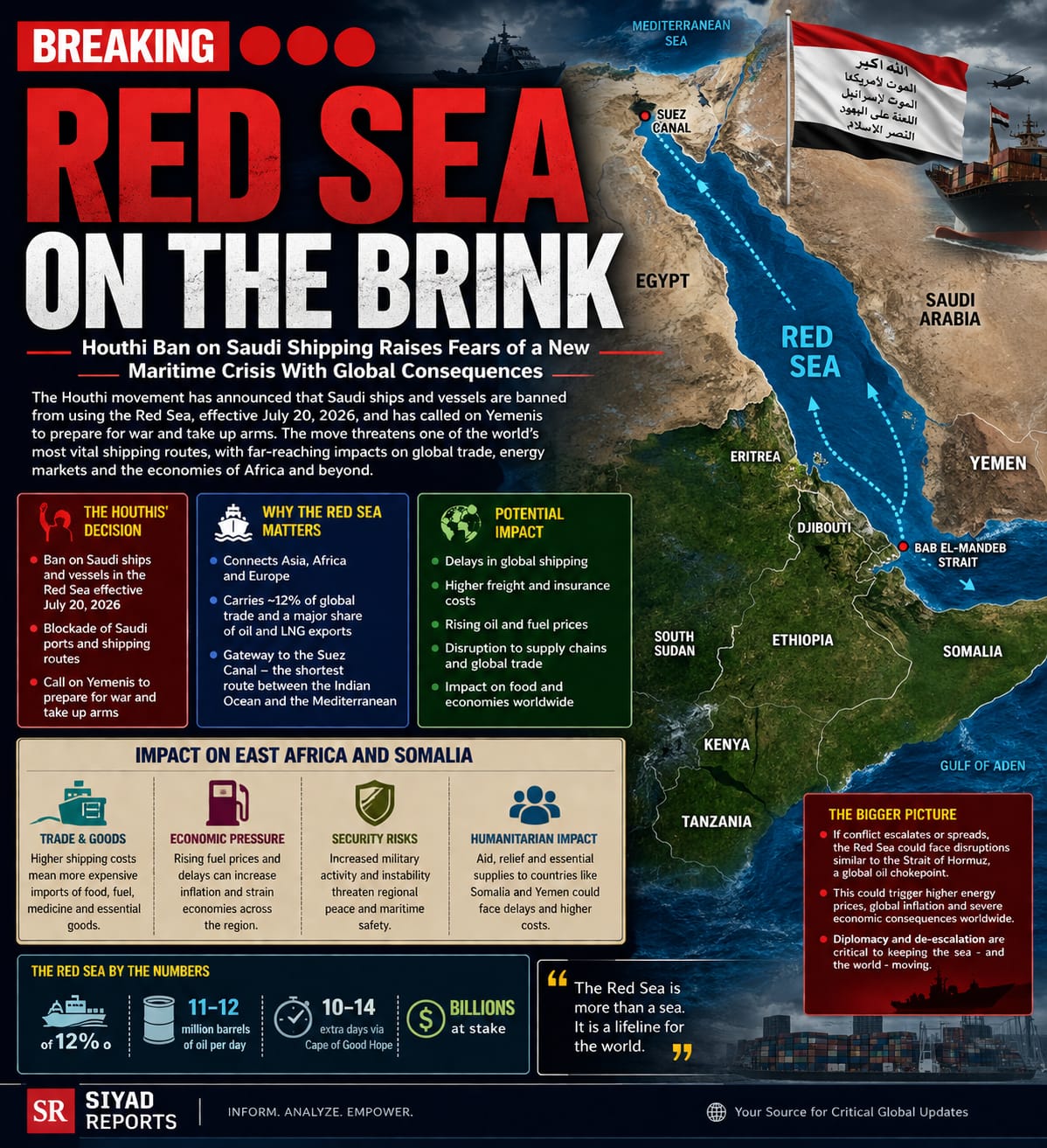
The Red Sea, one of the world’s busiest and most strategically important maritime corridors, is once again at the centre of escalating tensions in the Middle East after Yemen’s Houthi movement announced a ban on Saudi ships and vessels using the waterway. The declaration, which the group says takes effect from July 20, 2026, marks a significant escalation in an already volatile regional conflict and has renewed fears of a wider disruption to global trade, energy markets and regional security.
In the same announcement, the Houthis urged Yemenis to prepare for war, take up arms and be ready to join the front lines, signalling that the movement expects a new phase of confrontation. While it remains to be seen how effectively the Houthis can enforce such a ban across the entire Red Sea, the statement alone is enough to unsettle governments, shipping companies, insurers and financial markets.
The Red Sea is not simply another body of water. It serves as the maritime bridge connecting Europe, Asia and Africa through the Suez Canal and the Bab el-Mandeb Strait. Every day, hundreds of cargo vessels, oil tankers and container ships pass through this narrow route carrying everything from fuel and food to electronics, vehicles and industrial materials. Around 12 percent of global trade and a significant share of the world’s seaborne oil shipments move through this corridor, making it one of the most critical arteries of international commerce.
A disruption in this route has consequences far beyond the Middle East. It affects manufacturers waiting for raw materials in Europe, retailers importing goods from Asia, African countries relying on imported food and fuel, and global consumers who ultimately bear the cost through higher prices.
A Strategic Waterway That Connects Three Continents
The significance of the Red Sea lies not only in its geography but also in its economic importance. The Bab el-Mandeb Strait, located between Yemen and the Horn of Africa, is one of the world’s major maritime chokepoints. Any vessel travelling between the Indian Ocean and the Mediterranean through the Suez Canal must first pass through this narrow passage.
If shipping companies judge the route too dangerous, many vessels choose the much longer journey around the Cape of Good Hope at the southern tip of Africa. While this alternative keeps ships away from conflict zones, it adds thousands of kilometres to every voyage, extending travel times by up to two weeks in many cases.
Longer voyages translate directly into higher operating costs. Ships consume more fuel, crews spend more days at sea, insurance premiums rise and delivery schedules become increasingly unpredictable. Those additional expenses eventually filter down to consumers through increased prices for imported goods.
Energy markets are especially vulnerable. The Red Sea is an important route for crude oil, refined petroleum products and liquefied natural gas. Even the threat of disruption can cause global oil prices to rise as traders anticipate shortages or transport delays. Countries heavily dependent on imported fuel are often among the first to experience economic pressure.
For Saudi Arabia, the Houthi declaration represents both an economic and strategic challenge. The kingdom exports large quantities of oil through Red Sea ports, and any attempt to interfere with those exports could affect revenues while increasing regional tensions. Although Saudi Arabia possesses alternative export infrastructure, prolonged insecurity in the Red Sea would still complicate logistics and increase transportation costs.
The implications extend well beyond Saudi Arabia. Egypt, whose economy relies heavily on revenues generated by ships transiting the Suez Canal, could also face financial losses if commercial traffic declines. Every vessel choosing the longer route around Africa instead of the Suez Canal represents lost income for Cairo.
For shipping companies, the greatest concern is uncertainty. Even when attacks are limited or isolated, insurers often classify affected waters as high-risk zones. Insurance costs rise sharply, some operators suspend services and others demand higher freight charges before agreeing to enter the area. These developments ripple through global supply chains within weeks.
Africa is far from immune to these developments. In fact, the Horn of Africa sits directly opposite Yemen across the Bab el-Mandeb Strait, placing countries such as Somalia, Djibouti and Eritrea at the frontline of any maritime escalation.
Somalia, although not located directly on the Red Sea itself, depends heavily on maritime trade passing through nearby international shipping lanes. Imported food, fuel, medicine, construction materials and manufactured goods ultimately rely on secure sea routes. Should shipping costs rise substantially, Somali businesses and consumers would likely feel the impact through increased prices and possible shortages of certain imported commodities.
Djibouti faces even greater exposure because of its strategic location. The country hosts several foreign military bases precisely because of its importance in safeguarding one of the world’s busiest maritime corridors. Increased conflict could place additional security burdens on the country while also affecting commercial port operations that serve neighbouring Ethiopia and other regional economies.
Kenya, Tanzania and other East African nations are also vulnerable despite lying farther south. Their economies depend on stable international shipping networks for imports and exports alike. Rising freight charges, delayed cargo and expensive fuel can increase inflation, weaken purchasing power and place additional strain on already challenging economic conditions.
The fishing industry could also experience indirect consequences. Increased naval deployments, security operations and military activity may disrupt normal fishing patterns in some areas while creating additional risks for fishermen operating near international shipping routes.
A broader regional concern involves humanitarian operations. International organisations delivering food aid and emergency supplies to countries facing crises—including Somalia, Sudan and Yemen itself—depend heavily on secure maritime access. Any prolonged insecurity increases logistical complexity and the cost of humanitarian assistance.
Perhaps the greatest fear among analysts is the possibility of simultaneous instability in both the Red Sea and the Strait of Hormuz. The Strait of Hormuz serves as another vital global energy corridor through which roughly one-fifth of the world’s oil supply passes.
If significant disruptions were to occur in both waterways at the same time, the consequences could be unprecedented. Oil prices could spike sharply, shipping companies would struggle to identify safe alternative routes and global supply chains—already strained by previous geopolitical crises—would face renewed disruption.
The economic consequences would not be limited to energy alone. Food prices, consumer goods, industrial production and international trade could all suffer. Inflation could accelerate in both developed and developing economies, while central banks would face renewed pressure to balance economic growth against rising prices.
Financial markets typically react quickly to geopolitical uncertainty involving major shipping routes. Investors often shift toward safer assets while commodity markets experience increased volatility. Even countries geographically distant from the conflict can experience economic consequences through higher import bills and weakened investor confidence.
The Houthi announcement therefore represents more than a regional political statement. It highlights how modern globalisation has made distant conflicts capable of producing worldwide economic effects within days.
Whether the blockade becomes fully enforceable remains uncertain. International naval coalitions continue to patrol parts of the Red Sea, and several governments have previously responded militarily to attacks targeting commercial shipping. Diplomatic efforts may also intensify to prevent further escalation.
However, the situation illustrates the vulnerability of global trade to conflicts occurring at a handful of strategic maritime chokepoints. The Red Sea, together with the Suez Canal and the Bab el-Mandeb Strait, remains indispensable to the functioning of the global economy. Any sustained disruption threatens not only regional security but also international commerce, energy stability and food security.
For Africa and particularly the Horn of Africa the stakes are especially high. Geographic proximity means that countries such as Somalia, Djibouti and their neighbours are likely to experience both the security and economic consequences of any prolonged instability. Increased shipping costs, higher fuel prices, inflationary pressures and disruptions to humanitarian operations are among the risks that governments will be watching closely.
As the international community monitors developments, the coming days will determine whether the Houthi announcement remains a political warning or evolves into a wider maritime crisis. What is already clear, however, is that the security of the Red Sea extends far beyond the Middle East. It is a global concern whose stability underpins international trade, regional prosperity and the daily lives of millions of people across Africa, Asia and Europe.