

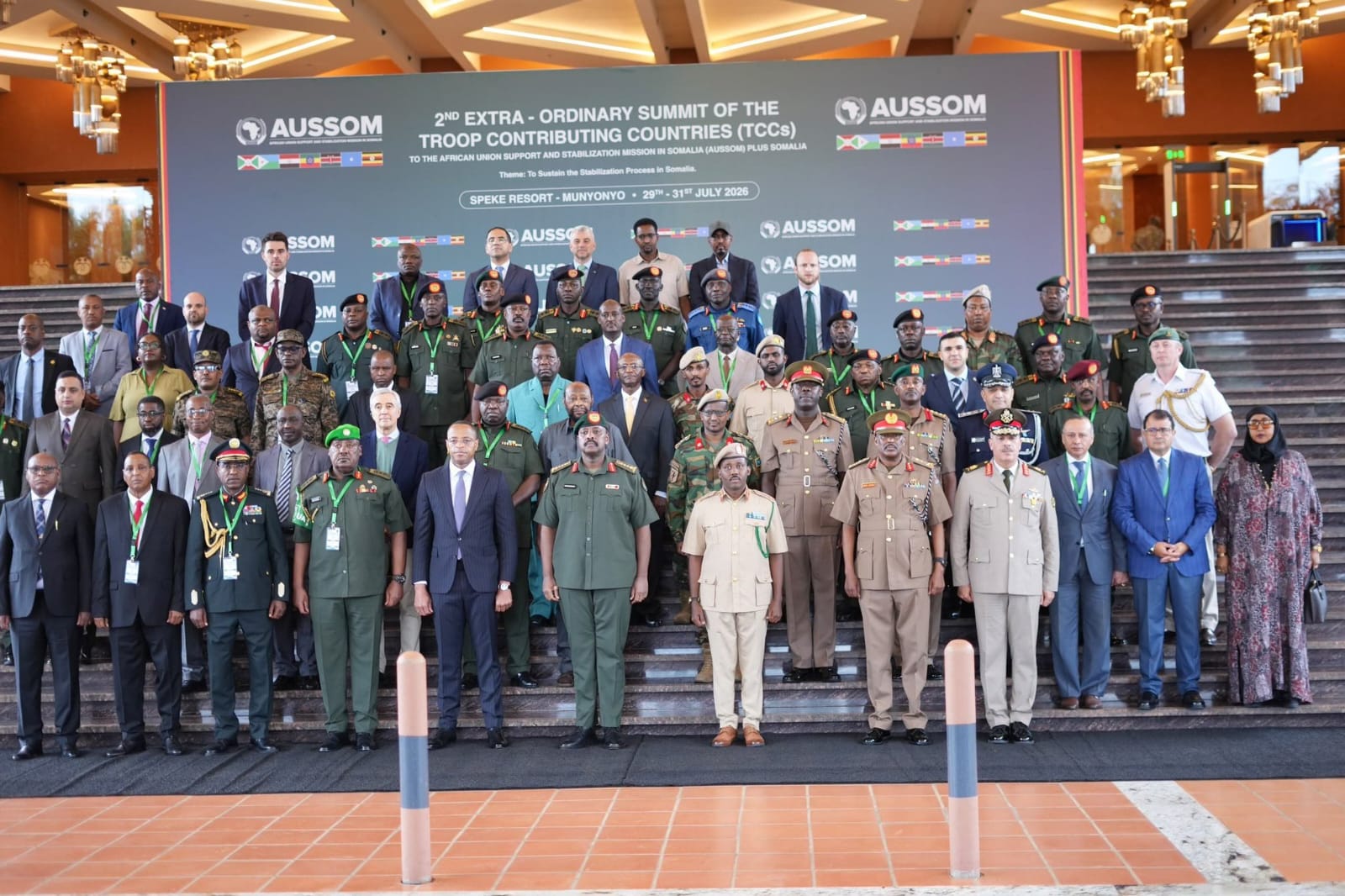
The future of the African Union Support and Stabilisation Mission in Somalia (AUSSOM) is at the center of high-level discussions in Uganda as military chiefs, defence ministers, and heads of state from troop-contributing countries convene for a series of crucial meetings expected to determine the next phase of the mission in Somalia.
The discussions, taking place from July 29 to 31 at Speke Resort Munyonyo in Kampala, come at a defining moment for Somalia’s security sector as the country continues its campaign against Al-Shabaab while preparing for the expiry of AUSSOM’s current mandate at the end of 2026.
Military leaders from countries contributing troops to the mission officially opened the Chiefs of Defence Staff meeting on Wednesday, where they began reviewing the operational progress of AUSSOM and assessing the security landscape across Somalia. The gathering is expected to produce recommendations that will be forwarded to defence ministers meeting on Thursday before a final summit of heads of state on Friday.
Somalia is represented at the meetings by Somali National Army Commander Brig. Gen. Ibrahim Mohamed Mohamud, accompanied by Somalia’s Ambassador to Uganda, H.E. Fardowsa Mohamed Qanyare.
The Kampala meetings are widely viewed as the most consequential since AUSSOM replaced the African Union Transition Mission in Somalia (ATMIS) at the beginning of 2025. While AUSSOM inherited the responsibility of supporting Somalia’s security institutions and assisting in the fight against Al-Shabaab, its long-term future has remained uncertain amid persistent security threats, funding challenges, and the Somali government’s ambition to eventually assume full responsibility for national security.
Delegates are expected to deliberate on several key issues, including the future mandate of AUSSOM, the mission’s financing model, troop levels, force posture, command arrangements, and Somalia’s broader security transition. The outcome of these discussions is expected to shape the mission’s direction beyond its current mandate and influence regional security policy in the Horn of Africa.
A major announcement is anticipated after Friday’s summit, where heads of state from troop-contributing countries are expected to consider recommendations presented by military commanders and defence ministers. Observers believe the summit could produce one of the most significant decisions on Somalia’s security architecture in recent years.
The meetings come against the backdrop of intensified military operations across central and southern Somalia, where Somali government forces, supported by local community fighters and international partners, have increased pressure on Al-Shabaab in recent weeks. Although the militant group continues to demonstrate its ability to launch deadly attacks, Somali authorities insist that sustained offensives remain essential to weakening its operational capacity.
These ongoing security operations have renewed debate over whether Somalia is ready to assume full responsibility for security by the end of next year or whether additional international military support will still be required.
According to reports, the Somali government is seeking a possible two-year extension of AUSSOM’s presence beyond 2026. The reported proposal reflects concerns that despite progress made in rebuilding the Somali National Army and other security institutions, the threat posed by Al-Shabaab remains significant and continues to require coordinated regional support.
Officials have not publicly confirmed any final position regarding the reported extension request, but the issue is expected to feature prominently during the Kampala deliberations. Any extension would require agreement among the African Union, Somalia, troop-contributing countries, and international partners supporting the mission.
The financing of AUSSOM also remains a critical issue. The mission has faced recurring funding uncertainties since its establishment, prompting extensive discussions among African Union member states and international donors over how best to ensure sustainable financial support while maintaining operational effectiveness.
Military planners are also expected to review force deployment across Somalia and evaluate whether adjustments to troop numbers or operational priorities are necessary to respond to evolving security challenges. Such decisions could determine how the mission supports Somali forces during the next phase of counter-insurgency operations.
For Somalia, the Kampala meetings represent more than routine consultations. They provide an opportunity to align regional security cooperation with the country’s long-term goal of assuming greater responsibility for protecting its territory while ensuring that security gains achieved in recent years are not reversed.
Regional leaders have repeatedly emphasized that the success of Somalia’s stabilization efforts depends on close coordination between Somali security institutions and partner countries contributing personnel, expertise, and logistical support to AUSSOM.
The summit also comes as international attention remains focused on security developments across the Horn of Africa, where instability in one country often carries wider regional implications. Decisions taken in Kampala are therefore expected to have consequences beyond Somalia, influencing regional peace and security cooperation for years to come.
As defence ministers meet on Thursday to consider recommendations from the Chiefs of Defence Staff, expectations continue to build ahead of Friday’s gathering of heads of state. The decisions reached over the coming days are expected to define not only the future of AUSSOM but also the next chapter of Somalia’s security transition.
Whether leaders endorse an extension of the mission, introduce reforms to its structure, or outline a new roadmap for Somalia’s security responsibilities, the Kampala summit is likely to become a landmark moment in determining how the fight against Al-Shabaab and the broader stabilization of Somalia will proceed beyond 2026.
With military commanders having completed the first stage of deliberations and political leaders now taking up the discussions, attention across the region is firmly fixed on Kampala, where the future of one of Africa’s most important peace support missions is expected to be decided.