

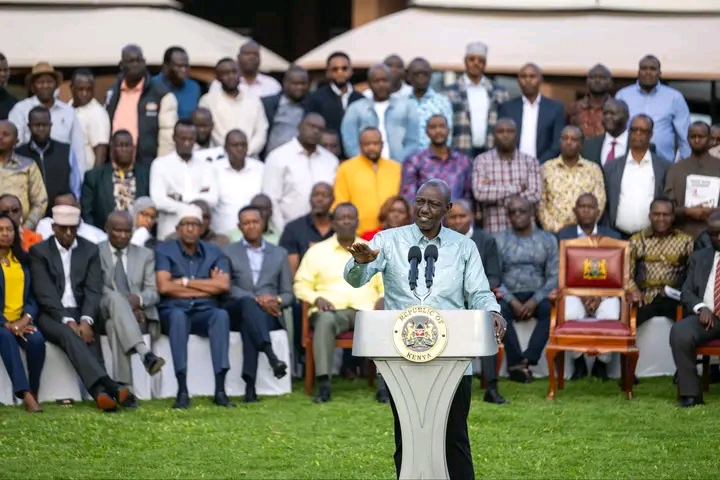
President William Ruto and ODM party leader Oburu Oginga have moved the broad-based government into a new political phase after UDA and ODM formally agreed to develop a joint manifesto and form a coalition to contest the 2027 General Election together.
The announcement, made during the ongoing political retreat in Naivasha, transforms the relationship between the two parties from cooperation in government into an electoral partnership, setting the stage for negotiations over power-sharing, leadership positions and the political architecture of a possible second Ruto administration.
President Ruto said the decision followed consultations within the two political formations and would provide a common platform through which the parties will seek the mandate of Kenyans in the August 2027 election.
“After consultations within our respective parties and formations, the Kenya Kwanza and the ODM have today formally resolved to develop a joint manifesto for the next election and constitute a coalition to contest the 2027 general election together,” Ruto said.
The declaration is arguably the most significant political outcome yet from the broad-based arrangement that brought ODM figures into Ruto’s administration.
What began as an agreement to work together in government following the political tensions that followed the 2022 election has now evolved into an attempt to build a formal electoral coalition capable of campaigning together in 2027.
For ODM, however, the announcement comes with an insistence that the party is entering the arrangement from a position of strength rather than weakness.
Oburu made that position unmistakably clear, directly addressing those who have argued that ODM risks being absorbed by UDA through the broad-based government.
“As we move forward, those who thought ODM was going to be swallowed, I tell them ng’ooooo! ODM is not going to be swallowed,” Oburu declared.
The statement was more than political rhetoric. It was a warning that ODM intends to retain its identity, bargaining power and influence within the emerging coalition.
Oburu said the next stage would involve the establishment of a framework team to work on the coalition agreement, including the question of power-sharing.
That issue is likely to become one of the most difficult components of the negotiations.
The two parties may now have agreed to campaign together, but the details of how power will be distributed between them remain unresolved. Questions surrounding senior government positions, the Deputy President position, parliamentary representation and other leadership arrangements are likely to dominate the next phase of negotiations.
Ruto acknowledged the importance of creating a formal structure to guide the partnership.
He announced that he and Oburu would each nominate five members from their respective political formations to a joint team tasked with preparing the coalition framework agreement.
According to the President, the team will recommend the principles and governance structures that will guide the partnership and propose the leadership arrangements necessary to take the coalition forward.
That announcement effectively creates a negotiating mechanism through which some of the most sensitive political questions ahead of 2027 can be handled.
The retreat also produced a second important decision: the creation of a joint team to prepare a common manifesto for the 2027 election.
Ruto said the manifesto would not simply be a political document written by party officials but would draw from the shared values and priorities of the two formations while taking into account the aspirations and ideas of Kenyans.
The President emphasized that past achievements would not be enough to win the next election.
“No election can be fought on past achievements alone,” Ruto said. “Those who seek your mandate as the people of Kenya must also tell you where they intend to take this country tomorrow.”
The statement signals an attempt by the emerging coalition to shift the 2027 campaign conversation from what the government has already delivered to what it promises to do in its next term.
Ruto also framed the coalition as an extension of the government’s existing agenda.
He said the partnership would seek to consolidate progress already made, complete reforms that are underway and present Kenyans with a common programme for the next phase of national transformation.
But while Ruto focused on continuity and a shared political programme, Oburu’s remarks highlighted the importance of ODM’s contribution to the arrangement.
He argued that ODM had already changed the character of governance since joining the broad-based government.
“President Ruto has welcomed ODM with two hands because he knows that ODM not only brings numbers, but it also brings quality,” Oburu said.
The remarks underline the bargaining position ODM intends to take into the coalition negotiations.
Oburu also revisited the circumstances that led ODM into the broad-based government, saying the party made a conscious decision to help stabilize the country rather than seek political change through street demonstrations.
“We came in to stabilize the government,” he said, explaining that the decision was made while his late brother Raila Odinga was still leading ODM.
Oburu described Raila’s death as particularly painful because it occurred shortly after the broad-based arrangement had begun.
He stressed, however, that ODM’s decision to work with Ruto was deliberate and was not imposed on the party.
“We did not want the government to be changed through demonstrations. We want the government of Kenya to be changed through a democratic process, through the ballot box,” he said.
That argument provides an important political explanation for ODM’s continued presence in the Ruto administration.
The party is positioning its participation not as an abandonment of opposition politics but as part of a strategy to preserve political stability while preparing for the next electoral contest.
Oburu further insisted that ODM remains capable of competing nationally.
“ODM is not a weak party,” he said, rejecting the perception that the party joined the government because it could not field a presidential candidate or lacked grassroots structures.
The comments are likely to become important as the two parties begin negotiating the terms of their coalition.
The creation of the joint teams means the next phase will be less about political declarations and more about the details of the agreement.
The framework team will have to determine how power is shared, how leadership positions are allocated and how the coalition operates after the election.
The manifesto team, meanwhile, will have to produce a common political programme capable of bringing together the interests of UDA and ODM supporters while appealing to voters beyond their traditional political bases.
The biggest test will be whether the two parties can maintain unity once negotiations reach the most sensitive questions.
The agreement to contest the election together may have settled the broad direction of the partnership, but it has not eliminated competition over political positions.
The Deputy President question, regional representation, party nominations and the distribution of elective seats will remain major sources of negotiation.
Still, the Naivasha retreat has produced a political development that would have appeared difficult to imagine when Ruto and Raila were on opposite sides of Kenya’s political divide.
UDA and ODM are now preparing to face the 2027 election on the same platform.
For Ruto, the alliance could significantly strengthen his national political base as he seeks a second term. For ODM, the coalition provides an opportunity to secure a formal stake in the next government while retaining its identity and bargaining power.
The next battle will therefore not be whether UDA and ODM will work together in 2027.
That question has now been answered.
The battle is over the terms of the partnership who gets what, where the political lines will be drawn, and how the two parties will share power if Kenyan voters give their joint ticket another mandate.
The Naivasha retreat has opened that conversation. The negotiations that follow could ultimately determine the shape of Kenya’s 2027 presidential contest.