

Somalia may be moving closer to a defining moment in its long-running security transition, with President Hassan Sheikh Mohamud declaring that the country has reached the point where it should take full responsibility for its own security and bid farewell to foreign African troops.
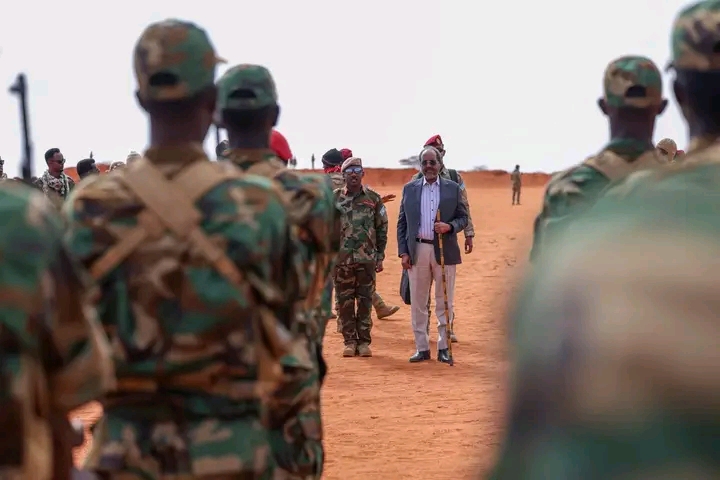
“The time has come for us to take charge of our own security. We should give the foreign forces a beautiful bouquet of flowers and let them go,” President Hassan Sheikh said on Sunday as he presided over the graduation of thousands of Somali National Army soldiers at Xananbuure in Galguduud region, Galmudug State.
The unusually direct remarks come at a critical juncture for Somalia’s security architecture, as government forces intensify operations against Al-Shabaab, while the future of the African Union Support and Stabilisation Mission in Somalia (AUSSOM) faces growing uncertainty over funding, logistics and the sustainability of international military support.
President Hassan Sheikh’s statement therefore carries significance beyond the graduation ceremony. It signals a potentially accelerated ambition by Mogadishu to place Somali forces at the centre of the country’s security operations, even as the African Union mission continues to provide critical military and logistical support.
The President was speaking before thousands of newly trained soldiers who had completed nearly a year of basic military training at Xananbuure. Recruited from across Somalia, the graduating forces represent one of the largest cohorts to complete basic military training inside the country in years.
Their graduation was attended by senior federal and Galmudug officials, including Galmudug President Ahmed Abdi Karie Qoorqoor, the Defence Minister, the Minister of Public Works, the commander of the Somali National Army and senior officers from the 21st Division, alongside members of the Federal Parliament and other military officials.
For Hassan Sheikh, however, the ceremony was not simply about celebrating a new generation of soldiers. It offered an opportunity to underline what his government increasingly sees as the ultimate destination of Somalia’s security strategy: a national army capable of taking over responsibilities that have for years depended heavily on foreign forces.
“Graduating such a large number of troops is a major achievement, especially since they were trained here in the country,” Hassan Sheikh said, acknowledging the contribution of international partners while stressing that Somalia’s own forces must now assume a greater role.
“Our international partners have supported us, but now your time has come,” he told the graduating soldiers.
The remarks come as Somalia intensifies its military campaign against Al-Shabaab, with the federal government portraying the current phase of the war as a decisive push to degrade the militant group and clear remaining areas under its influence.
That campaign has increasingly placed pressure on the Somali National Army to demonstrate that it can hold territory, conduct sustained operations and protect communities after areas are cleared of Al-Shabaab fighters.
The graduation at Xananbuure could therefore be viewed as part of a broader effort to build the manpower required for that transition.
But President Hassan Sheikh’s comments also arrive against a changing international security environment.
AUSSOM, the African Union mission supporting Somalia, has faced significant financial uncertainty.
On July 1, the United States notified the African Union that it would not continue funding the United Nations Support Office in Somalia beyond the end of 2026, a decision that has raised serious questions about the logistical sustainability of the AU mission. UNSOS provides critical services to AUSSOM, including fuel, food, transport, medical support, aviation and other operational requirements.
The funding crisis has placed the future of AUSSOM under renewed scrutiny. The African Union has already called for stronger and more sustainable financing for the mission, while warning about the importance of preserving security gains made in Somalia.
AUSSOM was created as part of a gradual transition toward Somali ownership of national security. Its mandate envisages the eventual transfer of security responsibilities to Somali forces, rather than an indefinite foreign military presence.
The problem is timing.
Somalia is saying it wants to take charge at a moment when the international support system that has sustained African forces is itself under increasing financial pressure.
That makes Hassan Sheikh’s statement particularly significant.
If the President’s remarks translate into policy, Somalia could seek to accelerate the transition rather than simply wait for AUSSOM’s future to be determined by international funding decisions.
Yet the challenge facing Mogadishu remains enormous.
Al-Shabaab has fought the Somali state for nearly two decades and continues to pose a serious security threat. Somali forces have made gains in recent years, but the ability to independently sustain large-scale operations across the country remains one of the central tests facing the government.
The United States decision to end support for UNSOS has already triggered warnings that a sudden weakening of AUSSOM could create security gaps if alternative arrangements are not secured. Analysts have cautioned that Somalia’s security forces remain overstretched and that an abrupt reduction of international support could create vulnerabilities that Al-Shabaab could exploit.
That is why the graduation in Xananbuure matters.
Every new trained soldier strengthens Somalia’s argument that responsibility for the country’s security should increasingly rest with Somalis themselves. But the number of soldiers alone will not determine whether that transition succeeds.
Training must be matched by equipment, command structures, intelligence, logistics, salaries, air support and the ability to sustain operations far beyond major urban centres.
President Hassan Sheikh’s message nevertheless reflects a growing political determination in Mogadishu to move toward that objective.
Galmudug President Ahmed Abdi Karie Qoorqoor also congratulated the graduating soldiers and praised their commitment throughout the lengthy training programme, reaffirming Galmudug’s support for efforts to build a stronger Somali National Army.
The symbolism was difficult to miss: thousands of Somali soldiers standing on Somali soil, trained inside the country, graduating before the country’s political and military leadership at a time when Somalia is calling for greater ownership of its own security.
For nearly two decades, African troops have been a central component of the international effort to prevent Somalia from falling further into the grip of militant groups. But that model was always intended to be transitional.
Now, with the war against Al-Shabaab entering what Mogadishu describes as a decisive phase, and with AUSSOM’s financial future increasingly uncertain, Hassan Sheikh appears to be signalling that Somalia wants to bring that transition closer.
His “beautiful bouquet of flowers” remark may have been delivered with a touch of political symbolism, but its underlying message is serious: Somalia does not want foreign military forces to remain the permanent guarantors of its security.
The question now is whether the Somali National Army can turn that political ambition into a sustainable military reality and whether Somalia can assume full responsibility before the departure of foreign forces creates a vacuum that Al-Shabaab could exploit.
The graduation at Xananbuure was therefore more than a ceremony marking the completion of military training. It was a statement of intent.
Somalia is telling its international partners that their support has been valuable, but that the ultimate goal is for Somali soldiers to stand on the front line of Somalia’s security.
And with the future of AUSSOM hanging in the balance, President Hassan Sheikh has now made that ambition unmistakably clear: the time, in his view, has come for Somalia to take charge of its own security.