

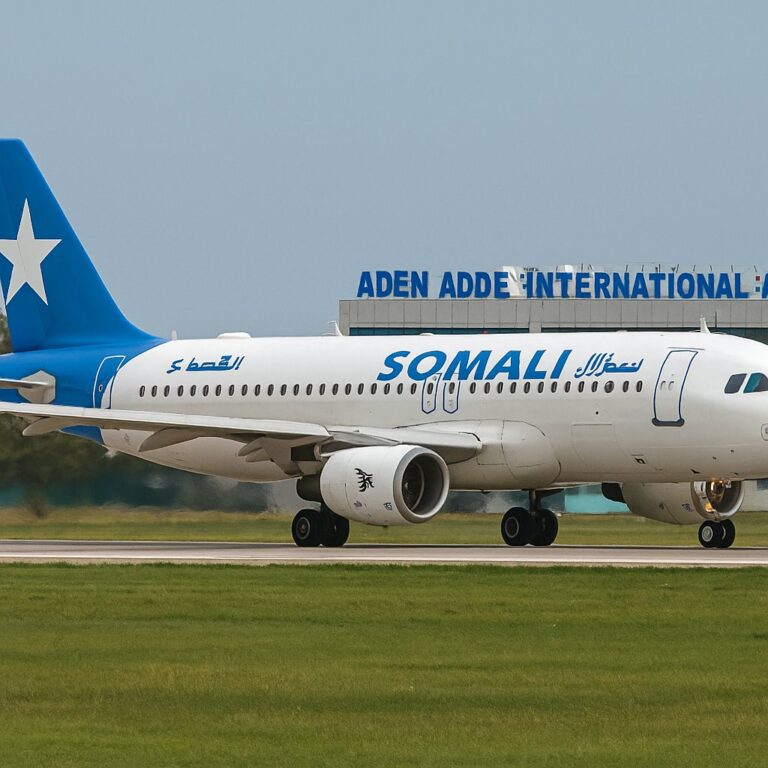
Somalia is once again preparing to bring its national carrier back into the skies, with the Civil Aviation Authority announcing September 2026 as the latest target for the resumption of Somali Airlines flights, more than three decades after the airline was grounded following the collapse of the country’s central government.
The announcement has revived hopes that Somalia could finally restore one of the most recognizable symbols of its aviation history. Civil Aviation Authority Director Ahmed Macallin said preparations for the relaunch had been completed and that Somali Airlines was expected to begin operating direct flights in September.
If achieved, the planned restart would mark a major moment for Somalia’s aviation sector and a significant step in the country’s broader efforts to rebuild national institutions that were disrupted by decades of conflict.
But the September target also comes with a familiar question: will this be the date when Somali Airlines finally returns to commercial skies, or another deadline in a revival process that has already seen several postponements?
Somalia’s national carrier has been the subject of renewed government efforts for several years. In July 2025, authorities announced an agreement involving two Airbus A320 aircraft, describing the arrangement as the initial stage of a plan to revive the airline after its operations were suspended in 1991.
At the time, officials said the first aircraft would form the foundation of a rebuilt national carrier, with plans to expand the fleet as operations grew. The government subsequently indicated that flights could begin within months, while another forecast in October 2025 suggested the airline could return before the end of that year.
Those deadlines passed without the carrier resuming scheduled commercial operations.
The latest September 2026 target therefore carries both optimism and scrutiny. After years of announcements, the focus is increasingly shifting from plans and promises to whether the necessary aviation systems are actually in place for the airline to operate safely and consistently.
Bringing a national airline back to life is considerably more complicated than acquiring aircraft.
Before an airline can operate scheduled commercial flights, it must satisfy a wide range of regulatory and operational requirements. These include obtaining the necessary approvals, meeting aviation safety standards, ensuring that pilots, cabin crew and technical personnel are properly trained and establishing reliable systems for aircraft maintenance, insurance, flight planning and airport operations.
The airline must also demonstrate that it can maintain these standards over time. For Somalia, where the aviation sector has undergone significant rebuilding since the collapse of the state, the successful completion of these requirements will be closely watched by regulators, passengers and the wider international aviation community.
The government’s agreement for two A320 aircraft in 2025 was presented as only the beginning of a much larger plan. Additional aircraft are expected to be introduced as the carrier expands its network and builds its operational capacity.
The ambition is not simply to put aircraft bearing the Somali Airlines name back into service, but to create a functioning national carrier capable of serving Somali passengers and connecting the country to regional and international destinations.
That ambition has deep historical significance.
Somali Airlines was established in 1964 and went on to become an important regional and international carrier. At its height, the airline connected Somalia with destinations beyond its borders and played an important role in passenger travel, trade and the country’s international links.
Its operations came to an end in 1991 following the collapse of Somalia’s central government and the outbreak of civil war. The disappearance of the airline became one of the many visible consequences of the collapse of state institutions.
For more than three decades, Somalia has operated without a functioning national carrier under the Somali Airlines name. While private and foreign airlines have continued serving Somali airports, the absence of a national airline has remained a significant gap in the country’s aviation infrastructure.
A successful revival could therefore have implications extending far beyond the aviation industry.
A functioning Somali Airlines could improve connectivity for Somali passengers travelling between the country and regional destinations. It could also support trade, tourism and business travel while creating employment opportunities for pilots, engineers, cabin crew, airport workers and other aviation-related professionals.
For a country with a large diaspora spread across Africa, the Middle East, Europe and North America, improved air connectivity could also strengthen links between Somalia and its citizens abroad.
However, the success of the project will ultimately depend on whether the airline can operate beyond the symbolism of its return.
The aviation industry is unforgiving of weak systems. Aircraft must be maintained properly, crews must be trained to international standards, flights must be planned efficiently and passengers must be able to trust that schedules will be reliable. Financial sustainability will also be essential if the carrier is to avoid the difficulties that have affected many national airlines around the world.
The September 2026 target is therefore more than another date on a government calendar. It is a test of whether Somalia can translate years of planning into a functioning national aviation operation.
For many Somalis, the sight of a Somali Airlines aircraft taking off again would represent more than the return of a company. It would symbolize the gradual rebuilding of a national institution that disappeared during one of the country’s darkest periods.
But after several missed timelines, the real milestone will not be another announcement that Somali Airlines is returning.
It will be the moment passengers walk into an airport, board a Somali Airlines aircraft and see it take off on a scheduled commercial flight.
Until then, September remains a target.
The real measure of the revival will be whether Somalia can turn that target into a sustainable reality.