

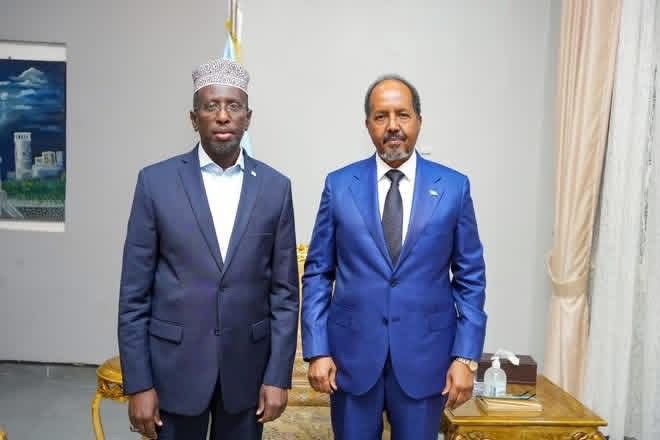
President Hassan Sheikh Mohamud paid a rare late-night visit to the residence of former President Sharif Sheikh Ahmed in Mogadishu, in a political development that has captured national political attention. The visit which reportedly lasted around two hours comes after months of visible political distance between the two leaders, who have previously worked together but increasingly found themselves on opposite sides of Somalia’s current political arena.
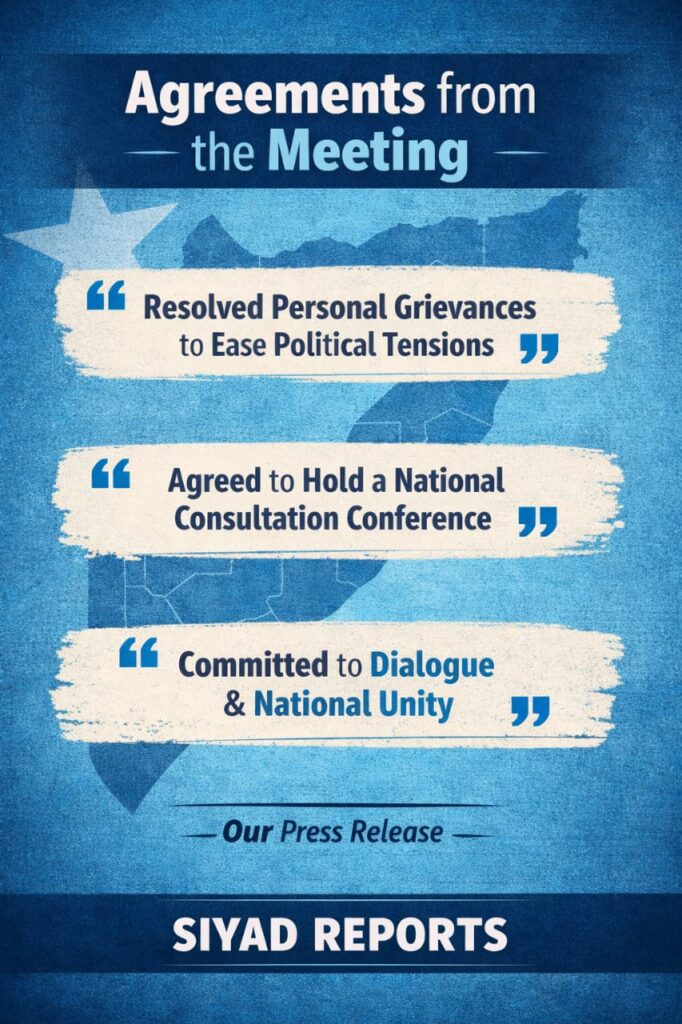
Although the official reason for the meeting was not immediately disclosed, both sides later confirmed that key political grievances were discussed and resolved.
The meeting was also notable for the informal tone of the visit, which observers say it differed from the usual presidential protocol, signalling a more personal attempt at reconciliation.
According to political sources, President Hassan Sheikh reiterated his support for the upcoming national consultation efforts, including participation in the Kismayo meeting scheduled for January 30.
He reportedly appealed to Sharif Sheikh Ahmed now leader of the Himilo Qaran political party to help guide a broader process of dialogue between federal authorities and political stakeholders.
A press release from Himilo Qaran confirmed that both leaders expressed commitment to national unity, compromise, and inclusive dialogue as the best way to resolve Somalia’s intensifying political disagreements.
A Reset in Relations After Months of Political Tension
Analysts note that the timing of this meeting is politically significant. It comes as President Hassan Sheikh approaches the end of his current constitutional term, a period in Somali politics that is often sensitive and prone to mistrust.
Opposition groups have repeatedly warned against any attempt to extend presidential tenure beyond constitutional limits. Against that backdrop, the president’s renewed emphasis on unity and reconciliation is being widely interpreted as an attempt to rebuild trust and open space for negotiations.
Inside sources indicate that some of the grievances discussed were linked to political propaganda and perceptions of exclusion. Sharif Sheikh Ahmed reportedly encouraged the President to formalize an invitation to all opposition blocs for national dialogue a step he pledged to support.
It is also understood that the President prefers Mogadishu as the central venue for the proposed national talks, a position that has already been discussed with some international partners.
What This Meeting Means — and What Comes Next
This surprise engagement marks one of the clearest signs yet that Somali political leaders recognize the growing risk of confrontation if dialogue fails.
Three key implications emerge from the meeting:
1. The Opposition Is Now Back at the Table
Sharif Sheikh Ahmed’s willingness to participate suggests a softening of previous political hard lines. His involvement adds credibility to any national conference and may encourage other skeptical actors to join.
2. Hassan Sheikh Is Seeking Consensus Not Confrontation
By initiating the visit personally and informally, the President signaled that reconciliation now outweighs political ego or protocol. That move may help lower the temperature at a critical political moment.
3. The National Consultation Conference Is Now More Likely
If successfully convened, such talks could reshape relations between Villa Somalia, federal member states, and opposition parties potentially defining Somalia’s political direction over the coming year.
However, challenges remain. Trust is still fragile. Opposition figures want guarantees that constitutional timelines will be respected. Federal member states continue to push for a greater say in national decision-making. And regional instability particularly security threats continues to complicate politics.
A Critical Turning Point for Somalia’s Political Future
The late-night encounter between Hassan Sheikh Mohamud and Sharif Sheikh Ahmed represents more than just a reunion of two former allies it may be a turning point in Somalia’s political climate.
If the spirit of reconciliation expressed during the meeting translates into real, inclusive dialogue, Somalia may avoid the political polarization that has destabilized past transitions. But the success of this new chapter will depend on follow-through, transparency, and genuine commitment from all stakeholders.
For now, Mogadishu is watching closely and cautiously as Somalia’s leaders reopen the door to political compromise.