

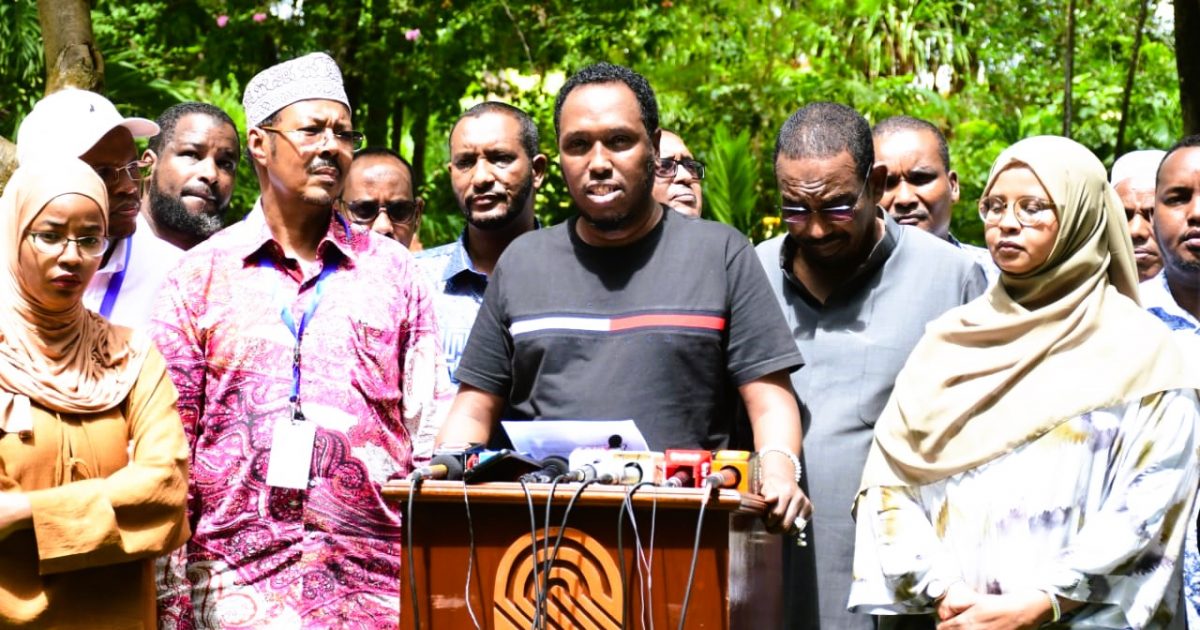
North Eastern Kenya has undergone one of the most significant political reorientations in the country’s recent history. Once treated as electorally peripheral and structurally marginalized, the region has rapidly evolved into a strategic pillar of President William Ruto’s re-election calculations. This shift reflects not only changing regional loyalties but also a broader recalibration of Kenya’s national political map, driven by internal realignments, opposition fragmentation, and deliberate policy choices by the current administration.
For President Ruto, the urgency is clear. As traditional support bases show signs of fragmentation most notably in Mt. Kenya the path to 2027 increasingly depends on constructing new, reliable coalitions. North Eastern Kenya, long excluded from the “inner circle” of power, has become central to that strategy.
From Opposition Fortress to Strategic Target
The scale of the political transformation becomes clearer when viewed against the backdrop of the 2022 General Election. At the time, North Eastern Kenya was firmly within the opposition column, delivering overwhelming majorities for Raila Odinga across Garissa, Wajir, and Mandera. President Ruto’s support in the region barely crossed the 20–36 percent range, reinforcing perceptions that North Eastern was politically inaccessible to the ruling coalition.
Yet by early 2026, political projections suggest a dramatic reversal. Some internal estimates now place Ruto’s potential support at up to 80 percent, translating to approximately 704,000 votes. While such figures remain projections rather than certainties, they point to a broader political momentum that was absent just four years earlier. What has changed is not merely voter preference, but the region’s relationship with the state itself.
Power, Policy, and the Rebuilding of Political Trust
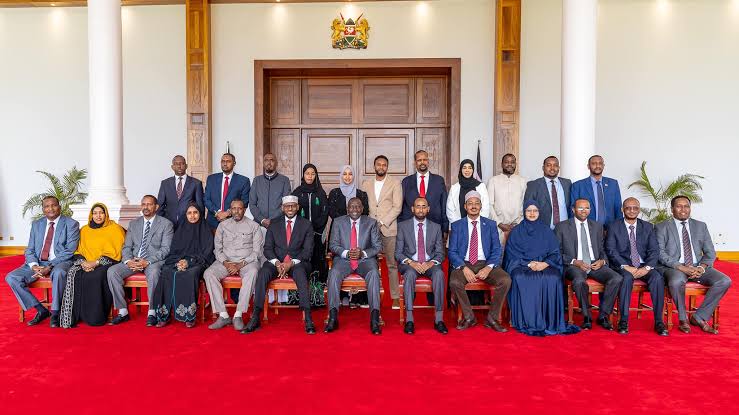
Central to this shift has been President Ruto’s sustained engagement with North Eastern’s political leadership. Unlike previous administrations that relied heavily on symbolic visits, Ruto has moved to integrate the region into the machinery of governance. Regular high-level consultations at State House, the elevation of key regional figures within government, and a consistent narrative of “inclusion through delivery” have helped recast North Eastern as a government partner rather than a political outlier.
This political outreach has been reinforced by tangible policy interventions that address long-standing grievances.
The abolition of the 60-year-old National ID vetting process in 2024 stands as the most transformative of these reforms. Beyond easing access to citizenship documents, the decision carried deep symbolic significance, ending decades of institutional discrimination and restoring a sense of equal belonging within the Kenyan state. The opening of a regional passport office in Garissa further normalized access to essential services that were once geographically and bureaucratically distant.
Infrastructure investment has also played a critical role in rebuilding political trust. The Isiolo–Mandera Highway, digital fiber expansion, electricity connections, and water projects are not simply development initiatives they are instruments of political integration, physically linking the region to the national economy and reducing the sense of isolation that historically fueled opposition sentiment. In this context, development has become a form of political capital.
The 2027 Equation: Replacing Votes and Redefining Alliances
North Eastern’s rising importance must also be understood within the broader national realignment unfolding ahead of 2027. The deepening rift between President Ruto and former Deputy President Rigathi Gachagua has destabilized Mt. Kenya, once the backbone of Ruto’s electoral coalition. As internal divisions erode vote certainty in that region, State House has increasingly turned to North Eastern and the Nyanza region as alternative anchors of stability.
At the same time, the opposition landscape has undergone a fundamental shift following the death of Raila Odinga in late 2025. In North Eastern, where Raila’s personal influence and historical symbolism anchored political loyalty, his absence has created a vacuum. Without a unifying opposition figure, many regional leaders have opted for pragmatic alignment with the ruling coalition, framing their choice as a strategy to secure development and political relevance rather than ideological submission.
A critical component of this emerging alliance is voter expansion. The abolition of ID vetting has unlocked the possibility of mass voter registration, with regional leaders projecting up to 2.7 million registered voters by 2027. For many first-time ID recipients, the reform is likely to carry emotional and psychological weight, fostering a sense of political loyalty toward the administration that ended decades of exclusion. This dynamic where policy reform translates into electoral gratitude could prove decisive.
A Calculated Political Bet
By early 2026, North Eastern Kenya has moved from the margins of national politics to the center of President Ruto’s re-election strategy. No longer viewed as a swing region, it is increasingly treated as a core pillar capable of offsetting losses elsewhere and reshaping the national electoral map.
Whether this realignment endures beyond 2027 will depend on continued delivery, political inclusion, and the sustainability of newly forged alliances. For now, however, one reality is clear: North Eastern Kenya is no longer observing Kenya’s politics from the sidelines. It has become one of its most consequential arenas.