

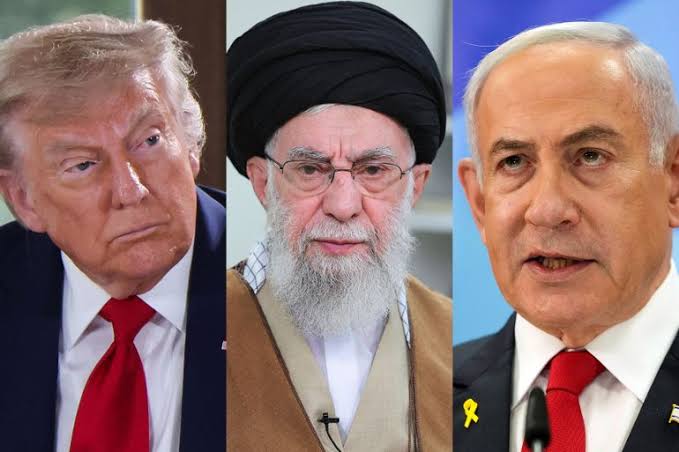
The Middle East crisis has escalated into what many leaders are now openly calling the beginning of a regional war, as U.S. and Israeli air operations against Iran expand into a sustained military campaign and Tehran responds with sweeping missile strikes across Israel and multiple Gulf states hosting American bases.
What began as coordinated strikes targeting Iranian military and strategic infrastructure has transformed within hours into simultaneous cross-border attacks, diplomatic breakdowns, airspace closures, oil supply disruptions, and urgent appeals from world leaders to halt the spiral before it consumes the region.
A senior White House official confirmed to Fox News that joint U.S.-Israeli air and aviation strikes will continue not just for hours but for “several days,” signaling that Washington and Tel Aviv are preparing for a prolonged military phase rather than a symbolic show of force. Israeli military statements claim that “hundreds of Iranian military targets,” including missile launchers and command facilities in western Iran, have been struck in waves of coordinated operations. Israeli officials insist the objective is to dismantle what Prime Minister Benjamin Netanyahu describes as an existential threat posed by Iran’s missile and nuclear infrastructure.
Tehran, however, has framed the operation as an imposed war. Iranian Foreign Minister Abbas Araghchi declared that the conflict is not only against Iran but “against all countries in the region,” warning that the response would be comprehensive and ongoing. Iranian state media announced the launch of “Operation True Promise 4,” marking a new phase of retaliation involving ballistic missiles and drones directed at Israel and U.S. military facilities scattered across the Gulf.
Missiles were reported targeting Al Udeid Air Base in Qatar, Al-Salem Air Base in Kuwait, Al-Dhafra Air Base in the United Arab Emirates, the U.S. Navy’s Fifth Fleet base in Bahrain, Muwaffaq Al-Salti Air Base in Jordan, and a U.S. base in northern Iraq.
Explosions rocked Manama, Abu Dhabi, Doha, and parts of Kuwait, with air defense systems intercepting many incoming projectiles. Qatar confirmed that its Patriot systems intercepted missiles aimed at its territory. Bahrain’s Ministry of Education announced a shift to distance learning as a precaution, highlighting the civilian disruption unfolding across the Gulf.
In Dubai, reports of multiple explosions near Jebel Ali port one of the busiest shipping hubs globally sent shockwaves through international markets. Roughly 7,000 vessels pass through that port annually, and any sustained threat to its operations would ripple through global trade chains. The world’s tallest building, the Burj Khalifa, reportedly began evacuations over fears that missile activity could threaten high-rise structures.
The symbolism of evacuations in the Gulf’s most iconic skyline underscores how deeply this conflict has penetrated daily life far from the immediate battlefield.
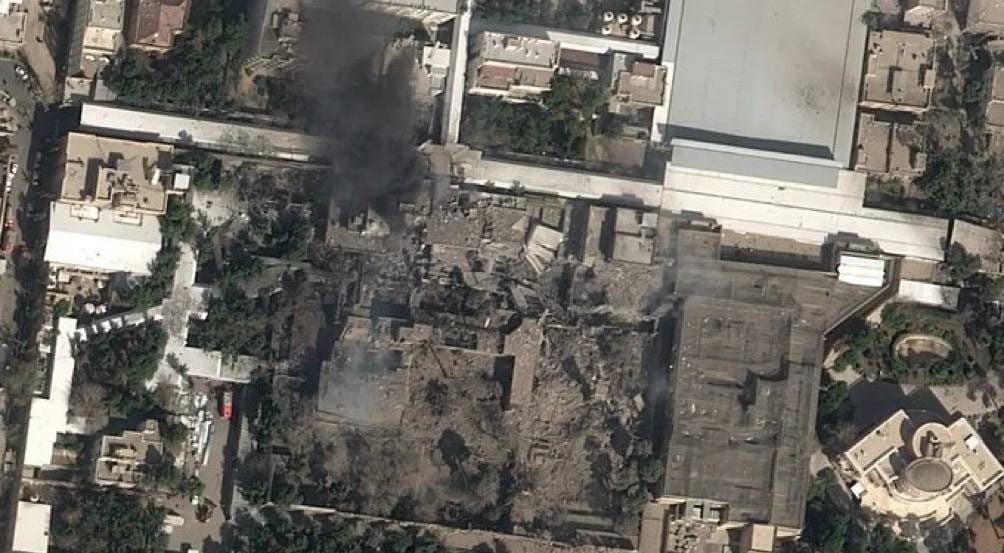
Inside Iran, images circulated showing damage within the compound of Supreme Leader Ali Khamenei in Tehran. Early claims suggested senior figures may have been targeted, but Foreign Minister Araghchi later confirmed that Khamenei and President Masoud Pezeshkian are alive. Reports also emerged alleging that Iran’s Defense Minister Amir Nasirzadeh and IRGC Commander General Mohammad Pakpour may have been killed in Israeli strikes; these specific reports remain unconfirmed amid the fast-moving developments.
One of the most tragic developments involves the confirmed strike on an elementary girls’ school in Minab, southern Iran, where 51 students were killed and 60 others injured. Iranian authorities have confirmed the casualty figures. Foreign Minister Araghchi described the bombing as an attack carried out in broad daylight while the school was full of pupils, calling it a crime that will not go unanswered. The incident has intensified public anger inside Iran and further escalated the gravity of the conflict.
The scale of missile exchanges has been described by U.S. officials as unprecedented. A U.S. source told The Wall Street Journal that Washington has never before faced simultaneous attacks of this magnitude on its Middle Eastern bases. Reports indicate that the base in Bahrain sustained significant damage.
Iran has portrayed the strikes on U.S. facilities as a strategic victory, signaling its ability to project force directly against American assets in the Gulf.
The Strait of Hormuz has become another flashpoint. Reuters reports that major oil companies have suspended tanker traffic through the strait following the escalation. Roughly 20 percent of the world’s oil supply transits this narrow waterway, making it the most critical artery in global energy markets. Iranian media stated that oil tankers have stopped using the route entirely, a move that could cause immediate spikes in oil prices and renewed global inflation pressures. Energy markets are bracing for severe volatility.
Diplomatic reactions have been swift and varied. Tedros Adhanom Ghebreyesus, Director-General of the World Health Organization, expressed deep concern for civilians trapped in the crossfire and urged leaders to choose dialogue over destruction.
The African Union Commission Chairperson Mahmoud Ali Youssouf warned that continued escalation threatens energy markets, food security, and economic resilience, particularly across Africa, and called for urgent de-escalation in line with the UN Charter.
Indonesia’s President Prabowo Subianto has reportedly offered to mediate between Washington and Tehran. Oman’s foreign minister, who had been facilitating nuclear talks, warned the United States not to be drawn deeper into what he described as “not your war,” suggesting that active negotiations had been undermined by the strikes.
European leaders are also responding. French President Emmanuel Macron condemned what he called the “start of war” between the United States, Israel, and Iran, warning of grave consequences for international peace and security. He announced that France is calling for an urgent United Nations Security Council meeting and stands ready to protect its partners if requested.
European Commission President Ursula von der Leyen expressed deep concern, emphasizing nuclear safety and the need to prevent further escalation that could undermine global non-proliferation efforts. Spanish Prime Minister Pedro Sánchez rejected what he termed unilateral military action by the U.S. and Israel.
Regional diplomacy is equally intense. Saudi Arabia condemned Iranian missile attacks on Gulf states and pledged full solidarity with the UAE, Bahrain, Qatar, Kuwait, and Jordan. Crown Prince Mohammed bin Salman spoke with UAE President Mohammed bin Zayed to coordinate responses. The Emir of Qatar, Tamim bin Hamad Al Thani, held a call with the Saudi Crown Prince urging an immediate halt to escalation and a return to negotiations. Gulf states appear increasingly alarmed at being direct targets in a conflict that initially centered on Israel and Iran.
Turkey has declared it will not allow its airspace, land, or waters to be used for attacks, signaling a cautious neutrality.
Meanwhile, Russia’s Security Council Deputy Chair Dmitry Medvedev has used rhetoric comparing the age of the United States to the ancient Persian Empire, implying resilience on Iran’s side.
The humanitarian dimension is rapidly deteriorating. Civilian evacuations, airspace closures, distance learning orders, and widespread fear define life in cities from Tehran to Dubai.
Confirmed casualties in Abu Dhabi and the confirmed deaths of 51 schoolgirls in Minab highlight the human cost beyond military objectives. Global aviation has been disrupted, with multiple airlines suspending routes across the region.
Strategically, this conflict marks the first time in modern history that Iran has openly and simultaneously targeted multiple U.S. bases across several sovereign Gulf states while also engaging Israel directly with large-scale missile barrages. Israel’s reported strikes on Iranian leadership compounds suggest a willingness to decapitate command structures. Iran’s declaration that it will not surrender its right to uranium enrichment signals that the nuclear issue remains central.
The coming days are critical. With Washington signaling sustained strikes and Tehran vowing continued retaliation, the risk of miscalculation is high. Any further attack on critical oil infrastructure, civilian population centers, or high-ranking officials could push additional regional or global powers into direct involvement.
For now, the Middle East stands in a moment of extraordinary peril. Energy markets tremble, diplomatic channels strain under pressure, and civilians across multiple countries brace for further sirens.
The world is watching not just a confrontation between three states, but a test of whether escalation can be contained in an era where regional wars carry immediate global consequences.