

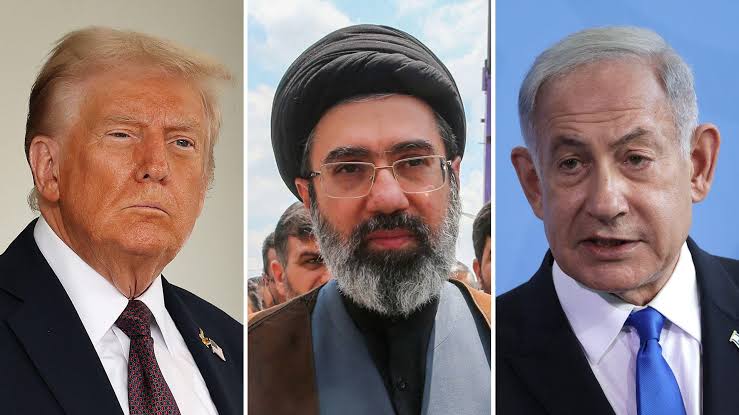
In the ever-shifting chessboard of Middle Eastern geopolitics, moments of pause often speak louder than moments of action. What appears on the surface as restraint can conceal preparation; what is framed as diplomacy can function as delay; and what is announced as strength may ultimately reveal uncertainty.
The recent sequence of events involving the United States, Israel, and Iran offers a striking example of this ambiguity. At the center of it all stands Donald Trump, whose abrupt shift from issuing a 48-hour ultimatum to announcing a five-day negotiation window has raised serious questions not only about intent, but about strategic coherence.
Initially, the message was unmistakably aggressive. The demand directed at Iran to reopen or secure the Strait of Hormuz a vital artery for global oil supply came with a stark warning: failure to comply would result in targeted strikes on Iran’s electrical infrastructure. Such a threat was not merely symbolic.
It signaled a willingness to cripple civilian and industrial life in Iran, a move that would have marked a significant escalation in the already tense standoff. Yet before the ultimatum could expire, the narrative changed. Trump announced that negotiations were underway and that military action would be paused for five days to allow diplomacy to take its course.
This sudden pivot has sparked a wave of speculation. Is this a calculated strategy buying time under the guise of diplomacy or does it reveal hesitation in the face of an adversary that has proven far more resilient and capable than previously assumed?
Reports suggesting the movement of ground military officers into the Middle East during this “pause” further complicate the picture. If true, the implication is clear: the delay may not be about peace, but about positioning.
To understand this moment, one must first examine the longstanding assumptions that have shaped U.S. and Israeli policy toward Iran. For years, both Washington and Tel Aviv have operated under a framework that views Iran as a destabilizing force dangerous, yes, but ultimately containable through a combination of sanctions, covert operations, and limited military pressure.
This framework has been reinforced by Iran’s economic struggles under sanctions and its avoidance of direct, large-scale confrontation with superior Western military forces.
However, this perspective may be dangerously outdated. Iran’s military doctrine has evolved significantly over the past two decades. Rather than seeking parity with conventional Western forces, Iran has invested heavily in asymmetric warfare capabilities.
Its arsenal includes advanced missile systems, a network of regional proxies, cyber warfare units, and naval strategies designed specifically to disrupt chokepoints like the Strait of Hormuz.
These capabilities are not theoretical they have been demonstrated in various conflicts and incidents across the region.
The Strait of Hormuz itself is a critical factor in this equation. Roughly one-fifth of the world’s oil passes through this narrow waterway. Any disruption would have immediate and severe consequences for global energy markets.
Iran has repeatedly signaled its ability to close or disrupt the strait if provoked. This is not an empty threat; it is a cornerstone of its deterrence strategy. By leveraging geography and asymmetric tactics, Iran has turned a potential vulnerability into a strategic advantage.
In this context, the ultimatum issued by Trump appears less like a show of strength and more like a gamble one that may not have accounted for the full scope of Iran’s capabilities. The subsequent decision to pause and pursue negotiations suggests that this gamble may have been reconsidered.
Whether this reconsideration was driven by intelligence assessments, military advice, or political calculations remains unclear. What is clear, however, is that the initial posture underestimated the risks involved.
Israel’s role in this dynamic is equally significant. As a key ally of the United States and a direct regional adversary of Iran, Israel has long advocated for a hardline approach. Its intelligence and military operations have targeted Iranian assets in Syria and beyond, aiming to limit Tehran’s regional influence. Yet even Israel has exercised caution when it comes to direct confrontation with Iran.
The potential for escalation into a broader regional war one involving Hezbollah in Lebanon, militias in Iraq, and other actors poses a risk that cannot be easily managed.
The idea that the United States and Israel may have underestimated Iran’s military capabilities is not merely speculative; it is supported by the pattern of events. The rapid shift from ultimatum to negotiation, the reported movement of ground forces, and the absence of immediate military action all point to a reassessment. This reassessment may be rooted in a recognition that Iran is not a conventional adversary that can be coerced through threats alone.
Moreover, the political dimension cannot be ignored. For Trump, whose leadership style often emphasizes bold declarations and decisive action, the decision to pause may carry domestic implications. It opens him to criticism from both sides those who see the move as a necessary step toward avoiding conflict, and those who interpret it as a sign of weakness. In the realm of international politics, perception is as important as reality. A perceived retreat can embolden adversaries and unsettle allies.
Yet it would be simplistic to frame this situation as a binary choice between strategy and surrender. In reality, it may be a combination of both. The five-day window could serve multiple purposes: allowing time for diplomatic engagement, enabling the repositioning of military assets, and providing space for further intelligence gathering. In this sense, the pause is not necessarily a retreat, but a recalibration.
However, recalibration in the midst of a high-stakes confrontation carries its own risks. It signals uncertainty, which can be exploited by all sides. For Iran, the pause may be interpreted as validation of its deterrence strategy. It reinforces the idea that its capabilities are sufficient to force even a superpower to reconsider direct action. This, in turn, could embolden Iran to adopt a more assertive posture, both in the Strait of Hormuz and across the region.
At the same time, the broader international community is watching closely.
Countries that rely on the stability of global oil markets have a vested interest in the outcome. Any miscalculation could trigger economic repercussions far beyond the Middle East. The stakes, therefore, extend beyond the immediate actors to encompass the global system.
The narrative that emerges from this moment is one of misjudgment and adjustment. The initial ultimatum reflects a belief in the effectiveness of coercive pressure. The subsequent pause suggests a recognition that such pressure may not be sufficient or may even be counterproductive. This shift underscores a fundamental challenge in dealing with Iran: its ability to absorb pressure and respond in ways that complicate traditional strategies.
In the end, the question is not simply whether the five-day pause is a strategy or a sign of giving up. It is whether the underlying assumptions guiding U.S. and Israeli policy are aligned with the realities on the ground. If those assumptions are flawed, then no amount of tactical maneuvering will produce a stable outcome.
What is unfolding in the Middle East is not just a confrontation between states; it is a test of strategic thinking. It challenges long-held beliefs about power, deterrence, and the limits of military force. The actions taken in these five days whether diplomatic, military, or both will shape not only the immediate crisis but the broader trajectory of the region.
In this sense, the pause is not merely a delay. It is a moment of reckoning. A moment in which decisions must be informed not by outdated perceptions, but by a clear-eyed understanding of a complex and evolving adversary.
Whether that understanding will emerge remains to be seen. But one thing is certain, underestimating Iran is no longer an option, and the consequences of doing so are becoming increasingly difficult to ignore.