

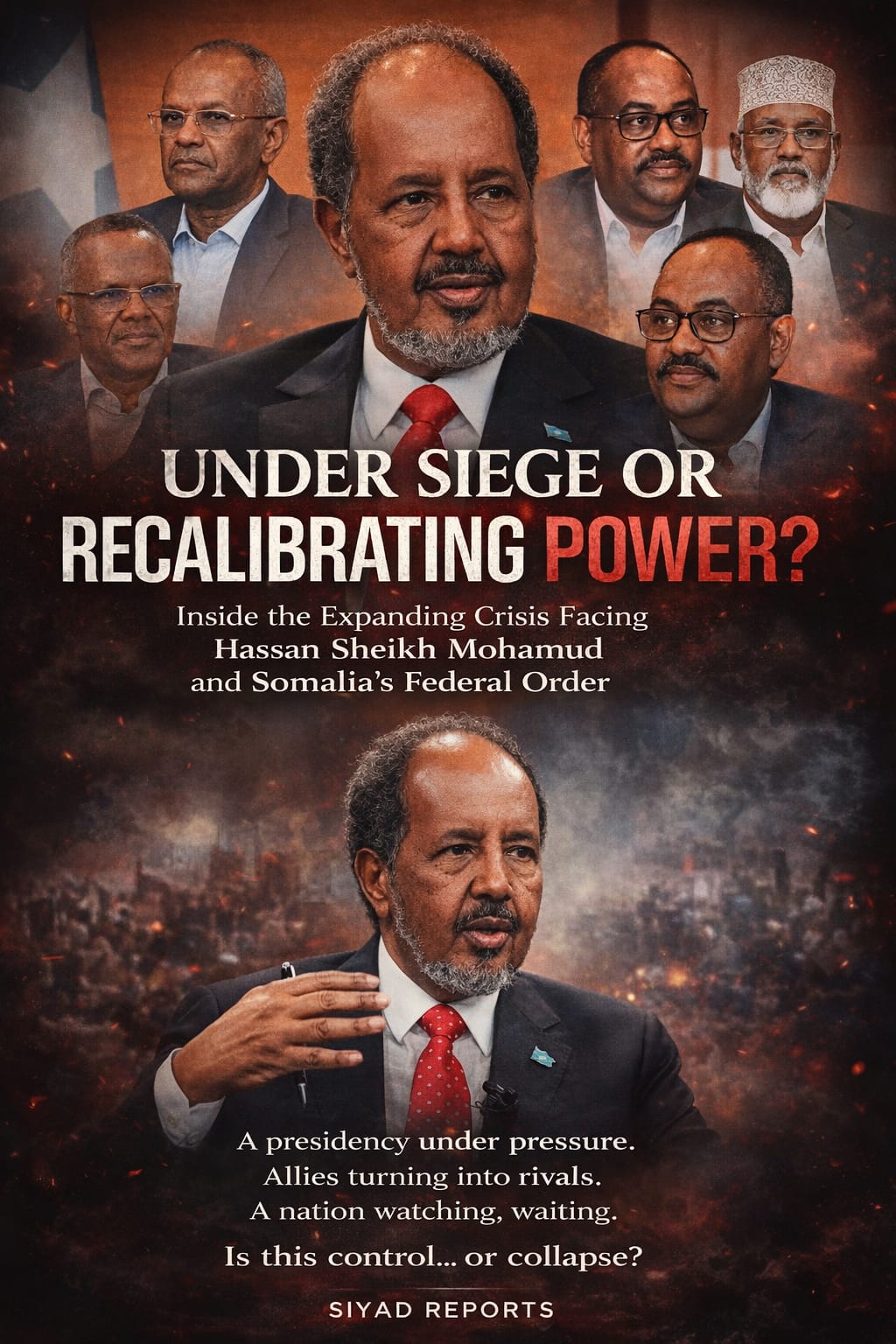
Somalia is once again standing at a critical political crossroads, where the balance between federal authority and regional autonomy is being tested in ways that could redefine the country’s trajectory for years to come.
President Hassan Sheikh Mohamud, who returned to power in 2022 with renewed legitimacy and a reform-driven agenda, now finds himself navigating one of the most intense political storms of his leadership. What initially appeared to be a calculated effort to stabilize governance, finalize constitutional structures, and deliver long-awaited democratic reforms has evolved into a multi-layered crisis—one that blends political fragmentation, security risks, institutional distrust, and personal leadership pressure.
At the center of this unfolding situation is the growing fracture between the Federal Government of Somalia and several Federal Member States, most notably South West State led by Abdiaziz Laftagareen. The breakdown of relations between Villa Somalia and Baidoa has not only exposed the fragility of Somalia’s federal experiment but also raised urgent questions about the president’s ability to maintain political cohesion while pursuing ambitious reforms such as the transition to a “one person, one vote” electoral system.
The crisis did not emerge suddenly. It is deeply rooted in Somalia’s post-1991 political architecture, where federalism was adopted not out of ideological preference but as a compromise to manage clan divisions and prevent centralized authoritarianism. For decades, Somalia has struggled to reconcile two competing visions: a strong central government capable of ensuring national unity, and autonomous regional administrations determined to protect their political space.
This inherent contradiction has shaped every administration, but under Hassan Sheikh Mohamud, it has reached a new level of intensity.
From the early days of his second term, the president made it clear that his administration would prioritize constitutional completion and electoral reform. His vision of universal suffrage “one person, one vote was framed as a historic milestone that would move Somalia beyond indirect clan-based elections toward a more democratic and accountable system.
However, achieving this vision required cooperation from regional leaders, many of whom viewed the reforms with suspicion.
Tensions began to rise as constitutional amendments were introduced and debated. Regional states, including Puntland and Jubaland, expressed concerns about the lack of consultation and the potential for these changes to shift the balance of power toward the center.
The disagreement was not merely procedural; it reflected deeper fears that federal reforms could be used as tools for political consolidation rather than genuine democratization.
The situation escalated further when disputes between the federal government and Jubaland leader Ahmed Mohamed Islam Madobe intensified, particularly over control of security forces and administrative authority in contested regions. The deployment of federal forces into these areas created a perception that political disagreements were increasingly being addressed through military means, setting a precedent that would later resurface in South West State.
As these tensions unfolded, Somalia’s broader security environment remained fragile. The ongoing threat posed by al-Shabaab continued to loom large, with analysts repeatedly warning that political fragmentation was one of the group’s greatest advantages. In a country where governance gaps often translate directly into security vulnerabilities, the lack of coordination between federal and regional authorities posed a serious risk to national stability.
Despite these challenges, the federal government pressed forward with its reform agenda. The municipal elections held in Mogadishu were celebrated as a symbolic step toward universal suffrage, reinforcing the administration’s commitment to democratic transition.
Yet beneath this progress lay unresolved tensions. Questions about readiness, security, and political consensus remained unanswered, creating a disconnect between ambition and reality.
It was within this fragile environment that the relationship between Villa Somalia and South West State began to deteriorate more visibly. Initially characterized by cautious cooperation, the partnership gradually gave way to mistrust as disagreements over constitutional reforms and electoral timelines intensified. Abdiaziz Laftagareen, once considered a federal ally, began to distance himself from the central government, reflecting broader discontent within regional leadership circles.
The turning point came in March 2026, when South West State announced the suspension of all cooperation with the federal government. This decision marked a significant escalation, transforming a political disagreement into a full-scale institutional rupture. It also signaled the emergence of a broader coalition of regional and opposition actors united by concerns over centralization.
At the same time, reports of security deployments and clashes in areas such as Baidoa highlighted the increasing militarization of the conflict. The involvement of elite units raised concerns about the neutrality of state security forces and the potential for political disputes to escalate into armed confrontations. For a country with a history of conflict, this trend carries profound risks.
Internally, President Hassan Sheikh Mohamud is facing mounting pressure. Reports of fragmentation within his political base and weakening cohesion within his party have added another layer of complexity to an already challenging situation. In Somali politics, where alliances are fluid and often transactional, maintaining a stable support base is essential for effective governance. The erosion of this base not only limits the president’s ability to negotiate with regional leaders but also increases his vulnerability to opposition forces.
As the president’s term approaches its critical phase, the convergence of external and internal pressures has created a sense of urgency. The question is no longer whether there is a crisis, but whether Hassan Sheikh Mohamud can navigate it successfully without further destabilizing the federal system.
A President Under Pressure: Fractured Alliances and the Struggle to Hold the Center
The image of President Hassan Sheikh Mohamud today is that of a leader caught between competing demands, each pulling in a different direction. On one hand, he is expected to deliver on his promises of reform, democratization, and national unity.
On the other hand, he must manage a political landscape that is increasingly fragmented and resistant to central authority.
The breakdown of relations with South West State is particularly significant because it represents more than just a bilateral dispute. It reflects a broader pattern in which regional states are asserting their autonomy in response to perceived federal overreach.
With Puntland and Jubaland already maintaining a cautious or oppositional stance, the addition of South West State to this camp creates a scenario in which the federal government is increasingly isolated.
This isolation has direct implications for the president’s political strategy. Without the support of key regional leaders, implementing nationwide reforms becomes exponentially more difficult. The federal system, by design, requires cooperation between the center and the states. When this cooperation breaks down, governance itself becomes a challenge.
Political analysts have noted that Hassan Sheikh Mohamud is now operating in a high-risk environment where every decision carries significant consequences. A move toward further centralization could provoke additional resistance, while attempts at compromise may be perceived as weakness.
This delicate balancing act is further complicated by internal divisions within his own camp, where competing interests and ambitions are beginning to surface.
There is also the question of timing. With his term approaching its end, the president faces pressure to deliver tangible results. The push for constitutional reform and electoral transition is not just a policy objective; it is a defining legacy issue.
Failure to achieve these goals could undermine his political standing, both domestically and internationally.
At the same time, the security dimension cannot be ignored. The ongoing fight against al-Shabaab requires a unified national effort, yet political divisions are undermining coordination.
Analysts warn that prolonged political instability could reverse recent gains and create opportunities for the group to expand its influence.
In this context, the president’s challenge is not simply to manage a crisis, but to redefine his approach to leadership. Whether through dialogue, negotiation, or strategic recalibration, he must find a way to rebuild trust with regional leaders while maintaining the momentum of reform.
One Person, One Vote: Vision, Reality, and the Uncertain Road Ahead
At the heart of the current political debate is the question of whether Somalia is ready for a “one person, one vote” electoral system and whether President Hassan Sheikh Mohamud can realistically deliver it under current conditions.
From a theoretical perspective, universal suffrage represents a critical step toward democratic consolidation. It promises to move Somalia beyond the clan-based indirect electoral model that has defined its politics for decades. It offers the possibility of greater accountability, broader participation, and a more legitimate political system.
However, the practical challenges are immense.
Political analysts point to several key obstacles. First is the issue of security. Large parts of Somalia remain affected by insurgency, making it difficult to conduct free and fair elections across the country. Second is the lack of institutional capacity.
Organizing nationwide elections requires infrastructure, resources, and administrative systems that are still under development. Third is the question of political consensus. Without agreement between the federal government and regional states, any attempt to implement universal suffrage risks being contested.
Many analysts believe that the success of the “one person, one vote” plan depends less on technical readiness and more on political unity. Without the support and cooperation of regional leaders such as Abdiaziz Laftagareen and Ahmed Mohamed Islam Madobe and Sicid Deni the process could face significant resistance, undermining its legitimacy.
There is also debate about whether the current approach is too ambitious. Some experts argue that a phased implementation, starting with more stable regions and gradually expanding, may be more realistic. Others contend that delaying the transition risks perpetuating the status quo and undermining public confidence in the political system.
For President Hassan Sheikh Mohamud, the stakes are particularly high. Success in delivering universal suffrage would cement his legacy as a reformer and potentially reshape Somalia’s political landscape. Failure, however, could deepen divisions and reinforce skepticism about the feasibility of democratic transition.
The question of whether he can bring regional states back into the fold remains central. Analysts suggest that this will require a shift from confrontation to dialogue, with greater emphasis on consultation and compromise. Building consensus may be time-consuming and politically challenging, but it is likely the only sustainable path forward.
As Somalia moves through this critical period, the outcome remains uncertain.
The country stands at a crossroads between competing futures. one defined by continued fragmentation and instability, and another by gradual progress toward unity and democracy.
In the end, the story of this crisis is not just about one president or one policy. It is about the struggle to define Somalia’s political identity in a complex and evolving landscape.
Whether President Hassan Sheikh Mohamud emerges from this moment strengthened or weakened will depend on his ability to navigate these challenges with both strategic vision and political pragmatism.
What remains clear is that the decisions made now will shape Somalia’s future for generations to come.