

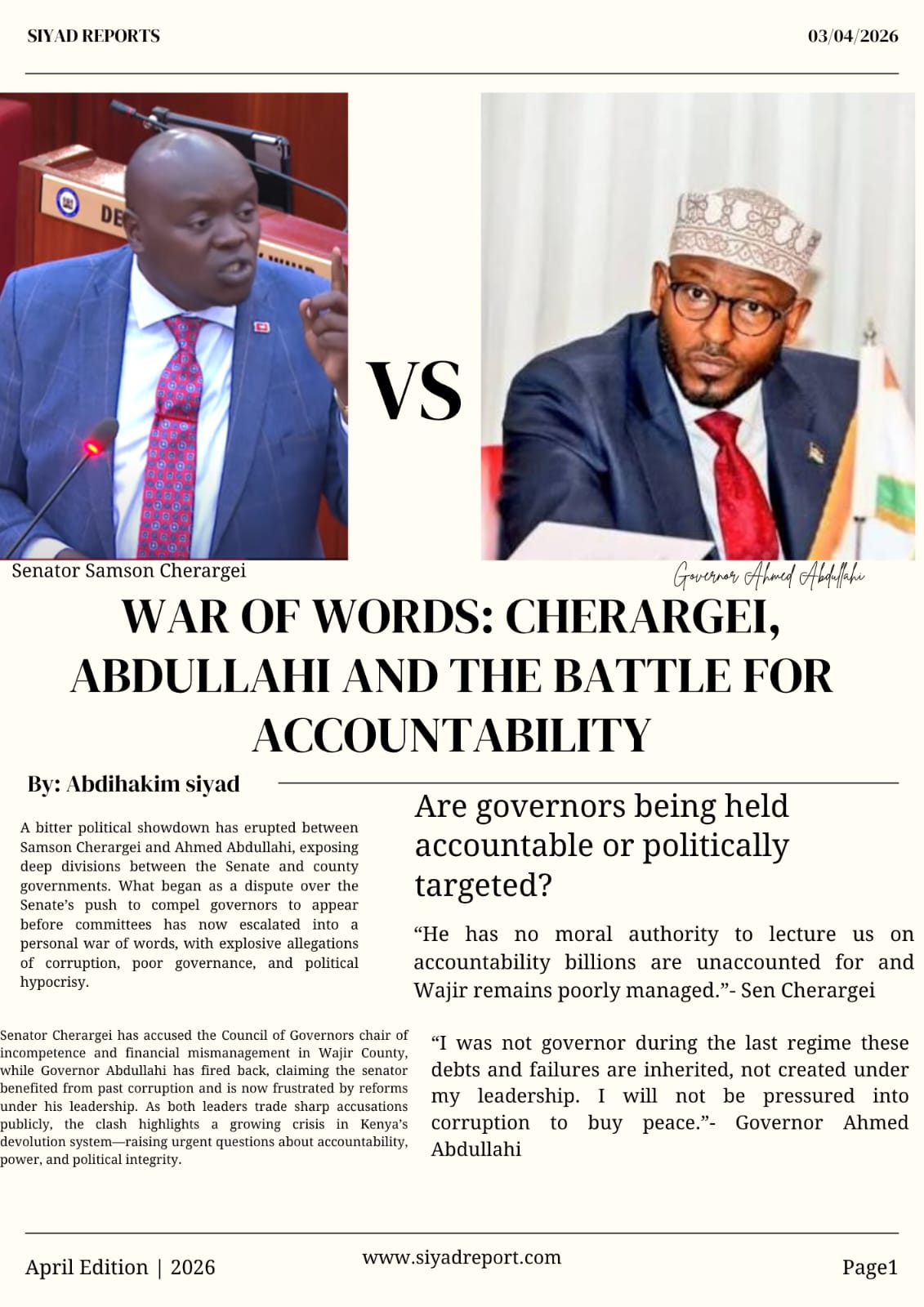
The simmering tension between Kenya’s Senate and county governments has once again erupted this time dramatically morphing from an institutional dispute into a deeply personal and politically charged confrontation between Samson Cherargei and Ahmed Abdullahi, the current Chair of the Council of Governors.
What began as a constitutional disagreement over oversight powers has spiraled into a fierce exchange of accusations, exposing deeper cracks in Kenya’s devolved governance system and raising urgent questions about accountability, political integrity, and the future of county leadership.
At the heart of the conflict lies a long-standing constitutional tension: the Senate’s mandate to oversee county governments versus the autonomy of governors as independently elected leaders. This tension escalated when senators proposed tougher enforcement mechanisms against governors who fail to appear before Senate committees suggesting that non-compliant governors could face arrest.
This proposal immediately triggered resistance from the Council of Governors, which argued that such actions would amount to an abuse of power and undermine the spirit of devolution.
Governor Abdullahi, speaking in his capacity as CoG Chair, maintained that the Senate’s role is strictly oversight not enforcement through coercion. His position reflected a broader concern among governors that the Senate has increasingly overstepped its constitutional boundaries, transforming oversight into what they perceive as intimidation. This institutional disagreement, however, did not remain confined to policy debates for long.
Senator Cherargei responded with a blistering personal attack, targeting not just Governor Abdullahi’s leadership but also his credibility and governance record in Wajir County. In a strongly worded statement, Cherargei declared:
“I am surprised that the Chair of the Council of Governors, Ahmed Abdullahi, whose town uses manual toilet collectors every evening, can lecture some of us on accountability. He must be held accountable: KSh 1.5 billion in employees’ payables cannot be accounted for, and there are almost KSh 3.5 billion in pending bills.”
This statement was not merely criticism it was a calculated political strike. By invoking issues such as sanitation and financial mismanagement, Cherargei sought to paint Abdullahi as both incompetent and morally unfit to speak on matters of governance. He further escalated the attack by pointing to alleged inefficiencies in county infrastructure and staffing:
“The Wajir County International Airport remains unutilised. There are 149 vehicles against 216 drivers. He does not have the moral authority to lecture the Senate on accountability.”
The senator’s remarks quickly ignited public debate, particularly his reference to “manual toilet collectors,” which struck a sensitive nerve around dignity, development disparities, and governance failures in marginalized regions like Wajir. By framing the issue in such stark terms, Cherargei effectively shifted the narrative from a legal dispute to a moral indictment.
But the escalation did not stop there. Cherargei went further, questioning Abdullahi’s integrity and labeling him an “absentee governor,” accusing him of failing the people of Wajir through poor development outcomes. His rhetoric took on a moral and even religious tone when he cited a verse from the Qur’an Surah Ar-Rum 30:41:
“Corruption has spread on land and sea as a result of what people’s hands have done…”
This invocation of scripture was a strategic move, appealing to moral authority and resonating with a predominantly Muslim constituency in Wajir. It underscored the seriousness of his accusations, framing them not just as political criticisms but as ethical failings.
Governor Abdullahi, however, did not remain silent. In a sharp and equally personal rebuttal, he accused Senator Cherargei of hypocrisy and opportunism.
According to Abdullahi, the senator’s sudden zeal for accountability was not driven by principle but by self-interest:
“I was not Governor for the last five years. Cherargei was a Senator. He was a beneficiary of the corruption in this county in those five years, so the taps have been closed now under my watch and that’s why he is frustrated.”
This counterattack shifted the focus back onto the senator, suggesting that Cherargei had been complicit or at least silentduring previous administrations when alleged corruption was taking place. Abdullahi’s argument was clear: the problems being cited were inherited, not created under his leadership.
He elaborated further, providing context on pending bills and financial obligations:
“All those pending bills were from the last five years. I was not governor during that time. The previous regime didn’t pay 25 months of statutory deductions pensions, NHIF, and SACCO deductions. Where was Cherargei then?”
By framing the issue as one of inherited challenges, Abdullahi attempted to reposition himself as a reformer cleaning up past messes rather than a perpetrator of mismanagement. He also made a pointed allegation that Cherargei had previously benefited from the very corruption he now condemns:
“He was looking the other way and collecting money from those guys… He probably expected that I should be doing the shenanigans of the previous regime buying my peace with him. Why would I buy my peace when I’m doing nothing wrong?”
Perhaps the most striking moment in Abdullahi’s response was his use of a popular proverb:
“Sometimes it’s not wise to fight with a pig in the mud you both get dirty, but the pig enjoys it.”
This metaphor was both dismissive and strategic. It signaled his reluctance to engage further in personal attacks while simultaneously portraying Cherargei as someone who thrives on political chaos.
As the exchange intensified, it became clear that what started as a constitutional debate had devolved into a personal feud one that risks overshadowing the substantive issues at stake. The original question whether the Senate has the authority to enforce attendance through arrests has been largely sidelined by the war of words.
Yet, this conflict is symptomatic of a deeper structural issue within Kenya’s devolved system. Since the promulgation of the Constitution of Kenya 2010, the relationship between national oversight institutions and county governments has remained fraught.
The Senate is constitutionally mandated to oversee county governments and protect the interests of counties, but the extent of its enforcement powers has often been contested.
Governors, on the other hand, argue that they are directly accountable to the electorate and that excessive interference from the Senate undermines their autonomy. The Council of Governors has consistently maintained that oversight should be exercised within constitutional limits and without coercion.
Legal experts are divided on the matter. Some argue that the Senate does have the authority to summon governors and enforce compliance, including through legal sanctions. Others contend that arresting governors would be unconstitutional unless backed by court orders, as it could violate the principle of separation of powers.
Beyond the legal arguments, the political dynamics cannot be ignored. The Senate is often seen as a platform for national political ambitions, while governors wield significant influence at the grassroots level. This creates an inherent tension, as both sides seek to assert their authority and relevance.
The Cherargei-Abdullahi clash exemplifies how quickly institutional disputes can become personalized in Kenya’s political landscape. It also highlights the role of public rhetoric in shaping political narratives. By taking their battle to social media and public platforms, both leaders have turned the issue into a spectacle one that captures public attention but risks trivializing serious governance concerns.
For residents of Wajir County, however, the stakes are far from abstract. Issues such as pending bills, salary delays, sanitation, and infrastructure are real and immediate.
The mention of manual waste collection, for instance, raises important questions about public health, dignity, and development priorities. Whether Cherargei’s claims are accurate or exaggerated, they point to challenges that require urgent attention.
Similarly, Abdullahi’s defense about inherited debts and unpaid statutory deductions sheds light on systemic issues within county administrations.
Transitioning between governments often reveals financial irregularities, and new administrations are frequently burdened with liabilities accumulated by their predecessors.
The broader question, then, is whether political infighting is helping or hindering efforts to address these challenges. While accountability is essential, it must be pursued in a manner that is constructive and grounded in facts rather than personal attacks.
This episode also raises concerns about the tone and quality of political discourse in Kenya. The use of inflammatory language, personal insults, and moral grandstanding may resonate with supporters but does little to foster meaningful dialogue. Instead, it deepens divisions and distracts from policy-focused discussions.
In the end, the Cherargei-Abdullahi feud is more than just a clash of personalities. It is a reflection of the ongoing struggle to define the boundaries of power within Kenya’s devolved system. It underscores the need for clearer legal frameworks, stronger institutions, and a commitment to accountability that goes beyond political rivalry.
As the dust settles, one thing remains clear: the relationship between the Senate and county governments will continue to be a defining feature of Kenya’s political landscape. Whether it evolves into a constructive partnership or remains a battleground for power struggles will depend on the willingness of leaders to rise above personal conflicts and focus on the greater good.
Until then, the war of words between Samson Cherargei and Ahmed Abdullahi serves as a stark reminder of the challenges and contradictions of devolution in Kenya.