

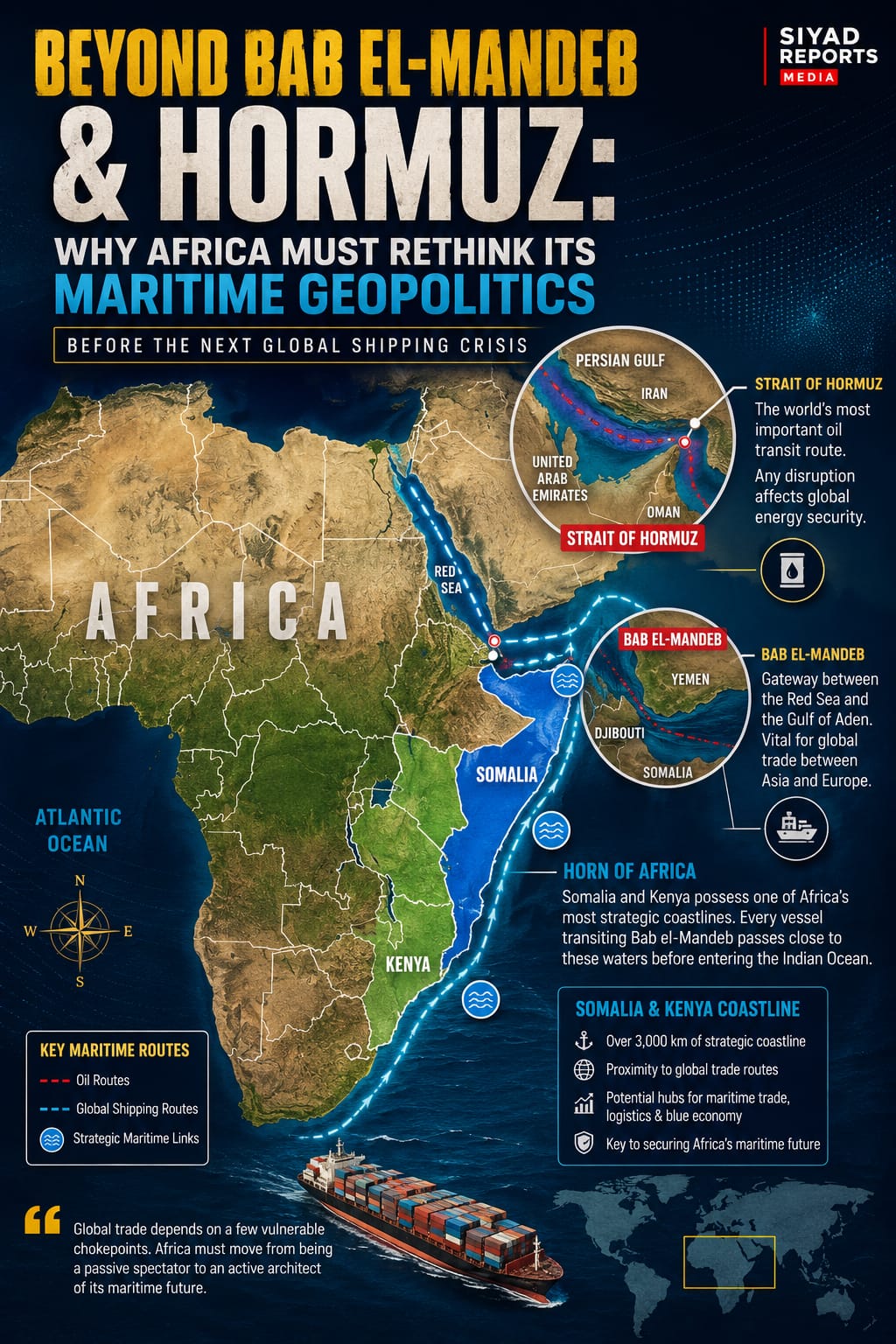
The world’s maritime arteries are once again under unprecedented pressure. From the Red Sea to the Persian Gulf, geopolitical tensions have transformed some of the world’s busiest shipping routes into strategic battlegrounds. The conflict involving the Houthis in Yemen, Saudi Arabia, Israel, the United States and Iran has gone far beyond a regional security crisis. It has evolved into a global economic challenge whose consequences are being felt from Asia to Europe and increasingly across Africa.
The Bab el-Mandeb Strait and the Strait of Hormuz are not simply narrow waterways on a map. Together, they form the backbone of global energy and commercial trade. Nearly all shipping moving between Europe and Asia through the Suez Canal depends on the security of Bab el-Mandeb, while the Strait of Hormuz remains the world’s most important oil transit route.
For decades, these maritime corridors were largely viewed as international commons protected by global naval powers. That assumption is now being tested.
Since the outbreak of the Gaza war in October 2023, Yemen’s Houthi movement has repeatedly targeted commercial vessels and military ships transiting the Red Sea, claiming solidarity with Palestinians. These attacks prompted a multinational naval response led by the United States and its allies. Air strikes against Houthi positions followed, while shipping companies increasingly diverted vessels around the Cape of Good Hope, adding weeks to delivery schedules and billions of dollars in additional costs.
At the same time, tensions between Iran and the United States have repeatedly raised fears that Tehran could restrict or even temporarily close the Strait of Hormuz should conflict escalate. Iranian officials have periodically warned that such a measure remains an option if Iran’s security or economy comes under direct threat.
Whether either chokepoint is fully closed or merely becomes too dangerous for commercial navigation, the result is similar: uncertainty, higher insurance premiums, rising freight costs, increased fuel prices and global supply chain disruptions.
For Africa, these developments carry implications that extend far beyond shipping delays.
The continent has traditionally been treated as a spectator in global maritime politics rather than as an active architect of it. Yet Africa occupies one of the world’s most strategically important geographical positions. Its eastern coastline stretches from the Suez gateway down the Red Sea, through the Gulf of Aden and into the Indian Ocean. Its western coastline connects directly to the Atlantic economy. Few continents are as geographically privileged.
Yet strategic geography alone does not create geopolitical influence.
Instead, Africa has often depended on external powers to guarantee maritime security, protect sea lanes and manage naval crises occurring along its own coastline. The Red Sea today illustrates this imbalance clearly. American, European, Chinese, Turkish and Gulf naval forces all maintain significant military footprints around the region, while African states possess comparatively limited naval capabilities.
This imbalance raises an uncomfortable question.
If the world’s most important maritime corridors remain vulnerable to conflict, should Africa continue relying primarily on outside powers to safeguard its economic future, or is the moment finally arriving for African states to formulate an independent maritime strategy?
Africa’s Maritime Future May Begin in the Horn
Among all African coastal regions, few are positioned as strategically as the Horn of Africa.
Somalia occupies one of the longest coastlines on the African continent, stretching more than 3,000 kilometres along both the Gulf of Aden and the Indian Ocean. Every vessel entering or leaving Bab el-Mandeb passes close to Somali waters before continuing toward the wider Indian Ocean.
This geography cannot be ignored.
For decades, Somalia’s coastline has been viewed largely through the lens of piracy, instability and humanitarian crises. Yet its strategic value extends far beyond those narratives. It represents one of Africa’s most significant maritime assets in an era when global trade increasingly depends on secure alternative routes, modern ports and resilient logistics.
Kenya also occupies a critical position further south. The Port of Mombasa serves as East Africa’s principal maritime gateway, linking Uganda, Rwanda, South Sudan, eastern Democratic Republic of Congo and parts of northern Tanzania to international markets. The development of the Lamu Port under the LAPSSET Corridor similarly reflects efforts to diversify regional maritime infrastructure and improve access to global trade.
Together, Somalia and Kenya possess coastlines that could become central pillars of East Africa’s maritime future.
However, geography alone is not enough.
Ports require investment. Coast guards require modern equipment. Navies require training. Maritime surveillance demands advanced technology. Shipping requires legal certainty, efficient customs systems and political stability. Without these foundations, strategic location remains only unrealised potential.
The possibility of prolonged instability around Bab el-Mandeb should therefore not simply be viewed as a security crisis. It should also serve as a wake-up call for African policymakers.
Rather than waiting for another global emergency, Africa could strengthen regional maritime cooperation through institutions such as the African Union, the Intergovernmental Authority on Development (IGAD) and the East African Community. Joint naval patrols, coordinated intelligence sharing, harmonised maritime regulations and investment in blue economy industries could transform the continent from a passive observer into a significant maritime actor.
The broader question extends beyond Somalia and Kenya.
Africa possesses more than 38 coastal states and vast exclusive economic zones rich in fisheries, offshore energy resources and emerging maritime industries. Yet much of this potential remains underdeveloped. Global powers recognise Africa’s maritime value, often competing for military access, commercial ports and logistical influence. African governments themselves must demonstrate equal strategic vision.
The ongoing tensions surrounding Bab el-Mandeb and the Strait of Hormuz illustrate a larger lesson in international relations: global trade increasingly depends on a small number of vulnerable chokepoints. Diversification is becoming not merely an economic objective but a geopolitical necessity.
For East Africa, this presents both risks and opportunities.
Should instability persist in the Red Sea, shipping patterns may gradually evolve. New logistics hubs, expanded port infrastructure and stronger regional supply chains could emerge across the western Indian Ocean. Countries capable of providing stability, reliable infrastructure and predictable investment environments will be best positioned to benefit.
Yet optimism must remain grounded in reality.
Somalia continues to confront political, security and institutional challenges. Kenya faces infrastructure financing pressures and increasing regional competition. Neither country alone can reshape global maritime trade. Success depends upon regional coordination rather than national ambition alone.
The future therefore belongs not to isolated ports but to integrated maritime systems linking ports, railways, highways, customs procedures and digital trade networks across East Africa.
Ultimately, the current maritime tensions should encourage Africa to think beyond immediate crises. Instead of reacting only when conflict threatens international shipping, African leaders should ask a more fundamental question: what role should Africa play in shaping the future of global maritime governance?
The answer lies not merely in protecting sea lanes but in building maritime economies, strengthening regional institutions, investing in naval capacity, promoting port competitiveness and treating the blue economy as a pillar of long-term development.
The Horn of Africa, particularly Somalia and Kenya, offers an opportunity to anchor that vision. Their geography places them at the crossroads of continents, trade routes and geopolitical interests. Whether that advantage becomes transformative depends not on geography itself but on strategic leadership.
The world is entering an era in which maritime security will increasingly define economic resilience. The Bab el-Mandeb Strait and the Strait of Hormuz have reminded the international community how fragile global trade can become when conflict reaches the sea.
For Africa, the lesson is clear. The continent cannot afford to remain merely the coastline through which global commerce passes. It must become an active maritime power, capable of protecting its interests, shaping regional security and leveraging its strategic geography for shared prosperity.
If the present crisis teaches Africa anything, it is this: the future of the continent will not be determined only on land. It will increasingly be decided at sea.