

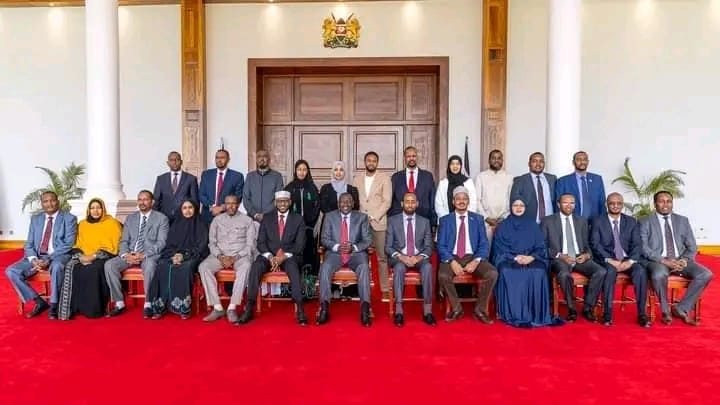
For years, leaders and residents of Northern Kenya have spoken of marginalisation, exclusion and the long struggle for equal access to government services. Among the most sensitive issues was the vetting process for national identity cards, a system that many communities in Garissa, Wajir, Mandera, Marsabit and Isiolo argued unfairly delayed or denied thousands of eligible citizens the right to obtain identification documents.
When President William Ruto’s administration abolished the practice, the move was widely celebrated across the region as a historic step towards inclusion and citizenship equality. Yet, during a high-level meeting at State House on July 13, it became clear that the government now expects a political and civic return from that decision.
What was publicly presented as a development consultation meeting on the transformation of Northern Kenya turned into a candid and direct conversation about identity cards, voter registration and electoral participation. Governors, senators, Members of Parliament, women representatives and other leaders from Northern Kenya reportedly found themselves facing difficult questions from the President: Why are eligible citizens still not applying for national identity cards? Why are thousands of processed IDs lying uncollected in registration offices? Why does voter registration remain low in some counties? And why does voter turnout in parts of Northern Kenya continue to trail national averages despite government investments and policy reforms?
At the centre of the discussion was a political reality that is becoming increasingly important as Kenya slowly moves towards the 2027 General Election: numbers matter. In Kenya’s electoral system, political influence is often measured not only by geography or leadership positions, but by voter registration figures, turnout percentages and the ability of leaders to mobilise communities. The President’s message to Northern Kenya leaders appears to have been straightforward: the government has addressed long-standing grievances and expanded development initiatives in the region, but greater civic participation must follow.
The reported three-month ultimatum issued to leaders from Garissa, Wajir, Mandera, Marsabit and Isiolo reflects more than an administrative exercise. It reveals a deeper political calculation that is shaping the country’s future electoral landscape. For decades, Northern Kenya has remained one of Kenya’s most strategically important yet politically underutilised regions. The area covers a vast geographical space, possesses significant economic potential and holds a sizeable population, but voter registration and turnout have often lagged behind other regions due to historical exclusion, logistical challenges, mobility patterns and limited access to government services.
The abolition of ID vetting changed an important part of that equation. National identity cards are more than documents; they are gateways to citizenship, education, employment, financial services, healthcare, social protection programmes and political participation. Without an ID, one cannot register as a voter, open certain bank accounts, access some government programmes or fully participate in public life. In many ways, the President’s insistence on increasing ID uptake can be viewed both as a governance agenda and as a political strategy.
This dual purpose explains why county governments moved swiftly after the State House meeting. Leaders in Wajir, Garissa and other counties convened discussions with administrators, chiefs, assistant chiefs, religious leaders and community elders to develop practical solutions. Wajir Governor Ahmed Abdullahi’s proposal to take ID registration services directly to secondary schools reflects an understanding that access remains a major challenge. If students can receive identity cards before leaving school, an entire generation could enter adulthood already equipped to participate in economic, social and political life.
The discussions also highlighted another challenge that rarely receives public attention: thousands of identity cards that have already been processed remain uncollected. The reasons vary, including distance to registration offices, lack of information, migration patterns and limited awareness. Addressing these issues may require not only government directives but sustained community engagement, public education campaigns and closer cooperation between local leaders and citizens.
Yet beyond administration and service delivery lies an unavoidable political question. What exactly does this renewed focus on IDs and voter registration mean for the politics of Northern Kenya?
The answer lies in the changing nature of Kenyan politics. Elections are increasingly won through broad coalitions and expanding support bases beyond traditional strongholds. Northern Kenya, with its growing population and strategic voting bloc, is becoming increasingly significant in national political calculations. By pushing for higher registration and participation, the government is not merely strengthening democratic processes; it is also recognising the region’s electoral importance.
This places Northern leaders in a unique position. They are now expected to act not only as representatives advocating for development but also as mobilisers ensuring that citizens participate fully in the democratic process. The President’s challenge effectively shifted responsibility onto local leadership, asking them to convert policy reforms into measurable outcomes through increased civic engagement.
For residents of Northern Kenya, however, the debate may extend beyond politics. Many may ask whether obtaining an ID should primarily be viewed as a pathway to voting or as a fundamental right tied to equal citizenship. Others may argue that civic participation must be accompanied by continued investment in education, health, infrastructure, water projects and economic opportunities. The two, however, are not mutually exclusive. Stronger participation often translates into greater political visibility, and greater visibility can influence national priorities.
The State House meeting therefore represented more than a discussion about statistics and registration figures. It reflected the evolving relationship between Northern Kenya and the national government, moving from a historical narrative centred on exclusion to one increasingly focused on inclusion, representation and participation. The message from the President was clear: barriers have been reduced, opportunities have been expanded and the expectation now is that communities will take full advantage of those changes.
Whether the three-month push produces significant results remains to be seen. What is certain is that the issue of identity cards and voter registration has moved from being an administrative concern to becoming a central political conversation. The road to 2027 has already begun, and Northern Kenya finds itself at the heart of an important national debate: how development, citizenship and political participation intersect in shaping the future of the region and the country.
As the countdown to the next election continues, one question from the State House meeting is likely to echo across towns, villages and political gatherings throughout Northern Kenya: if the barriers have been removed and the opportunities created, will the region translate that moment into greater civic participation and stronger political influence? The answer may not only determine electoral outcomes in 2027, but also define the next chapter of Northern Kenya’s place in Kenya’s national story.