

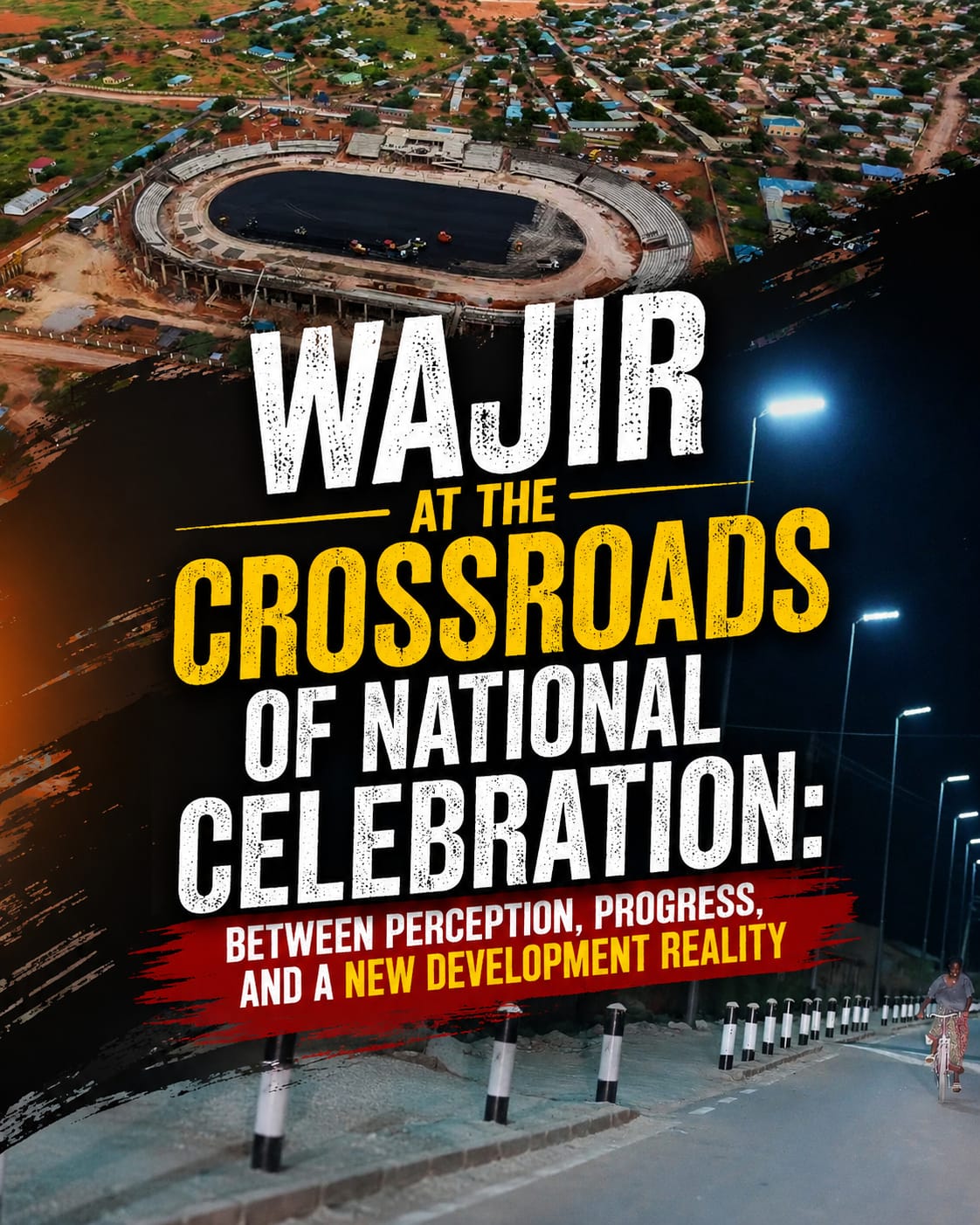
When discussions emerged around Wajir County potentially hosting Madaraka Day celebrations, the conversation quickly moved beyond symbolism and national inclusion into a much sharper public debate about readiness, capacity, and development.
On one side, there was enthusiasm a recognition that hosting a national day in the North Eastern frontier would represent a historic shift in how Kenya imagines its own geography of inclusion. On the other side, there was skepticism arguments that Wajir lacks sufficient hotel infrastructure, adequate accommodation facilities, and the urban systems necessary to host an event of such national scale.
At first glance, these concerns appear grounded in practical realities. National celebrations require logistics, hospitality capacity, transport networks, security coordination, and urban services that can accommodate guests from across the country and beyond. Wajir, like many frontier counties, has historically been associated with limited urban infrastructure compared to Kenya’s major cities.
This perception is not entirely unfounded; for decades, development in the region has lagged behind national averages due to historical inequalities, geographic challenges, and long-term underinvestment in hospitality and urban commercial expansion.
However, what this debate reveals is far more important than the question of hotels or physical readiness. It exposes a deeper tension in Kenya’s development narrative the gap between historical perception and current transformation. Wajir is not the same county it was ten or even five years ago. Yet public perception often lags behind physical change, especially in regions that have long been defined by marginality rather than visibility.
To understand this moment properly, it is necessary to move beyond surface-level criticism and examine the broader evolution of Wajir’s development trajectory. The county’s current state is the result of a long historical process that stretches back to independence, when infrastructure investment in northern Kenya was minimal and uneven.
For decades, Wajir remained on the periphery of national development planning, with limited roads, sparse public infrastructure, and an economy largely shaped by pastoralism and cross-border trade dynamics rather than formal urban growth.
During those early decades, the idea of hosting a national celebration in Wajir would have seemed almost unimaginable. Not because the county lacked importance, but because it lacked the infrastructural foundation that such events demand.
Kenya’s development model at the time concentrated major investments in central and high-potential agricultural regions, leaving arid and semi-arid counties structurally behind.
Over time, successive administrations introduced gradual changes. The expansion of administrative presence, security infrastructure, and limited road networks under earlier governments began to slowly integrate Wajir into the national framework. However, these efforts were incremental rather than transformative. The county remained connected to the state administratively, but not fully integrated economically or infrastructurally.
A significant shift occurred with the advent of devolution following the 2010 Constitution. For the first time, Wajir gained a locally elected government with direct control over development priorities and budget allocation. This marked the beginning of a new development era one defined not by absence, but by gradual construction of governance systems and infrastructure foundations.
County leadership began focusing on roads, health facilities, water access, and urban development, setting the groundwork for future growth.
Yet even within the devolution era, development was not uniform. Early phases focused heavily on establishing systems rather than achieving visible transformation. The perception of underdevelopment persisted, even as foundational progress was being made beneath the surface. This disconnect between reality and perception is central to understanding today’s debate around hosting national events.
Wajir is experiencing a more visible phase of development acceleration. Infrastructure projects have expanded in scale and visibility, including the ongoing improvement of road networks, the expansion of Wajir Airport, and the construction of major public facilities such as the 10,000-seat stadium. These developments are not merely symbolic; they represent a shift toward urbanization, connectivity, and long-term planning for economic activity.
At the national level, President William Ruto’s development agenda has further reinforced this momentum, particularly through a bottom-up economic model that emphasizes infrastructure expansion and inclusion of historically marginalized regions.
Within this framework, counties like Wajir are no longer viewed solely through the lens of distance or difficulty, but as potential nodes of economic growth and regional integration, especially given their proximity to Somalia and Ethiopia and their role in cross-border trade dynamics.
It is within this evolving context that the conversation around Madaraka Day hosting must be understood. The argument that Wajir lacks sufficient hotels or accommodation infrastructure reflects an older snapshot of the county one that does not fully account for ongoing urban development, emerging hospitality investments, and expanding public infrastructure.
While it is true that Wajir does not yet have the hotel density of Kenya’s major cities, development is not static. Urban capacity grows in response to demand, investment, and policy direction.
More importantly, hosting a national celebration is not only about existing capacity; it is also about national intent. It is about recognizing regions that have historically been excluded from the symbolic geography of national events.
When a state chooses to hold a major national celebration in a frontier county, it is making a statement that goes beyond logistics it is signaling inclusion, recognition, and confidence in that region’s trajectory of development.
Criticism around infrastructure readiness, therefore, should not be dismissed, but it must also be contextualized. It is precisely because infrastructure is still developing that such opportunities matter. Large-scale national events often act as catalysts for accelerated investment in hospitality, transport, communication, and urban services. In many cases globally, cities and regions have used such moments as turning points in their development trajectory.
Wajir today stands at a similar intersection. The visible development underway roads, airport expansion, public facilities is gradually reshaping its urban profile. The hosting of Madaraka Day would not only test existing capacity but also highlight areas requiring further investment, potentially accelerating future growth. In that sense, the debate itself becomes part of the development process.
What is also important to recognize is the shift in narrative. For decades, Wajir has been discussed primarily in terms of what it lacks. Infrastructure gaps, distance from major economic centers, and climatic challenges have dominated external perceptions. However, the current phase of development introduces a different narrative one that emphasizes potential, connectivity, and strategic importance.
This shift does not erase existing challenges, but it repositions them within a framework of ongoing transformation rather than permanent limitation.
The question, therefore, is not simply whether Wajir is fully ready to host a national celebration today. The deeper question is what it means for a country like Kenya to begin rotating its national moments into regions that are still actively developing. It is a question about inclusion, national identity, and the geography of opportunity.
In this sense, Wajir becomes more than a county under evaluation. It becomes a case study in how nations evolve how they expand the boundaries of visibility, how they redefine the meaning of readiness, and how they balance historical infrastructure inequalities with contemporary political and developmental ambitions.
The debate around accommodation and infrastructure is valid, but it should not obscure the larger reality: Wajir is not a static space waiting to be developed; it is a dynamic region already undergoing visible transformation. Roads are being expanded, connectivity is improving, and urban infrastructure is gradually taking shape. The presence of gaps does not negate progress; it simply reflects a development journey that is still unfolding.
Ultimately, whether or not Wajir hosts Madaraka Day, the significance of the conversation remains the same. It signals that the county is no longer on the margins of national imagination. It is now part of a broader discussion about where Kenya chooses to place its most symbolic national moments, and what that choice says about the direction of the country itself.
Wajir’s story, in this context, is not just about infrastructure or accommodation. It is about recognition, transition, and the slow but visible redefinition of a frontier that is steadily becoming part of Kenya’s evolving development map.