

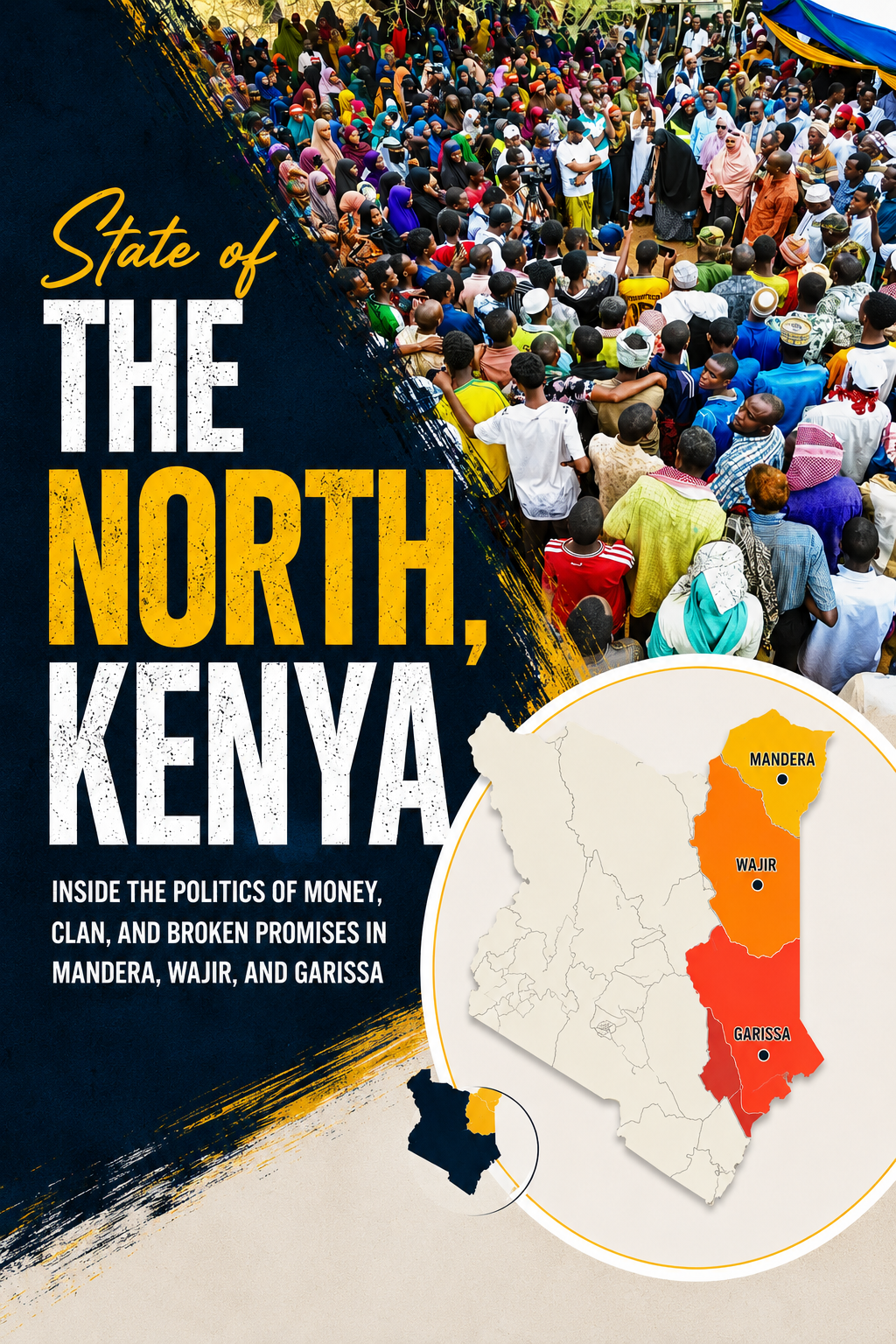
There are moments in the political life of a region when everything feels like it is happening all at once when the air is thick with anticipation, rumors move faster than facts, and every roadside gathering, every tea shop conversation, and every evening elders’ meeting feels like part of a larger unfolding drama.
Northern Kenya is in one of those moments again.From Mandera to Wajir to Garissa, the political temperature is rising. The roads that connect these counties are busier than usual.
Convoys of vehicles carrying aspirants, brokers, elders, financiers, and political strategists move from one settlement to another, often under the cover of “consultations.”
In reality, these are not just visits they are negotiations for power, influence, and survival in a political system that has learned to function through informal agreements more than formal ideology.
At the center of it all is a system that has become deeply familiar yet increasingly contested: clan-based negotiated democracy.
A system born out of necessity in moments of state fragility and insecurity, but one that today sits at the heart of both political stability and political stagnation in equal measure.
In theory, it was meant to ensure inclusion, peace, and representation in a region where the state was once distant and institutions weak.
In practice, it has evolved into something more complex sometimes a stabilizer, sometimes a gatekeeper, and often a filter through which leadership is not selected by ideas, but by lineage, loyalty, and financial strength.
The modern political season in the North is no longer just about campaigns. It is a carefully choreographed economy of influence.
Aspirants arrive in villages not only with manifestos but with resources cash envelopes, promises of future contracts, sponsorships for ceremonies, and contributions to community projects that are often more symbolic than sustainable.
Political ambition has become inseparable from financial capacity, and in many cases, financial display has replaced policy debate altogether.In tea stalls and manyatta gatherings, conversations rarely begin with governance anymore. Instead, they begin with calculations.
Who has the strongest backing? Which clan is aligning with which coalition? Who has the deepest pocket? And perhaps most importantly, who is “being supported from outside”?
Politics, in this sense, has become a form of public accounting except the currency is not transparency or accountability, but perception and influence.The irony is difficult to ignore.
The total legitimate remuneration a Member of Parliament earns over a full term is a fraction of what is often spent during the campaign season alone. Yet the race for office grows more expensive every cycle.
Campaigns are no longer simply contests of ideas they are investments, and like all investments, they come with expectations of returns.
Those returns are not always financial in the narrow sense, but they often revolve around access: to development funds, procurement influence, appointment power, and strategic networks that extend far beyond the constituency office.In this environment, development becomes both the promise and the bargaining chip.
Roads, boreholes, electricity connections, and youth programs are no longer just public goods they are part of a political currency used to negotiate loyalty. A borehole is not just water; it is influence. A development visit is not just service delivery; it is political branding.
Even basic administrative changes, such as the appointment of local officials, can turn into grand public spectacles, complete with ceremonies that sometimes cost more than the very services they are meant to enhance.
This is where the contradiction deepens.On one hand, communities in Mandera, Wajir, and Garissa continue to face very real challenges: insecurity along borders, drought cycles that devastate livelihoods, underdeveloped road networks, limited electricity access in vast rural areas, and persistent gaps in education and healthcare.
These are not abstract policy issues they are daily realities. Yet on the other hand, the political conversation that could address these issues is often overshadowed by short-term calculations and ceremonial politics.Elders, who once played a stabilizing role in mediating conflicts and guiding communal decisions, now find themselves operating in a more transactional political environment.
Their endorsement is not just symbolic; it is often decisive. But even this authority is increasingly shaped by competition, where influence is measured not only by wisdom or legitimacy, but by the ability to mobilize blocs of support.
And so, the political season unfolds like a familiar script, repeated with minor variations every election cycle. Aspirants arrive, consultations are held, alliances are formed and broken, and resources flow in multiple directions.
Feasts are organized, speeches are delivered, promises are made. Camel meat is shared generously, tea is poured endlessly, and miraa sessions stretch long into the night as negotiations continue in coded language.
Beneath the hospitality, however, lies a more strategic process: mapping numbers, securing loyalty, and calculating advantage.Yet amid all this activity, a fundamental question often remains absent from the center of the discussion: what kind of leadership is actually being selected?
Rarely is the conversation anchored on competence, governance experience, or long-term vision. Instead, it is shaped by identity and capacity who belongs to whom, and who can afford what. The result is a political culture where financial strength can outweigh administrative skill, and where communal alignment can matter more than policy substance.
Over time, this has created a paradox. Communities frequently express frustration about poor service delivery, insecurity, and lack of development. Yet the very systems used to select leadership often reproduce the same outcomes.
It becomes a cycle: dissatisfaction with governance, followed by political choices driven by the same criteria that contributed to that dissatisfaction.Still, it would be too simplistic to dismiss clan-based negotiated democracy as merely a problem.
In its original context, it emerged as a pragmatic solution in a region where formal electoral systems were weak and security was fragile.
It provided structure in uncertainty, and representation in fragmentation. It prevented total exclusion and reduced the likelihood of conflict in highly competitive political environments.But systems do not remain static.
They evolve. And what once served as a stabilizer can, over time, become a constraint if not reformed or balanced with stronger institutions.The challenge today is not whether clan structures exist they do, and they will continue to exist as social realities.
The real challenge is whether they can coexist with a more merit-based political culture that prioritizes accountability, development outcomes, and leadership competence.Because at the heart of it, the aspirations of the people in northern Kenya are not complicated. They are deeply universal. Better roads.
Safer communities. Quality education for children. Reliable water access. Economic opportunities that do not depend solely on political cycles. These are not radical demands; they are basic expectations of governance.
And yet, every election season, those expectations are filtered through layers of negotiation that often prioritize short-term political settlements over long-term structural solutions.
Perhaps the most difficult question is not why the system is the way it is, but why it has been so difficult to change. Part of the answer lies in the entanglement between politics and survival.
In environments where resources are scarce and opportunities limited, political alignment is not just about ideology it is about access. Access to development, access to protection, access to opportunity.
This makes the political arena not just competitive, but existential.Still, change is not impossible. It begins with slowly shifting the questions that communities ask of their leaders.
Moving from “who is supporting this candidate?” to “what has this candidate achieved?” From “which clan is this?” to “what vision does this leader hold for the next decade?” From “how much is being spent now?” to “what will remain after the election?”
These shifts are not immediate, and they are not easy.
But they are necessary if the cycle is to break.Because ultimately, leadership is not meant to be a performance of wealth or a negotiation of identity. It is meant to be a responsibility of transformation.
And until that understanding becomes the foundation of political choice in Mandera, Wajir, and Garissa, the region will continue to experience the same political seasons familiar in appearance, but unchanged in outcome.
The future of the North will not be determined by how much is spent in campaign seasons, or how many alliances are formed in backroom meetings.
It will be determined by whether the people begin to demand more than promises, and whether leadership begins to mean more than victory.Only then will the story begin to change.