

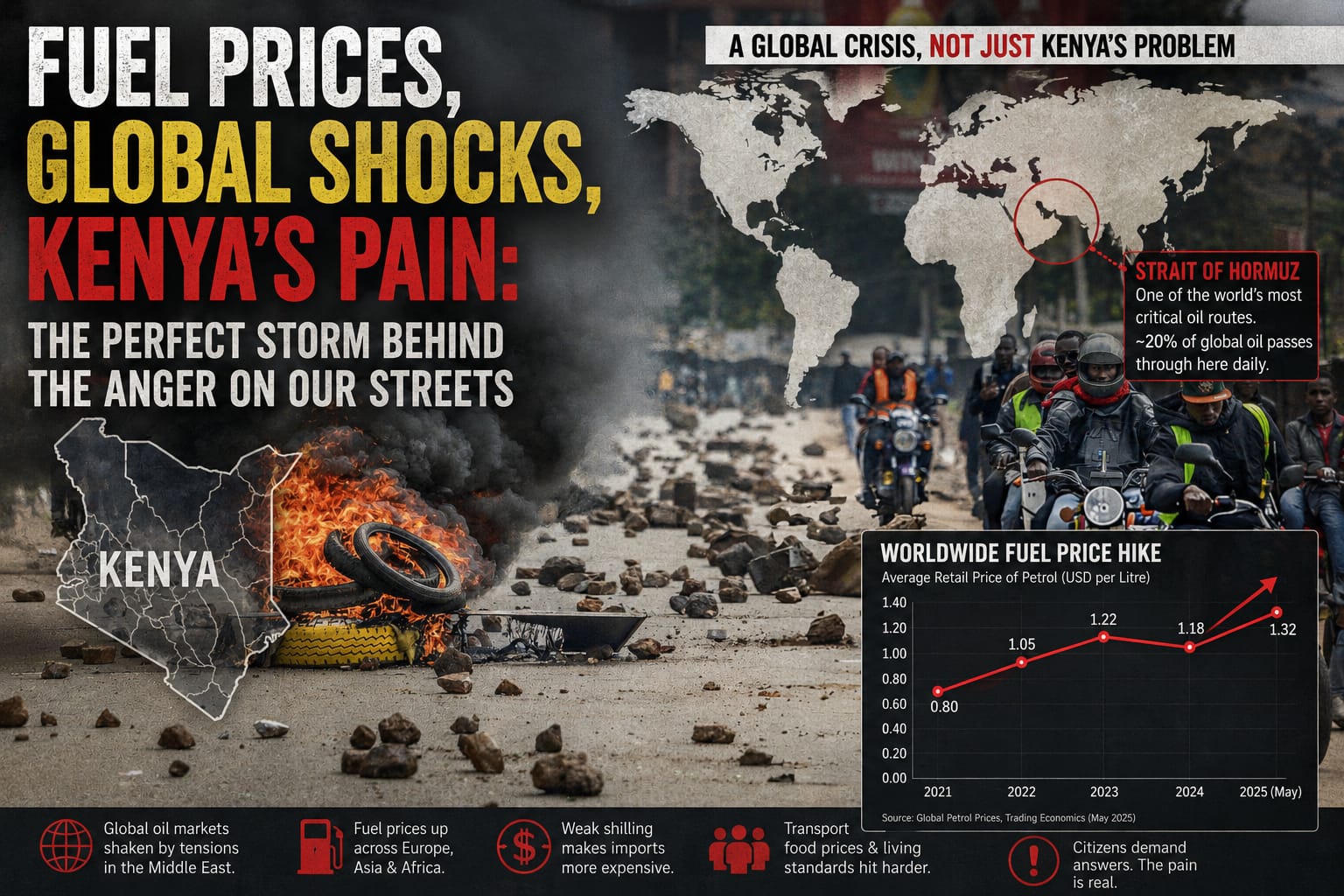
Kenya is once again witnessing a familiar cycle: rising fuel prices, public anger, transport disruptions, political blame games, and growing frustration among ordinary citizens struggling to survive an already difficult economy. The demonstrations witnessed across parts of the country this week were not simply protests over petrol and diesel. They were protests against pressure, exhaustion, and the feeling among many Kenyans that life is becoming unaffordable.
Matatu operators have openly accused the state of piling more taxes onto citizens while doing little to ease the burden of the rising cost of living. Commuters are angry over increased fares. Small businesses are struggling with transport and delivery costs. Across markets and estates, the discussion is the same: fuel prices are no longer just an economic issue they have become a national social crisis.
At the center of the debate is one major question: is Kenya’s fuel crisis purely a local problem, or is the country being hit by a much larger global storm?
The answer is uncomfortable for everyone because it reveals that the crisis is bigger than politics alone. Around the world, fuel prices have been rising due to growing instability in the global energy market. The ongoing tensions involving Iran have shaken oil markets internationally, creating fear over possible disruptions in global supply routes. Iran remains one of the most strategically important countries in global energy politics because of its position near the Strait of Hormuz, a narrow waterway through which a large percentage of the world’s oil passes every day.
Whenever conflict escalates in that region, international oil markets react immediately. Investors panic. Shipping costs increase. Insurance for oil tankers rises. Oil-producing countries begin adjusting supply forecasts. The result is a chain reaction that affects countries thousands of kilometers away, including Kenya.
But while global events matter, many Kenyans feel the explanation of “international markets” is repeatedly used every time prices rise while citizens continue carrying the burden. To many wananchi, the issue is no longer just about the Middle East or international oil prices. The issue is about survival inside Kenya itself.
The frustration is understandable because fuel affects nearly every part of daily life. Once petrol and diesel prices rise, everything else follows. Matatu fares go up almost immediately. Food transport becomes more expensive. Construction materials cost more. Businesses increase prices to recover operating costs. Farmers spend more moving produce from rural areas to towns. Electricity production costs can also rise depending on the energy source. Within weeks, the entire economy begins passing the pressure directly to consumers.
For many low-income families, even a small increase in transport fares becomes devastating. A worker who relies on public transport daily may suddenly find that a significant portion of their salary is being consumed by commuting alone. Small traders and boda boda riders face shrinking profits. Parents struggle to balance school fees, rent, food and transport at the same time. The anger now visible on the streets is the result of months, even years, of accumulated economic strain.
The matatu sector in particular has become one of the loudest voices in this crisis because it sits directly between rising fuel costs and public frustration. Operators are under pressure from both sides. Fuel prices increase their operating expenses, but passengers themselves are already financially strained and resist higher fares. The result is tension across the entire transport sector.
Yet despite the public outrage, Kenya is not the only country facing this challenge. Across Europe, parts of Asia and Africa, governments are dealing with inflation linked to rising energy prices. Airlines have warned of higher travel costs due to expensive aviation fuel. Farmers in several countries have protested the increasing cost of diesel and fertilizer. Some countries have experienced panic buying whenever Middle East tensions intensify. In global markets, oil prices remain highly sensitive to every new military escalation or diplomatic breakdown involving Iran.
Still, comparisons with other countries have only fueled more debate inside Kenya. Many citizens ask why fuel remains painfully expensive despite Kenya not being directly involved in any war. Others question whether local taxation, levies and inefficiencies are making the crisis worse than it should be. Critics argue that while global oil prices may explain part of the increase, domestic policy decisions also contribute heavily to the pain felt by consumers.
This is where the national conversation becomes politically charged. Some leaders focus entirely on blaming global events. Others focus entirely on blaming government policies. But the reality is more complicated than either side often admits publicly.
The global energy market is genuinely unstable. The Iran conflict has created serious uncertainty around oil supply routes, and countries dependent on imported fuel are especially vulnerable. Kenya imports most of its petroleum products, meaning it cannot fully escape international price shocks. The value of the Kenyan shilling against the US dollar also plays a major role because oil imports are purchased in dollars. When the shilling weakens, import costs become even higher.
At the same time, many Kenyans feel exhausted by continuous taxation and rising living costs regardless of international explanations. Citizens are asking a simple question: if global prices rise, why does the burden always appear to fall directly on ordinary people rather than being absorbed elsewhere in the system?
That growing distrust explains why fuel protests quickly become emotional and political. Fuel is not viewed in isolation. It is connected to unemployment, inflation, taxation, corruption allegations, and declining public confidence in economic management. For many young Kenyans already struggling to find stable income, every fuel increase feels like another signal that survival is becoming harder.
The danger now is that the economic pressure could deepen social tensions further if solutions are not found. Prolonged fuel instability can weaken businesses, slow economic growth and increase poverty levels. Transport strikes disrupt movement and affect productivity. Investors become cautious. Consumers reduce spending. The entire economy begins operating under stress.
There is also fear about what may happen if the Middle East crisis worsens further. If tensions involving Iran continue escalating, oil prices could remain high for months or even longer. Any direct disruption in global oil shipping routes would immediately affect fuel-importing countries like Kenya. That possibility is already creating anxiety across global markets.
But perhaps the biggest issue emerging from this crisis is not simply the cost of fuel itself. It is the widening gap between economic reality and public trust. Many citizens no longer believe official explanations because they feel trapped in a cycle where every month brings a new increase somewhere fuel, electricity, food, transport or taxes. Whether the causes are global or local, the pain remains personal.
And that is why the demonstrations seen this week carry a deeper meaning. They are not just about petrol stations or transport fares. They are about the pressure ordinary people are carrying every day. They are about citizens questioning whether the economic burden is being shared fairly. They are about fear over the future in a country where many already feel financially cornered.
As Kenya continues navigating this difficult moment, one reality is becoming increasingly clear, global wars and international economic shocks are no longer distant stories watched on television. They now arrive directly at the fuel pump, the matatu stage, the market stall and the family dining table.
The crisis unfolding today is therefore not just Kenya’s problem alone, nor is it entirely someone else’s fault abroad. It is a collision between global instability and local hardship and ordinary citizens are standing at the center of that collision, carrying its heaviest weight.