

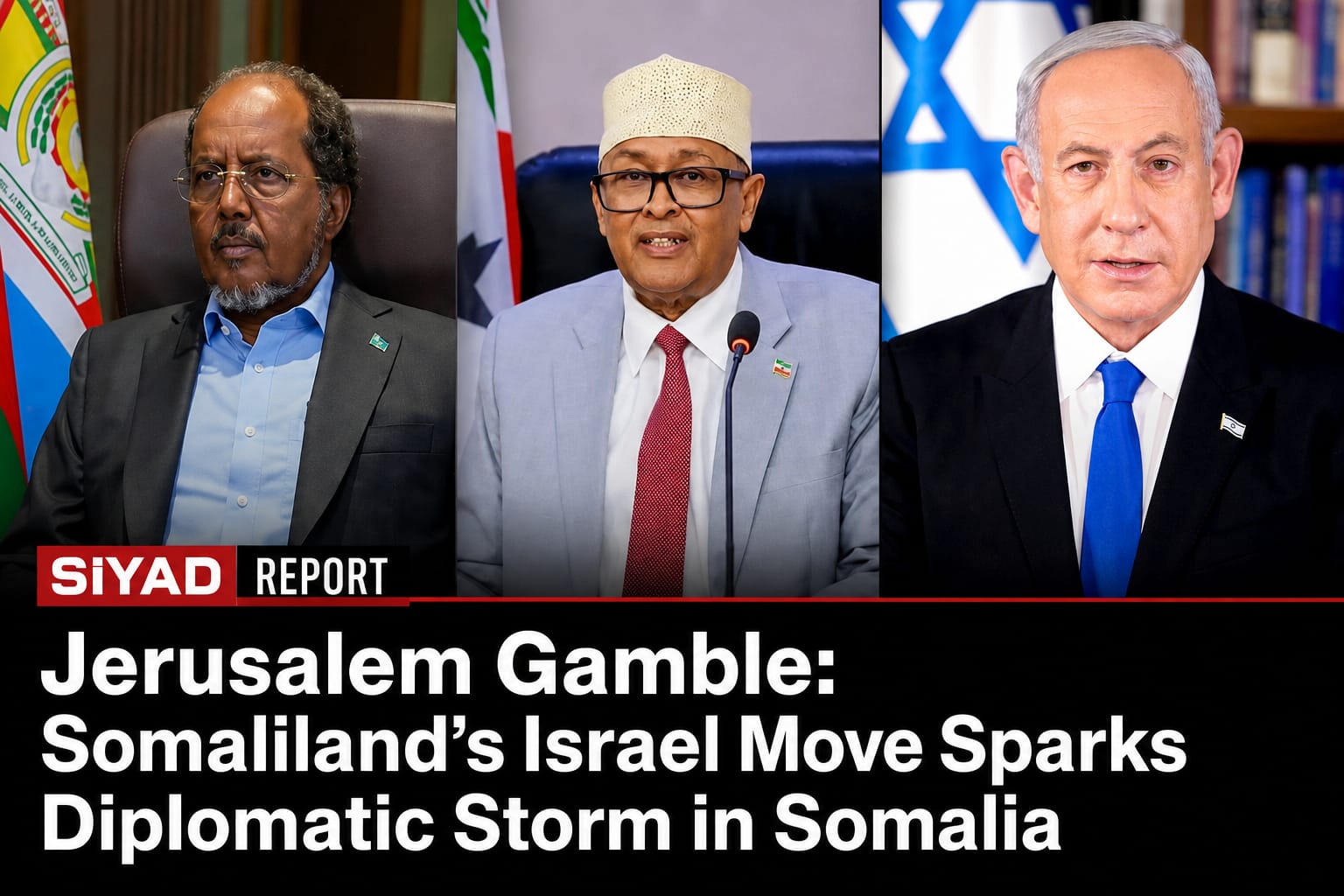
The Somali federal government has sharply condemned reports that Somaliland intends to open what it described as a “so-called embassy” in Jerusalem, calling the move illegal, provocative, and politically dangerous in an already fragile Horn of Africa.
In a strongly worded statement issued by the Ministry of Foreign Affairs and International Cooperation of Somalia, Mogadishu declared the initiative “null and void,” insisting that Somaliland has no legal authority to conduct independent foreign policy or establish diplomatic missions abroad.
The statement reaffirmed Somalia’s commitment to “the unity, sovereignty and territorial integrity of the Federal Republic of Somalia,” while warning that any unilateral diplomatic engagement by Somaliland undermines internationally recognized Somali sovereignty.
“The Federal Government of Somalia categorically rejects any unilateral actions or measures that undermine the legal and political status of the Somali state,” the statement read. It further described the reported Jerusalem move as “an unacceptable provocation to the Arab and Islamic worlds.”
The controversy has once again exposed the deepening political fault lines between Somaliland and Somalia, while also placing Israel at the center of an increasingly sensitive geopolitical contest in the Horn of Africa.
For Somaliland, the move appears to be another attempt to gain international legitimacy after more than three decades of self-declared independence. For Somalia, however, it represents a direct challenge to national sovereignty and a dangerous diplomatic escalation that could complicate relations with Arab allies, regional powers, and the wider Muslim world.
Since declaring independence in 1991 following the collapse of the Somali state, Somaliland has operated with its own government, currency, security forces, and political institutions. Yet despite maintaining relative stability compared to southern Somalia, it remains internationally unrecognized.
That lack of recognition has long shaped Somaliland’s foreign policy strategy. Hargeisa has spent years building informal ties with countries seeking strategic influence in the Red Sea and Horn of Africa corridor. Relations with Ethiopia, the United Arab Emirates, Taiwan, and increasingly Israel have become part of Somaliland’s broader search for diplomatic relevance.
The Israel connection, however, is especially sensitive.
While there have been intermittent reports over the years of quiet contacts between Somaliland officials and Israeli representatives, no formal diplomatic breakthrough has ever materialized publicly. Somaliland leaders have occasionally signaled openness to stronger ties with Israel, arguing that pragmatic diplomacy should outweigh ideological considerations.
Somalia has consistently rejected such engagements.
Mogadishu remains firmly aligned with the broader Arab and Islamic consensus supporting Palestinian statehood and opposing Israeli control over Jerusalem. Somalia does not recognize Jerusalem as Israel’s capital and has historically supported Palestinian positions in international forums.
The symbolism of Jerusalem therefore matters immensely.
Any attempt by Somaliland to establish a diplomatic presence there touches not only Somalia’s internal political dispute but also one of the most emotionally charged issues in global Muslim politics.
Analysts say the timing is equally significant.
The Horn of Africa is currently witnessing intense geopolitical competition involving Gulf states, Turkey, Egypt, Ethiopia, the United States, China, and Israel. Strategic access to Red Sea trade routes and military positioning has transformed the region into a major arena of international rivalry.
Somaliland’s leadership likely understands that diplomatic visibility even controversial visibility keeps its recognition campaign alive internationally.
But the risks are considerable.
A New Diplomatic Front in the Horn of Africa
The dispute could further harden Somalia’s position against Somaliland at a moment when tensions between Mogadishu and Hargeisa are already high over sovereignty, security, and regional alliances.
In recent years, Somalia has increasingly accused Somaliland of pursuing independent foreign agreements that violate national unity. The most dramatic example emerged earlier this year when Somaliland signed a controversial memorandum of understanding with Ethiopia granting potential sea access in exchange for possible recognition discussions.
That agreement triggered a major diplomatic crisis across the Horn, with Somalia accusing Ethiopia of violating its territorial integrity.
Now, the Jerusalem issue risks opening another diplomatic front.
If Israel were perceived as entertaining official Somaliland representation in Jerusalem, Somalia could intensify diplomatic pressure through Arab League and Organization of Islamic Cooperation channels. Mogadishu may also seek stronger regional backing to isolate Somaliland diplomatically.
For Somalia’s federal government, the matter is about more than symbolism. Officials fear that allowing Somaliland to independently build diplomatic relations abroad gradually normalizes the idea of Somaliland as a separate state.
That normalization process is precisely what Hargeisa has pursued for decades.
Some regional analysts believe Somaliland calculates that closer engagement with Israel could attract Western attention, security partnerships, technological cooperation, and lobbying influence in Washington. Israel itself has strategic interests in the Red Sea corridor, where maritime security and regional alliances have become increasingly important.
However, the political cost for Israel could also be significant.
Formal engagement with Somaliland would likely anger Somalia and potentially strain relations with several Muslim-majority African nations. It may also complicate Israel’s broader regional diplomacy at a time when Middle East alignments remain highly volatile following the Gaza war and shifting Arab-Israeli relations.
Within Somalia, the issue could fuel nationalist sentiment and increase pressure on the federal government to respond aggressively. Politicians and religious leaders are likely to frame the Jerusalem move not only as a sovereignty issue but also as a religious and ideological provocation.
Public reaction across Somali society could therefore become highly emotional.
At the same time, Somaliland supporters argue that Hargeisa has the right to pursue international partnerships independently because it has functioned separately from Mogadishu for more than thirty years. They often point to Somaliland’s relative stability, electoral processes, and security record as evidence that it deserves recognition.
Still, recognition remains elusive.
No country has officially recognized Somaliland as an independent state despite years of lobbying. International actors continue to formally support Somalia’s territorial integrity, even while engaging Somaliland pragmatically on security, trade, and development.
That contradiction has created an ambiguous diplomatic environment where Somaliland enjoys unofficial relations abroad but lacks legal international standing.
The Jerusalem controversy may intensify that ambiguity rather than resolve it.
For Somalia, the immediate priority will likely be damage control — reassuring Arab allies, reaffirming support for Palestine, and preventing any perception that Somaliland’s actions represent Somali foreign policy.
For Somaliland, the challenge will be balancing its pursuit of international visibility against the risk of diplomatic isolation in the Muslim world.
What happens next may depend largely on Israel’s response.
If the reports remain symbolic or unofficial, the crisis could gradually cool. But if concrete diplomatic steps emerge, tensions between Mogadishu and Hargeisa may deepen significantly, with wider implications for regional geopolitics.
The Horn of Africa is already navigating fragile alliances, contested sovereignty disputes, and growing foreign influence. The Jerusalem issue has now added religion, symbolism, and Middle Eastern geopolitics into an already combustible equation.
For Somalia, the message from Mogadishu is clear: Somaliland’s diplomatic ambitions abroad will not be accepted quietly.
For Somaliland, the calculation appears equally clear: international visibility even through controversy may be preferable to diplomatic invisibility.
And in the middle of that contest lies Jerusalem, a city whose political symbolism continues to ignite tensions far beyond the Middle East itself.