

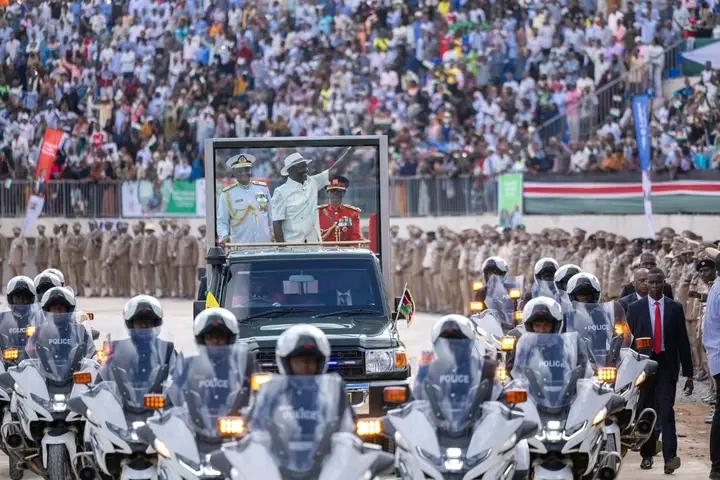
For decades, discussions about Northern Kenya have often focused on drought, insecurity and underdevelopment. During his Madaraka Day address in Wajir, President William Ruto sought to present a different narrative one that places the region at the centre of Kenya’s future economic growth.
Addressing thousands of residents at Wajir Stadium, the President argued that Northern Kenya should no longer be viewed through the lens of hardship but through its immense economic potential.
“For too long, Northern Kenya was viewed through the lens of scarcity. Today, we recognise its immense potential in renewable energy, livestock production, irrigated agriculture, trade, logistics and regional commerce,” he said.
The statement formed a key pillar of his speech, which focused heavily on inclusion, development and investment in historically marginalised regions.
According to President Ruto, the transformation of Northern Kenya is not simply a regional agenda but a national economic strategy. He argued that the region’s strategic location bordering Ethiopia and Somalia gives it a unique advantage in trade and regional integration.
“Its strategic location at the crossroads of Kenya, Ethiopia and Somalia places it at the heart of regional connectivity and economic opportunity.”
The President described Northern Kenya as a gateway connecting Kenya to regional and global markets, particularly through major infrastructure projects currently underway.
Among the flagship projects highlighted was the Northern Kenya Gateway Corridor, a road network linking Isiolo, Wajir and Mandera.
“With the KSh100 billion, 750-kilometre Northern Kenya Gateway Corridor linking Isiolo, Wajir and Mandera, we are undertaking the most significant road investment in this region since independence.”
For residents who have long endured poor road connectivity, the project represents more than improved transport.
The President described it as a tool for economic inclusion.
“Yes, this is more than a road project. It is a bridge between exclusion and opportunity, between neglect and investment, and between the Kenya that was and the Kenya we are building.”
Road infrastructure has long been one of the major barriers to development in Northern Kenya. Poor connectivity increases the cost of doing business, limits access to markets and slows the delivery of public services.
Government officials believe improved roads will reduce transport costs, encourage trade and attract new investments into the region.
The President also highlighted major investments under the Affordable Housing Programme.
According to Ruto, the government has invested KSh15.6 billion in the construction of 4,600 housing units in Wajir County alone.
“Today, in Wajir County, through our Affordable Housing Programme, we have invested KSh15.6 billion in the development of 4,600 housing units.”
He described the housing projects as both a social and economic intervention.
Beyond providing homes, the developments are expected to create employment opportunities for local youth and stimulate economic activity for businesses involved in construction and related sectors.
One of the projects, located a few kilometres from Wajir Stadium, was highlighted as an example of the government’s commitment to ensuring that modern development reaches regions that were historically left behind.
The President further revealed that projects worth approximately KSh38.5 billion are currently being implemented across Wajir, Garissa and Mandera counties.
These include affordable housing projects, student accommodation facilities, markets, police housing, classrooms and other supporting infrastructure.
The investments, he said, are intended to improve livelihoods while accelerating economic growth in the region.
A New Economic Vision for Northern Kenya
Beyond infrastructure, President Ruto outlined a broader economic vision that seeks to position Northern Kenya as a major contributor to Kenya’s future prosperity.
Central to that vision is the belief that development should not be concentrated in traditional economic centres while other regions remain behind.
“No county is too remote to deserve development. No child is too far away to deserve an opportunity.”
The President argued that Northern Kenya’s future lies in unlocking sectors where the region already possesses natural advantages.
Renewable energy, livestock production, trade and logistics were identified as key drivers of future growth.
He also pointed to ongoing investments in digital infrastructure, ICT centres and Jitume Digital Hubs designed to equip young people with skills required in the modern economy.
“We are investing in Jitume Digital Hubs, ICT centres, digital skills programmes and digital infrastructure so that a young person in Wajir can compete with any young person in Kenya and the world.”
For a region with one of the youngest populations in the country, such investments are viewed as critical in creating employment opportunities and expanding access to the digital economy.
The President’s speech repeatedly returned to the theme of inclusion.
He argued that economic transformation cannot be achieved if entire regions remain disconnected from national development.
Instead, he said, every part of the country must be integrated into Kenya’s growth story.
“The future of Kenya’s growth lies in unlocking the full potential of every part of our Republic.”
The significance of hosting Madaraka Day in Wajir was therefore not limited to symbolism.
For the government, it served as a platform to showcase a vision of Northern Kenya not as a region seeking assistance, but as a region capable of driving national economic growth.
Whether through roads connecting remote communities, housing projects creating jobs, digital infrastructure empowering youth or regional trade opportunities linking Kenya to neighbouring countries, the message from Wajir was clear.
Northern Kenya is no longer being presented as the country’s periphery.
Instead, President Ruto’s administration is positioning it as one of the key frontiers of Kenya’s future development.
As the celebrations concluded, the challenge ahead remained implementation. The success of the vision outlined in Wajir will ultimately be measured not by speeches or promises but by completed projects, new opportunities and improved livelihoods.
Yet for many residents, Madaraka Day 2026 represented a significant shift in national discourse a moment when Northern Kenya was spoken of not in terms of what it lacks, but in terms of what it can become.