

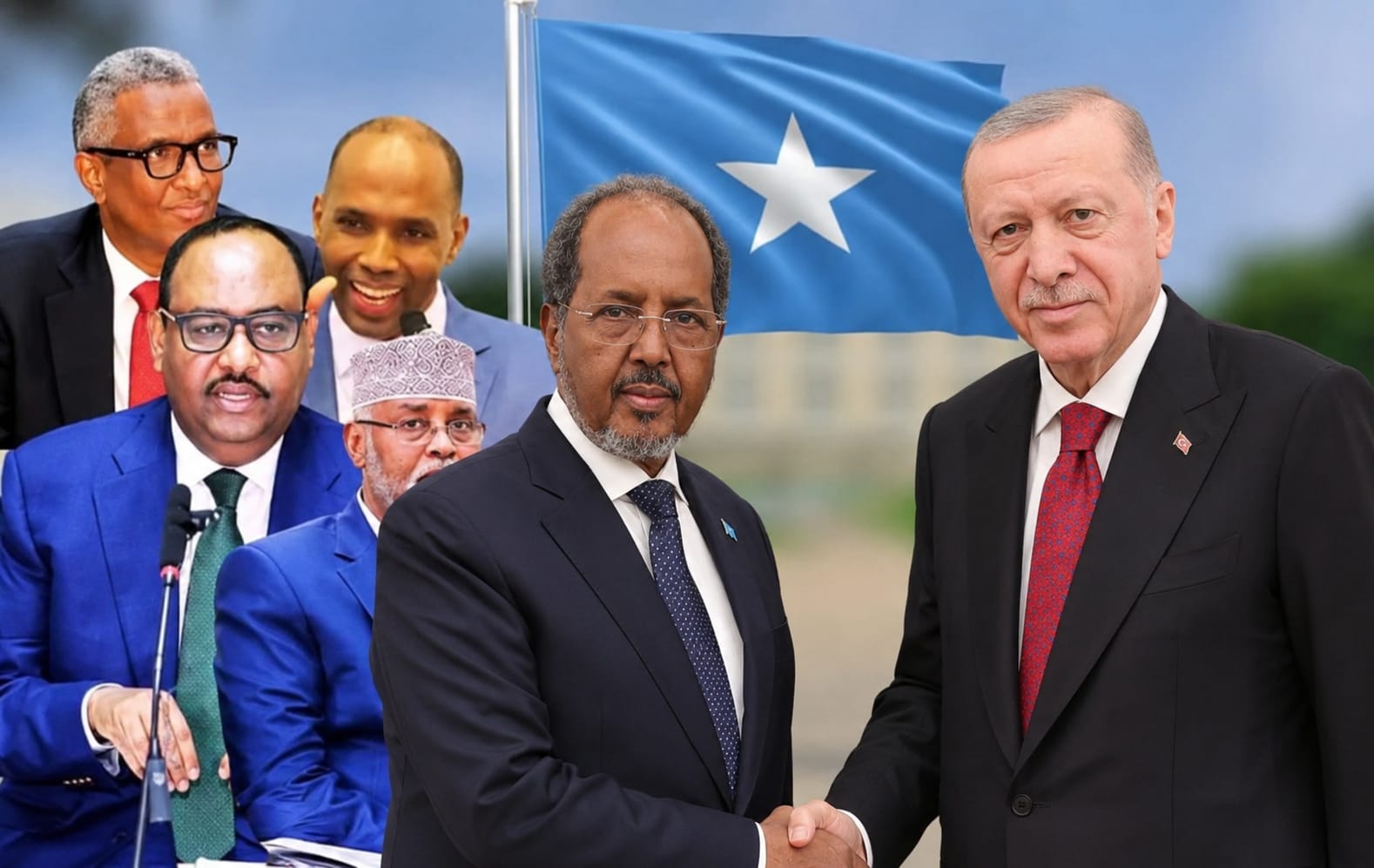
The armed confrontation that shook Mogadishu for more than 48 hours in this week was not merely another security incident in Somalia’s long and turbulent political history. It was a moment that exposed the fragile relationship between political competition and state power, revealed the growing role of foreign actors in Somali affairs, and highlighted how regional geopolitics are increasingly shaping events inside the country.
What began as a political standoff between the Federal Government of Somalia and opposition leaders led by former President Sharif Sheikh Ahmed and former Prime Minister Hassan Ali Khaire quickly evolved into one of the most serious political-security crises witnessed in the capital since the 2021 electoral dispute. By the time the gunfire stopped, thousands of civilians had fled their homes, international actors had intervened diplomatically, Turkish intelligence officials had entered mediation efforts, and Somalia once again found itself confronting questions about the future of its political system.
The crisis unfolded against a backdrop of growing disagreements over constitutional amendments, election arrangements, and accusations from opposition figures that President Hassan Sheikh Mohamud’s administration was pursuing a political path without sufficient national consensus.
According to political sources and accounts from opposition figures, plans had been developed to relocate from their primary residences and position themselves in different parts of Mogadishu. The objective was to increase political pressure on the government and demonstrate opposition strength closer to the heart of state power.
However, events did not unfold as expected.
Instead of creating momentum, the strategy triggered a direct confrontation with government security forces. Fighting erupted in several districts of Mogadishu, including Howlwadaag, Abdiasis, Hodan, Wardhiigley and surrounding areas. Heavy gunfire echoed across residential neighborhoods as residents rushed to seek safety.
The Federal Government maintained that armed groups linked to opposition politicians had entered the capital carrying heavy weapons and had attacked security forces and civilians. Opposition leaders rejected that narrative and accused the government of launching military operations against their residences and political gatherings.
Former Prime Minister Hassan Ali Khaire described the operation as an attempt to target senior political figures, while former President Sharif Sheikh Ahmed accused government forces of surrounding and attacking his residence.
As competing narratives emerged, ordinary civilians became the primary victims.
According to a Protection of Civilians report issued by the Protection Cluster and UNHCR Somalia on June 4, approximately 12,500 households were displaced as a result of the violence. The report recorded at least 13 fatalities and 189 injuries while warning that women, children, older persons, refugees, asylum seekers and persons with disabilities faced heightened risks.
The report described a multidimensional protection crisis in which civilians were trapped in conflict zones, displaced from their homes and exposed to increased risks of family separation, exploitation, gender-based violence and severe psychological distress. Humanitarian agencies also expressed concern about restrictions on movement and access to essential services.
The findings underscored an uncomfortable reality: regardless of which political narrative ultimately prevails, the immediate consequences were borne by civilians.
As fighting intensified, mediation efforts began simultaneously.
Traditional elders, senior political figures, security officials and international actors quietly worked behind the scenes to prevent the confrontation from escalating further. Meetings took place across Mogadishu as negotiators sought a formula that would allow both sides to step back without appearing to surrender politically.
The first major breakthrough came when Hassan Ali Khaire agreed to leave his position and return to his residence following discussions involving senior security officials. Shortly afterward, former President Sharif Sheikh Ahmed also departed the Mirinaayo area of Abdiasis District after prolonged negotiations.
By Friday, Mogadishu had become noticeably calmer.
The government subsequently announced that security forces had completed their operation and restored order in the capital. Authorities declared that investigations would continue against individuals accused of participating in armed activities.
Yet although the immediate security confrontation subsided, the political crisis itself remained unresolved.
The Turkish Factor
Perhaps the most significant development emerging from the crisis was the increasingly visible role of Turkey.
For years, Turkey has been one of Somalia’s closest international partners. Turkish involvement spans military training, security cooperation, infrastructure projects, humanitarian assistance, trade, diplomacy, education and state-building programs. The largest Turkish military training facility abroad is located in Mogadishu, symbolizing Ankara’s deep commitment to Somalia.
During the crisis, reports emerged that senior Turkish intelligence officials met opposition leaders, including Sharif Sheikh Ahmed and Hassan Ali Khaire.
According to political sources familiar with the discussions, opposition leaders raised concerns regarding the alleged use of Turkish-supplied military equipment during operations around their residences. Claims included allegations involving armored vehicles and drones supplied through Somalia-Turkey security cooperation agreements.
Whether those allegations are ultimately substantiated or not, their political significance is undeniable.
The fact that opposition leaders chose to raise these concerns directly with Turkish officials demonstrates that Ankara is no longer viewed merely as an external partner. Instead, Turkey has become a central political stakeholder whose influence extends into Somalia’s internal political dynamics.
Turkey’s involvement during the mediation process was equally important.
Rather than remaining on the sidelines, Ankara engaged with multiple actors in an apparent effort to prevent further escalation. This reflects a broader pattern observed in Turkish foreign policy over the last decade.
In Libya, Turkey intervened militarily and diplomatically to support the internationally recognized government during its conflict with forces led by Khalifa Haftar. Turkish drones, advisers and diplomatic backing played a major role in preventing the collapse of Ankara’s allies.
In Azerbaijan, Turkey provided extensive military, technological and political support during the Nagorno-Karabakh conflict, helping strengthen Azerbaijan’s position both militarily and diplomatically.
In both cases, Turkey first invested heavily in strategic partnerships and later became deeply involved in managing political outcomes affecting those partnerships.
A similar pattern appears increasingly visible in Somalia.
Turkey has invested billions of dollars politically, economically and strategically over more than a decade. Turkish companies have participated in major infrastructure projects. Turkish military trainers have helped build Somali security institutions. Turkish humanitarian organizations have maintained a significant presence throughout the country.
More recently, offshore energy cooperation and petroleum agreements have further increased Somalia’s strategic importance for Ankara.
From a geopolitical perspective, Turkey’s calculations are rooted in continuity.
Governments come and go, but strategic interests endure. Ankara’s primary concern is protecting long-term investments, security partnerships and regional influence in the Horn of Africa. President Hassan Sheikh Mohamud’s administration currently serves as the political framework through which many of those interests are managed.
This helps explain why Turkish engagement has intensified during periods of political instability.
It is not necessarily about supporting one individual alone. Rather, it is about ensuring that political upheaval does not threaten years of investment and strategic positioning.
The relationship between President Recep Tayyip Erdoğan and President Hassan Sheikh Mohamud further reinforces this dynamic. The two leaders have maintained close cooperation across multiple sectors, including defense, infrastructure, trade and energy. Their governments have signed several agreements that significantly expanded Turkish involvement in Somalia.
Consequently, instability affecting Hassan Sheikh Mohamud’s administration naturally raises concerns in Ankara about the future of those agreements and projects.
At the same time, Turkish officials also recognize that Somalia’s long-term stability requires political dialogue. This likely explains why Turkish intelligence representatives reportedly met opposition leaders despite Ankara’s close partnership with the federal government.
Turkey’s objective appears to be preserving stability while maintaining influence across the political spectrum.
Meanwhile, the United States has also entered the discussion more actively. American officials have called for dialogue and reportedly emphasized the importance of reaching an agreed electoral framework within the coming months. Washington’s position reflects growing international concern that unresolved disputes over elections and constitutional changes could trigger renewed instability.
The broader geopolitical picture is becoming increasingly complex.
Somalia’s domestic political disagreements are now intersecting with the interests of major regional and international actors. Turkish influence continues to expand. Gulf powers remain active across the Horn of Africa. Western governments are closely monitoring developments. Regional organizations are urging restraint and compromise.
For Somalia, the lesson from the June 2026 crisis is clear.
Military superiority may determine the outcome of a confrontation, but it cannot resolve underlying political disputes. The government successfully maintained control of key institutions and prevented opposition forces from achieving their immediate objectives. However, the grievances that fueled the confrontation remain unresolved.
Likewise, opposition leaders discovered that political prominence alone is insufficient to challenge a government that retains control of state security structures and enjoys strong international partnerships.
The immediate crisis may have ended, but the larger struggle over Somalia’s political future continues.
And increasingly, Turkey stands at the center of that story not only as Somalia’s closest security partner, but as one of the most influential external actors shaping the country’s political trajectory.
The events of June 2026 may therefore be remembered not simply as a confrontation between the government and the opposition, but as the moment when the depth of Turkish influence in Somali politics became fully visible to the world.