

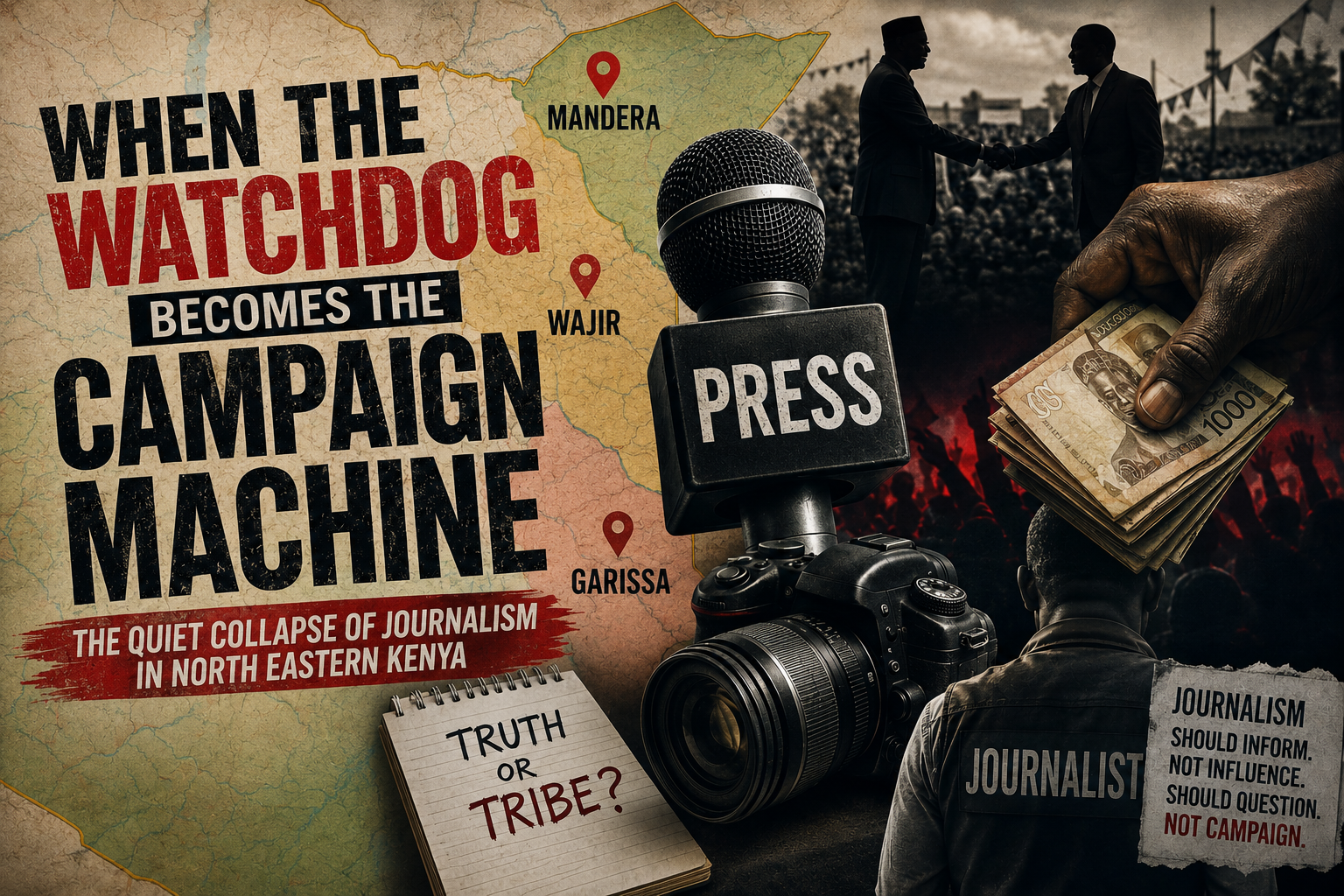
As Wajir, Garissa and Mandera slide deeper into the heat of negotiated democracy, a disturbing question is confronting the region’s media fraternity: who is watching the politicians when the people assigned to watch them are increasingly accused of becoming part of the political machinery?
There is a dangerous silence developing behind the microphones, cameras and social-media pages of North Eastern Kenya. It is a silence that does not come from the absence of news, but from the possibility that the people entrusted with reporting the news are increasingly becoming participants in the very political battles they are supposed to cover. Across Wajir, Mandera and Garissa, where political temperatures traditionally rise dramatically as elections approach, another contest is taking place away from the public rallies and political meetings. It is a contest over the soul of journalism itself.
The region is entering another politically charged period in which negotiated democracy, clan calculations, political alliances, incumbency and the search for elective positions are once again occupying the centre of public conversation. Aspirants are positioning themselves. Incumbents are defending their records. Political camps are being assembled. Supporters are mobilising. Communities are debating who should lead them next. And somewhere in the middle of all this are journalists, reporters, presenters, photographers, videographers, bloggers and online commentators who have been given an extraordinary responsibility: to tell the public what is happening.
But what happens when the journalist stops standing outside the political arena and starts standing inside it?
That is the uncomfortable question that North Eastern Kenya can no longer afford to avoid.
Journalism is supposed to be a public trust. A journalist is not elected to represent a clan, hired to protect an aspirant, appointed to defend an incumbent or deployed to attack a political opponent. The journalist’s responsibility is to the public, to facts, to verification, to fairness and to the truth. The microphone is supposed to belong to the people, not to whoever has the deepest pockets, the strongest political machinery or the most powerful clan network.
Yet concerns about political alignment among some journalists in the region are becoming increasingly difficult to ignore. During campaign periods, the distinction between journalism, political public relations, personal activism and political blogging can become dangerously blurred. A person holding a microphone may look like a journalist, speak like a journalist and appear on a media platform, but the question remains: are they actually performing journalism, or are they campaigning?
That distinction matters.
It matters because North Eastern Kenya has historically struggled with many of the very problems that responsible journalism is supposed to expose. Questions surrounding development, public resources, healthcare, education, unemployment, drought, insecurity, infrastructure, corruption allegations, representation and accountability require journalists who are courageous enough to ask difficult questions regardless of who is involved.
The region does not need journalists who simply report that a politician arrived at a rally, addressed supporters and promised development.
It needs journalists who ask what happened to the promises made five years ago.
It needs journalists who ask how public money was spent.
It needs journalists who examine whether development projects were completed.
It needs journalists who question both government and opposition.
It needs journalists who can interview an ally today and challenge that same ally tomorrow.
Instead, critics argue that political journalism in parts of the region is increasingly becoming transactional, with political communication sometimes taking precedence over independent reporting. The accusation is not that every journalist is compromised. Far from it. There are professional journalists working under difficult circumstances who continue to report with integrity, often without adequate resources, security or institutional support. But the existence of good journalists should not prevent the industry from confronting the weaknesses that threaten its credibility.
One of the most troubling issues is the growing confusion between journalism and political public relations.
WHEN JOURNALISTS BECOME POLITICAL PLAYERS
A politician needs publicity. A journalist is supposed to provide scrutiny. Those two functions can coexist in a democratic society, but they cannot be confused without damaging the public interest.
When a journalist begins identifying personally with an aspirant because they belong to the same clan, sub-clan, community or political network, professional distance can quickly disappear. A political statement may be reported as fact. A campaign promise may be presented without interrogation. An opponent may be subjected to aggressive questioning while the preferred candidate receives soft treatment. A political attack may be amplified while inconvenient information about one’s preferred candidate is quietly ignored.
At that point, the journalist is no longer simply covering the election.
They are influencing it.
And that is where the danger begins.
The issue becomes even more complicated when some individuals operating as journalists have little or no formal journalism training or have not gone through the professional structures expected within the media industry. Citizen journalism and digital media have democratised information, allowing ordinary people to document events and bring stories to the public. That is a positive development. But accessibility should not be confused with professional accountability.
Anyone can hold a phone.
Anyone can create a Facebook page.
Anyone can establish a TikTok account.
Anyone can livestream a political rally.
But not everyone who does so automatically becomes a journalist.
Journalism is more than holding a microphone in front of a politician. It requires verification, context, balance, accuracy, ethical judgement and an understanding of the consequences of publishing information. It requires knowing the difference between an allegation and a fact, between a campaign claim and an established truth, between commentary and reporting, and between public interest and political propaganda.
When those distinctions disappear, the public is left exposed.
And perhaps the most painful irony is that even trained journalists can become vulnerable to the same political pressures they were trained to resist.
A journalist can graduate from journalism school, obtain professional experience, understand media ethics and still lose independence once political relationships, financial incentives, clan loyalties or personal ambitions enter the equation. Professional qualification provides knowledge; integrity determines how that knowledge is used.
This is why the debate cannot simply be reduced to trained journalists versus untrained journalists.
The deeper question is whether the individual behind the microphone still understands who they work for.
If the answer is a political candidate, then that person may be performing political communication.
If the answer is the public, then journalism has a fighting chance.
North Eastern Kenya’s political environment makes this conversation particularly urgent because politics in the region is rarely just about individual candidates. It can involve clan negotiations, collective interests, historical grievances, political alliances and perceptions of community representation. In such an environment, a journalist who openly identifies with one political side can unintentionally transform a newsroom, radio programme or digital platform into another battlefield.
The consequences extend far beyond one election.
When citizens stop trusting journalists, they begin questioning everything the media publishes. When every story is suspected of having been sponsored, every interview is viewed through a political lens and every journalist is assumed to belong to someone’s camp, the credibility of the entire profession suffers.
And once credibility is lost, accountability becomes much harder.
A politician who knows that the media will ask difficult questions has a reason to prepare answers. A politician who knows that journalists will simply reproduce campaign messages has little reason to fear scrutiny.
That is why journalism matters most during elections.
The media should not become an extension of the campaign.
It should become the place where campaigns are interrogated.
A candidate should not merely be given airtime to tell voters what they want to hear. They should be asked what they did when they previously held office, what they failed to accomplish, how they intend to finance their promises and why voters should trust them again. An incumbent should not be protected because of personal relationships with journalists. They should face questions about their record. An aspirant should not be attacked simply because they belong to a rival political camp. They should be judged on facts.
The same standard must apply to everyone.
There is also a growing responsibility for media houses operating in the region. If a platform broadcasts political content, it must be clear whether the material is news, commentary, advertising, sponsored political communication or campaign programming. The public deserves to know the difference.
A political advertisement should not masquerade as independent journalism.
A campaign speech should not be packaged as investigative reporting.
A personal political opinion should not be presented as an established fact.
And a journalist should never allow clan identity to become a substitute for professional ethics.
The media cannot complain about bad leadership while helping create the environment in which bad leadership flourishes.
If journalists repeatedly amplify politicians without scrutiny, they contribute to political personality cults. If they silence legitimate criticism because it comes from an opposing camp, they weaken democratic debate. If they attack political opponents more aggressively than they question the politicians they support, they become part of the problem they should be exposing.
This is not a call for journalists to become enemies of politicians.
It is a call for journalists to stop becoming their friends at the expense of the public.
There is nothing wrong with a journalist knowing a politician personally. There is nothing inherently wrong with coming from the same community as a politician. There is nothing wrong with covering an aspirant’s campaign. The problem begins when personal relationships, community loyalties or political interests determine what gets reported, how it gets reported and what gets deliberately left out.
North Eastern Kenya deserves better.
Wajir deserves journalists who can challenge the governor and still interview him the next morning.
Garissa deserves journalists who can question an incumbent and still report their achievements fairly.
Mandera deserves journalists who can investigate political claims without fear of losing access.
The region deserves media professionals who understand that their greatest loyalty is not to a clan, candidate, political party, employer or personal friendship, but to the public.
And perhaps the most uncomfortable truth is that the political class is not entirely responsible for the deterioration of political discourse if the media willingly provides the machinery through which political narratives are manufactured and amplified.
Politicians will always seek publicity.
Candidates will always want favourable coverage.
Political camps will always attempt to influence the narrative.
That is politics.
The journalist’s job is to resist becoming the instrument.
The coming election period should therefore become more than another season of political rallies and negotiated alliances. It should also become a moment of reckoning for journalism in North Eastern Kenya. Media organisations, professional bodies, trained journalists, citizen journalists and the public must confront the uncomfortable boundaries between journalism, blogging, activism and political public relations. The public must begin asking who is speaking, whose interests they represent, whether their claims have been verified and whether the person behind the microphone is reporting the election or campaigning in it.
Because democracy does not collapse only when politicians steal votes.
Sometimes it begins to weaken when the people responsible for informing voters stop asking questions.
Sometimes it begins when a journalist chooses clan loyalty over professional duty.
Sometimes it begins when political money becomes more attractive than public accountability.
Sometimes it begins when a microphone that was supposed to belong to the people quietly becomes the property of a political campaign.
And if the journalist who was supposed to watch the politician has already joined the politician’s campaign team, then who, exactly, is left to watch the people who are asking for our votes?