

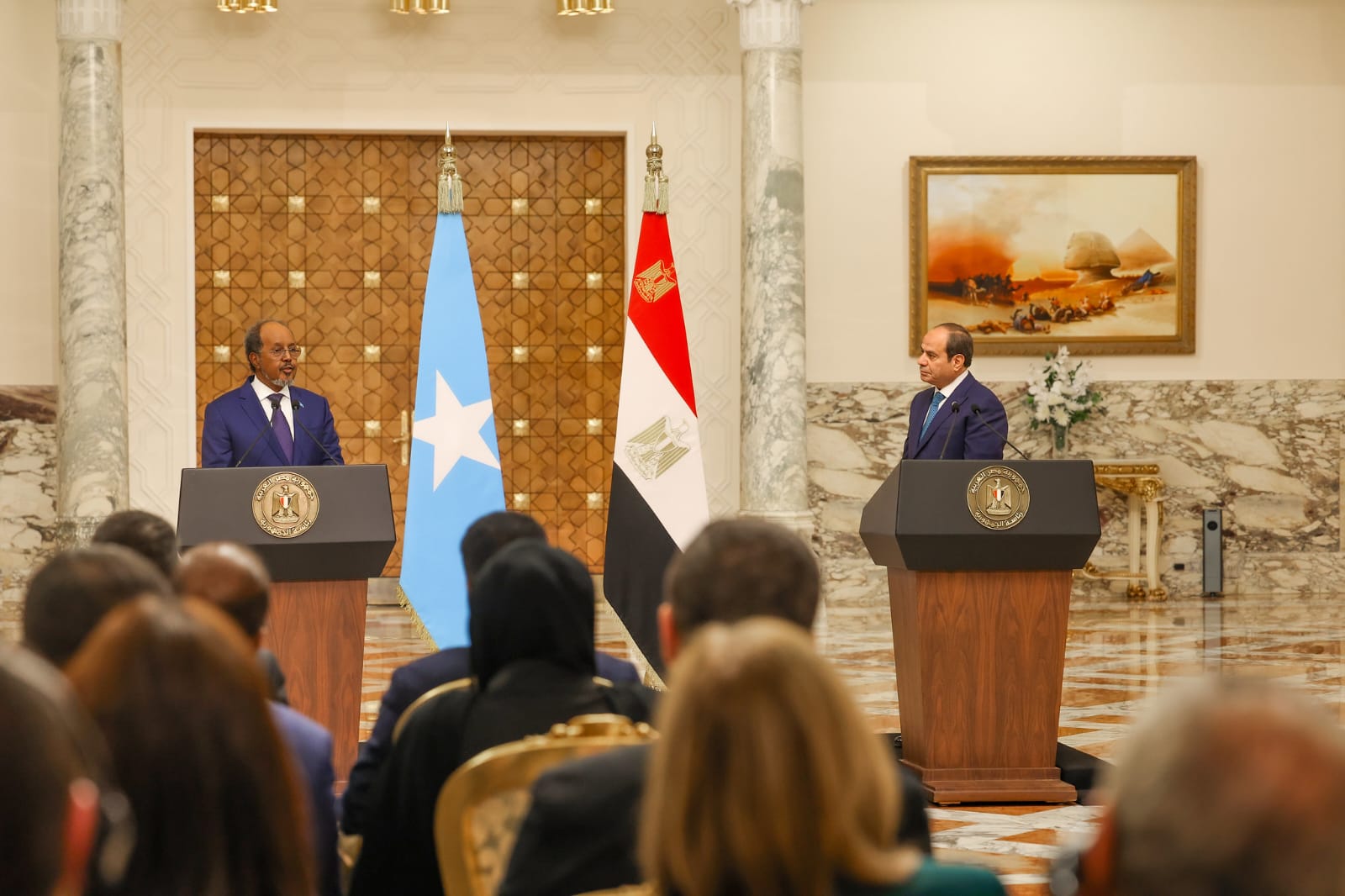
President Hassan Sheikh Mohamud’s visit to Cairo has underscored a rapidly deepening strategic alignment between Somalia and Egypt at a moment of heightened geopolitical tension in the Horn of Africa. The joint condemnation by Cairo and Mogadishu of Israel’s reported moves toward recognising Somaliland goes beyond diplomatic language; it reflects a broader convergence of interests centred on sovereignty, regional stability, maritime security, and the preservation of the post–World War II international order anchored in the United Nations and African Union charters.
At the heart of the talks was a firm rejection of any action that undermines Somalia’s territorial integrity. Both President Abdel Fattah el-Sisi and President Hassan Sheikh Mohamud framed the issue not as a bilateral dispute but as a challenge to international law and regional stability. By explicitly linking recognition of Somaliland to violations of established international regulations, the two leaders placed the matter squarely within global legal norms rather than regional politics alone. “The illegal steps taken by Israel… violate established international regulations and threaten to further ignite tensions,” the Somali presidency said in a statement following the talks. This framing is significant: it elevates Somalia’s position from a national grievance to a test case for the credibility of multilateral institutions such as the UN and AU, both of which uphold the principle of respect for inherited borders in Africa.
For Somalia, the message from Cairo carries substantial political weight. Egypt’s unequivocal support for Somali unity reinforces Mogadishu’s long-standing stance that Somaliland’s unilateral declaration of independence lacks legal basis and international legitimacy. At a time when Somalia is rebuilding state institutions after decades of conflict, any external recognition of a breakaway region would, in Mogadishu’s view, weaken the fragile progress made toward national cohesion. President Mohamud emphasized this point during the visit, stating, “We are keen to strengthen coordination with Egypt in a manner that serves regional security.”
His public appreciation of Egypt’s role signals how crucial Cairo has become as a diplomatic ally in defending Somalia’s sovereignty amid shifting regional alliances.
Egypt’s position, however, is driven by more than solidarity alone. Cairo’s emphasis on Somalia’s territorial integrity aligns closely with its own strategic interests in the Red Sea, the Gulf of Aden, and the wider Horn of Africa. President el-Sisi highlighted this strategic dimension, saying, “We remain committed partners and supporters of Somalia. Any recognition of the independence of any part of Somali territory sets a dangerous precedent that threatens stability in the Horn of Africa.”
El-Sisi’s remarks on maritime security stressing that responsibility for securing the Red Sea and the Gulf of Aden rests exclusively with the states bordering them underscore Egypt’s concern over external actors gaining footholds that could alter the balance of power along critical shipping lanes. Somalia’s geographic location at the southern entrance of the Red Sea makes it an indispensable partner for Egypt, which controls the northern gateway through the Suez Canal. Any destabilisation of Somalia, or fragmentation of its territory, would have direct implications for maritime trade, energy routes, and regional security.
The leaders’ warning that such diplomatic manoeuvres create “opportunities for extremist groups” adds another layer to their analysis. Somalia has long battled Al-Shabab and other militant actors that thrive in environments of political uncertainty and contested authority. From Mogadishu’s perspective, recognition of Somaliland could embolden armed groups by reinforcing narratives of state weakness and fragmentation. Egypt, which has its own history of confronting extremist threats, shares this concern. The emphasis on counter-terrorism cooperation during the talks reflects a shared assessment that political instability and security vacuums are mutually reinforcing risks.
Security cooperation was therefore not merely rhetorical. Egypt’s commitment to proceed with the deployment of forces as part of the African Union Support and Stabilization Mission in Somalia (AUSSOM) marks a tangible escalation of its engagement on the ground. This move signals Cairo’s willingness to translate diplomatic support into concrete security assistance, reinforcing Somalia’s capacity to stabilise liberated areas and protect national institutions. President el-Sisi also highlighted Egypt’s humanitarian support, noting plans to send “an Egyptian medical convoy to Somalia covering a range of specialities,” projecting Egypt’s role as both a security and development partner in Somalia’s state-building process.
Beyond security, the discussions revealed an ambition to anchor the relationship in long-term development and capacity building. Talks on expanding cooperation in trade, education, and development programmes through the Egyptian Agency of Partnership for Development suggest that Cairo and Mogadishu are seeking to institutionalise their partnership across multiple sectors. For Somalia, access to training, education, and technical expertise is critical to rebuilding a professional civil service and sustainable economy. For Egypt, such cooperation strengthens its influence in the Horn of Africa through soft power and development diplomacy.
The symbolism of the visit was carefully choreographed.
The official reception ceremony, guard of honour, national anthems, and joint press conference all conveyed a message of parity and respect between the two states. In regional diplomacy, such symbolism matters. It signals to other regional and international actors that Somalia is not isolated and that its concerns are shared by influential partners. President el-Sisi’s repeated characterisation of Egypt as a “committed partner and supporter of Somalia” reinforces this narrative of enduring alliance rather than transactional cooperation.
Contextually, the Cairo meeting builds on a series of high-level engagements between the two leaders, including their recent meeting in Alamein and an earlier summit that produced a joint political declaration elevating relations to a strategic partnership. This continuity suggests that Egypt–Somalia relations are entering a more structured and predictable phase, defined by regular consultations on security, defence, and regional politics. Such predictability is particularly valuable in a region often marked by abrupt shifts in alliances.
The strong language used by President el-Sisi describing any recognition of a part of Somali territory as a “dangerous precedent” reflects concern about the wider implications for Africa. If unilateral secessionist claims were legitimised through external recognition, it could reopen dormant disputes across the continent, undermining decades of AU policy aimed at preventing border conflicts. In this sense, Egypt’s stance resonates with broader African anxieties about fragmentation and the erosion of state sovereignty.
For Somalia, the visit to Cairo and the resulting joint statements serve both external and internal purposes. Internationally, they bolster Mogadishu’s diplomatic campaign to deter recognition of Somaliland by framing it as a threat to regional and global stability. Domestically, they reinforce the government’s narrative that it is successfully rebuilding alliances and defending national unity on the world stage. President Mohamud expressed this clearly during the visit: “I am pleased to visit Egypt and meet President El-Sisi, a brotherly leader, and to strengthen the historic relations between our countries. Somalia values Egypt’s continued support for our unity and stability.”
Ultimately, the Cairo talks illustrate how the Somaliland issue has become entangled with larger geopolitical currents in the Horn of Africa and the Red Sea region. What might appear as a question of recognition is, in practice, bound up with maritime security, counter-terrorism, regional influence, and the authority of international law. By aligning closely with Egypt, Somalia has secured a powerful advocate for its sovereignty while Egypt has reinforced its role as a key security actor in one of the world’s most strategically vital corridors.
As military, political, and economic coordination between Cairo and Mogadishu continues to expand, the partnership is likely to shape regional dynamics well beyond the immediate controversy. The visit signals that Somalia’s unity remains a red line for both governments and that any attempt to alter the status quo through unilateral recognition will be met with coordinated diplomatic resistance.
In a volatile region, the Egypt–Somalia axis is emerging as a stabilising counterweight, rooted in a shared commitment to sovereignty, security, and regional order.