

As the Orange Democratic Movement (ODM) approaches the 2027 General Election, it finds itself at a critical juncture. The party, once the unshakable backbone of opposition politics in Kenya, is no longer a monolith. A hundred days into the post-Raila Odinga era, cracks within the party are not just visible they are widening.
External forces, opportunistic and strategic, have stepped in to exploit these fissures. In Busia County on Sunday, February 8, 2026, the “Linda Mwananchi” tour, led by a hardline faction of ODM, laid bare a struggle for the soul of the party a struggle that could define its trajectory for the next general election.
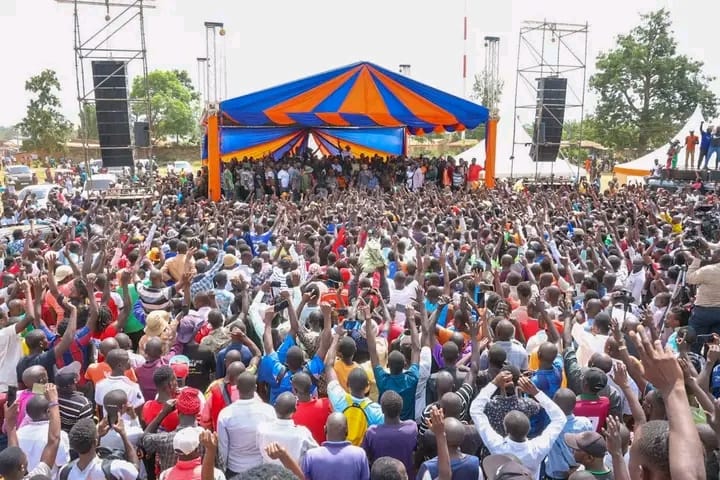
At the heart of this contest is a question of identity and purpose. Is ODM to remain a fiercely independent opposition party, a voice of the people, or will it be absorbed into alliances that dilute its founding principles? The Busia rally was as much a statement of defiance as it was a demonstration of the party’s enduring grassroots appeal. Thousands of supporters gathered at Busia Stadium, arriving without state sponsorship, hired transport, or branded paraphernalia a testament to the organic support the party still commands despite internal turbulence.
Leading the charge was ODM Secretary-General Edwin Sifuna, Embakasi East MP Babu Owino, and Siaya Governor James Orengo, a trio representing a younger, more militant faction determined to reclaim the party’s activist identity. Sifuna, speaking to the crowd, was unambiguous: “You are the ones who sent me. Yet, when I echo your voices, they threaten to fire me from the secretary general position… I want to tell them, they said we will not enter Busia, where are we now? Raila did not raise up cowards!”
This fiery declaration highlighted the growing generational and strategic divide within ODM. The “Linda Mwananchi” tour was launched not only to rally citizens around pressing issues such as the high cost of living and unemployment but also to establish Busia as ODM’s new strategic stronghold. Traditionally, the party’s power base has been in Nyanza, Raila Odinga’s home region, but Sifuna’s message was clear, ODM is now looking westward to build a power center that could withstand both internal dissent and government pressure. “Busia is our single largest stronghold,” Sifuna stated, signaling a deliberate attempt to decentralize the party’s influence and assert authority independent of the old guard.
Governor James Orengo reinforced this narrative with a firm declaration that ODM would remain independent, field its own presidential candidate, and not be “auctioned” to the state. “No one will force us to enter into a government that we are not in agreement with,” he said, drawing a line in the sand against collaboration with President William Ruto’s United Democratic Alliance (UDA). Orengo’s words underline a significant ideological divide: one faction seeks to maintain ODM as a purely opposition party, while another, associated with figures such as Oburu Oginga and Gladys Wanga, has pursued rapprochement with the ruling government.
Babu Owino, representing the youthful and radical wing, took the rhetoric a step further. Addressing party members and critics alike, he lamented what he termed the commercialization of ODM: “The party we have now is ODM Limited. It is a company that now focuses on making money. We are now being told that the party cannot produce a presidential candidate, nor does it want a deputy presidential position, We want our leader, Oburu Oginga, to call for NDC and hand over the party to Babu because he has a reason.” Owino’s statement reflects not only personal ambition but also a broader push to reclaim leadership roles for those he perceives as genuinely committed to ODM’s founding mission of advocating for the people.
The political implications of these developments are profound. ODM is not simply navigating internal disagreements; it is engaged in a civil struggle that will determine the party’s future role in Kenya’s electoral landscape. The faction led by Sifuna, Owino, and Orengo is positioning itself as the custodian of Raila Odinga’s legacy, emphasizing courage, accountability, and grassroots mobilization. Their strategy is clear: reclaim the party from those they accuse of opportunism, rebuild a disciplined and ideologically coherent organization, and position ODM as the leading opposition force capable of challenging President Ruto in 2027.
Meanwhile, the rival faction, led by Oburu Oginga and allies, advocates for a more collaborative approach with the national government, arguing for strategic partnerships that could influence policy and secure positions within state structures. This approach, however, is viewed by the “Linda Mwananchi” faction as a betrayal of the party’s foundational principles. The tension between these two visions has turned what was once a united party into a contested political battlefield, with each side claiming legitimacy and grassroots support.
The Busia rally also served as a reminder that despite these internal divisions, ODM remains a formidable political force. The sheer scale of the turnout demonstrated the party’s capacity to mobilize ordinary citizens around core issues, particularly the rising cost of living and high youth unemployment a theme that Babu Owino did not shy away from. “Sisi tunasema hivi sahihi: gharama ya maisha iko juu, vijana hawana kazi, alafu unasema serikali ni nzuri,” he said, directly criticizing government policies while emphasizing ODM’s role as the voice of the marginalized.
As ODM navigates this post-Raila era, the question of succession and leadership is unavoidable. With Raila Odinga’s passing on October 15, 2025, the party has entered uncharted territory. The younger leaders are not only asserting their authority but are also signaling a generational shift that could redefine the party’s approach to national politics. The narrative emerging from Busia is one of revival, insurgency, and strategic recalibration.
The stakes could not be higher. The outcome of this internal struggle will determine whether ODM remains a coherent opposition force or fragments under competing ambitions and ideological differences. The coming months will test the ability of party leaders to reconcile differences, harness grassroots energy, and project a unified vision ahead of the 2027 elections.
Ultimately, the Busia rally underscored a simple but powerful message: ODM is not for sale. It is a party rooted in principles, fighting for the citizen, and unwilling to compromise its independence for short-term gains. As Sifuna, Orengo, and Owino demonstrated, the party’s future lies in reclaiming its activist roots, empowering the youth, and redefining the opposition in Kenya. The coming months will reveal whether this new generation of leaders can translate fiery rhetoric into political reality, steering ODM toward a new era of influence and relevance in Kenya’s dynamic political landscape.
But as ODM navigates this crossroads, one question hangs over the party: can it truly unite its factions and rise stronger, or will internal divisions hand victory to its rivals in 2027?