

In the shifting political landscape of the Horn of Africa, diplomacy often unfolds quietly before its true meaning becomes visible. Meetings are announced with formal language phrases about cooperation, regional stability, economic integration, and mutual respect but behind those carefully crafted statements lies a deeper struggle over security, sovereignty, and influence.
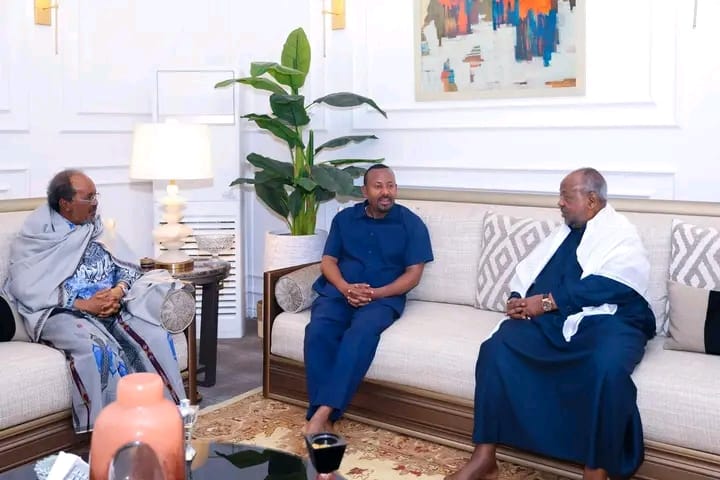
The Wednesday trilateral meeting in Djibouti between Somali President Hassan Sheikh Mohamud, Djiboutian President Ismaïl Omar Guelleh, and Ethiopian Prime Minister Abiy Ahmed represents one of those moments when the official narrative tells only part of the story. On the surface, the meeting was described as a continuation of regional dialogue aimed at strengthening cooperation among the three neighboring states. Yet beneath that language lie deeper anxieties, ambitions, and strategic calculations that reveal much about the current direction of the Horn of Africa.
The official communiqué from Mogadishu framed the meeting as a constructive dialogue focused on regional security, the fight against terrorism, Somalia’s democratic transition, stability in the Horn of Africa, and economic cooperation. These are familiar themes in diplomatic language across the region. Security and counterterrorism remain central concerns because the Horn continues to grapple with armed groups, fragile institutions, and cross-border threats that have shaped politics for decades.
Somalia’s ongoing struggle against extremist networks remains one of the defining security challenges in East Africa, and cooperation with neighboring states is essential to maintaining pressure on these groups.
Ethiopia has historically played a significant role in Somali security dynamics, both through direct military interventions and through participation in regional stabilization missions.
Djibouti, although smaller in population and territory, has positioned itself as a diplomatic hub and security partner, hosting international military bases and facilitating regional dialogue.
But the deeper reality is that security discussions in the Horn of Africa are rarely limited to terrorism alone. Security also means territorial integrity, strategic access to ports, alliances with global powers, and the balance of influence between neighboring states. Each of the three leaders who met in Djibouti arrived with a distinct set of priorities shaped by domestic pressures and regional ambitions.
For Somalia, the central concern remains sovereignty. The Somali federal government continues to guard its territorial integrity carefully, particularly in light of the complex political relationship with the self-declared independent region of Somaliland. Any development involving Somaliland whether diplomatic, economic, or military immediately becomes a matter of national concern for Mogadishu.
This context explains why discussions about foreign relations involving Somaliland often trigger strong reactions from Somali leadership. Reports emerging around the time of the meeting suggest that one of the sensitive issues discussed behind closed doors involved the possibility of foreign actors establishing relationships or presence in Somaliland without the approval of the Somali federal government.
Such developments are interpreted in Mogadishu not simply as diplomatic moves but as potential challenges to Somalia’s sovereignty and territorial unity.
Within this broader conversation about Somaliland, another sensitive subject reportedly surfaced during the Djibouti discussions: the political dynamics surrounding the Awdal region and the idea of an Awdal political project that could challenge or counterbalance the authority of Somaliland’s leadership in Hargeisa.
Awdal, located in the western part of the territory administered by Somaliland, has historically maintained a distinct political identity shaped by local leadership structures, historical grievances, and clan dynamics. The region is largely inhabited by the Gadabuursi community, which has occasionally expressed concerns about political representation and influence within Somaliland’s central administration.
The relevance of the Awdal discussion lies in the broader strategic contest over Somaliland’s claim to represent the entirety of northern Somalia. For decades, Somaliland’s leadership has argued that it functions as a unified political entity capable of operating as an independent state. However, internal regional dynamics sometimes complicate that narrative.
If political movements within Awdal were to pursue a different political trajectory whether greater autonomy, direct engagement with the Somali federal government, or alternative governance arrangements it could reshape the political landscape of northern Somalia. Such developments would challenge the assumption that Somaliland speaks with a single unified voice.
For policymakers in Mogadishu, the existence of alternative political perspectives within regions like Awdal introduces new possibilities in the long-running debate over Somalia’s territorial unity. While the federal government publicly emphasizes dialogue and reconciliation with Somaliland, it is also aware that internal regional dynamics can influence the broader political equation.
The emergence of an Awdal-centered political initiative could complicate Somaliland’s diplomatic outreach and potentially create space for new negotiations over the future governance of the northern territories.
Djibouti also has a direct interest in developments in Awdal. The region shares close cultural, historical, and familial ties with communities inside Djibouti’s borders. Cross-border clan relationships have long shaped the social and political landscape of the area. As a result, political developments in Awdal often attract attention in Djiboutian political circles.
President Ismaïl Omar Guelleh has historically followed northern Somali politics closely, partly because stability in these regions directly affects Djibouti’s own security environment.
The Awdal question therefore carries both symbolic and strategic weight within the broader trilateral discussions. Symbolically, it represents the internal diversity of political views within northern Somalia.
Strategically, it introduces another layer of complexity to the ongoing regional debate about sovereignty, recognition, and political legitimacy.
At the same time, Ethiopia approaches these discussions from a different strategic perspective. Ethiopia’s primary concern is access to maritime trade routes. As a landlocked nation with a population exceeding one hundred million people, Ethiopia depends heavily on external ports to sustain its economy. Currently, the majority of Ethiopian maritime trade flows through Djibouti’s ports.
However, Ethiopian policymakers have increasingly explored alternative maritime access points to diversify the country’s economic lifelines.
Prime Minister Abiy Ahmed has repeatedly emphasized the importance of securing maritime access for Ethiopia’s growing economy. With a population exceeding one hundred million people and ambitions for industrial expansion, Ethiopia sees access to the sea as a strategic necessity. While Djibouti currently handles the majority of Ethiopia’s maritime trade, Ethiopian policymakers have explored options that could diversify the country’s port access.
These discussions have included potential arrangements with neighboring coastal territories, which inevitably carry political implications.
The issue of maritime access is therefore not merely an economic question but a geopolitical one. Any agreement involving Ethiopian access to ports outside Djibouti can alter regional power dynamics. For Somalia, this matter intersects directly with questions about territorial integrity and federal authority.
If external actors negotiate port access arrangements with regional administrations inside Somalia without the approval of the federal government, it raises constitutional and political challenges. This is why maritime discussions often become sensitive topics in Somali diplomacy.
The trilateral meeting in Djibouti reportedly followed earlier discussions that had taken place in the Ethiopian city of Jigjiga. Those earlier conversations were brief but symbolically significant because they suggested an effort to maintain dialogue despite underlying disagreements.
Continuing those discussions in Djibouti allowed the three leaders to revisit unresolved issues while presenting a unified image of regional cooperation.
Behind closed doors, the conversation likely revolved around several interconnected themes. One involved the political situation in Somaliland and the broader implications of external partnerships there.
Another involved Ethiopia’s search for maritime access and how such ambitions could be reconciled with Somalia’s sovereignty concerns. A third involved the broader regional security environment, including the ongoing fight against extremist groups and the stability of border regions.
Reports also suggest that Somali officials had recently traveled to Addis Ababa seeking clarification regarding Ethiopia’s position on certain foreign engagements involving Somaliland. These diplomatic efforts appear to reflect Somalia’s desire for explicit assurances that its territorial integrity will be respected. However, the absence of a publicly announced resolution indicates that negotiations remain delicate.
Djibouti’s role in these discussions is particularly important because the country maintains strong relationships with both Somalia and Ethiopia. As a host and mediator, Djibouti has an interest in ensuring that tensions between its neighbors do not escalate into open conflict.
Regional stability is essential for Djibouti’s economic and security environment, especially given its reliance on international trade and military partnerships.
The broader geopolitical context also cannot be ignored. The Horn of Africa sits at the intersection of global trade routes and strategic military interests. Major powers including the United States, China, France, and others maintain military facilities in Djibouti, reflecting the region’s importance to international security.
Meanwhile, Middle Eastern states have increasingly expanded their diplomatic and economic presence across the Horn, investing in ports, infrastructure, and political partnerships. These external actors often pursue their own strategic interests, which can complicate local political dynamics.
For Somalia, navigating this geopolitical environment requires balancing relationships with multiple partners while maintaining control over national decision-making. The Somali government has sought to strengthen diplomatic ties with regional neighbors while also engaging international allies who support security and development efforts.
However, Somalia’s political landscape remains complex, with internal debates about federalism, regional autonomy, and the distribution of power.
Ethiopia, meanwhile, faces its own internal pressures that shape its foreign policy decisions. Prime Minister Abiy Ahmed came to power promising political reform and national reconciliation, but the country has experienced significant internal conflicts during his tenure. Managing Ethiopia’s diverse political landscape while pursuing regional ambitions requires careful balancing. Access to maritime trade routes is often framed domestically as a strategic necessity rather than a geopolitical ambition.
Djibouti’s leadership understands that stability in the Horn of Africa benefits all three countries. By hosting trilateral meetings and encouraging dialogue, Djibouti positions itself as both mediator and strategic partner.
President Guelleh has repeatedly emphasized the importance of regional integration, arguing that economic cooperation and infrastructure development can reduce tensions and create shared prosperity.
Infrastructure itself has become a central theme in regional diplomacy. Railways, highways, and port facilities are not merely economic assets but also instruments of political influence. The Addis Ababa–Djibouti railway, for example, represents a major logistical corridor connecting Ethiopia’s industrial zones to international shipping routes. Expanding similar infrastructure networks could enhance regional trade but also reshape political relationships.
The Djibouti meeting therefore represents more than a routine diplomatic gathering. It reflects the ongoing negotiation of power, sovereignty, and cooperation in one of Africa’s most strategically important regions. Each leader arrived with different priorities, but all share a recognition that open confrontation would carry significant risks for regional stability.
The official language of cooperation may obscure the intensity of the discussions that took place behind closed doors. Diplomatic statements often emphasize unity even when disagreements remain unresolved. Yet the willingness of the three leaders to continue meeting suggests that dialogue remains the preferred path forward.
For observers of the Horn of Africa, the trilateral meeting highlights several broader trends. First, regional diplomacy is increasingly shaped by economic considerations, particularly access to ports and trade routes.
Second, questions of sovereignty and territorial integrity remain central to political debates.
Third, internal political dynamics such as the evolving debate around regions like Awdal continue to influence the strategic calculations of governments across the region.
Ultimately, the future of the Horn of Africa will depend on whether its leaders can transform competition into cooperation. The region possesses enormous economic potential due to its strategic location and growing population. Yet realizing that potential requires political stability and mutual trust among neighboring states.
The Djibouti meeting may not have resolved all outstanding issues, but it demonstrates that the region’s leaders recognize the importance of maintaining dialogue. In a region where historical grievances and geopolitical rivalries often shape politics, even the act of sitting together at the same table carries significance.
Whether these conversations lead to lasting agreements remains uncertain, but the willingness to engage in trilateral diplomacy suggests that the Horn of Africa is entering a new phase of strategic negotiation one where power, ports, internal regional politics, and political legitimacy will continue to define the region’s evolving landscape.