

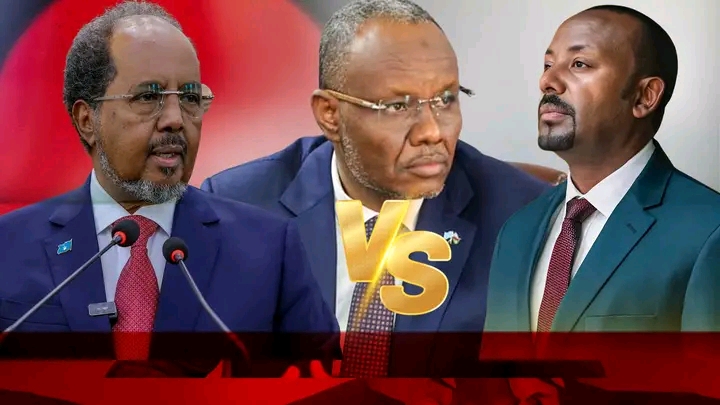
The Horn of Africa has long been a region where internal politics, regional rivalries, and historical grievances intertwine in complex and often volatile ways. Today, that intricate web is tightening once again, with Somalia and Ethiopia at the center of a rapidly evolving political and security dilemma. What may appear on the surface as a diplomatic disagreement between two neighboring states is, in reality, a deeply layered crisis rooted in Somalia’s internal political fractures, regional power dynamics, and shifting geopolitical alliances.
At the heart of the current tensions lies a confrontation that is as domestic as it is international: the political standoff between Somalia’s federal government under President Hassan Sheikh Mohamud and the leadership of Southwest State under President Abdiaziz Laftagareen. This dispute, however, cannot be understood in isolation. It is unfolding within a broader strategic context that includes Ethiopia’s military presence in Somalia, longstanding mistrust between Mogadishu and Addis Ababa, and the growing involvement of other regional actors such as Egypt.
To fully grasp the magnitude of the situation, one must examine each layer of this crisis political, military, and diplomatic. while understanding how they intersect and reinforce one another.
From a domestic standpoint, Somalia is once again facing the persistent challenge of balancing federal authority with regional autonomy. The federal system, designed to distribute power across various member states, has often been a source of tension rather than stability. In the case of Southwest State, this tension has escalated into open political defiance.
The leadership in Southwest has increasingly resisted directives from the federal government, particularly on issues related to constitutional reforms and electoral processes. These disagreements are not merely procedural; they strike at the core of Somalia’s political future. The federal government seeks to consolidate authority and push forward a unified national agenda, while regional leaders like Laftagareen aim to preserve autonomy and maintain their political relevance within their territories.
This divergence of interests has led to a breakdown in trust. The withdrawal of political support by Southwest State from the federal government marked a turning point, transforming what had been a strained relationship into a full-blown political confrontation. The deployment of federal troops toward key areas within Southwest, including strategic towns near Baidoa, signals that the situation has moved beyond political rhetoric into the realm of potential armed conflict.
Military movements, even when framed as precautionary, carry significant implications. They alter the balance of power on the ground, create perceptions of imminent confrontation, and increase the likelihood of miscalculation. In a region already grappling with insecurity and the presence of armed groups, any escalation between federal and regional forces risks opening new fronts of instability.
However, the internal dimension of this crisis cannot be separated from the role of external actors most notably Ethiopia. Ethiopia’s involvement in Somalia is neither new nor incidental. For decades, it has maintained a strategic interest in Somalia’s internal affairs, driven by security concerns, historical rivalries, and geopolitical calculations.
Ethiopian forces have been deployed in various parts of Somalia, including regions within Southwest State, under the framework of regional peacekeeping and bilateral security arrangements. These deployments are officially aimed at combating extremist groups and stabilizing the region. Yet, their presence also provides Ethiopia with significant leverage over local political dynamics.
This dual role security partner and political influencer places Ethiopia in a delicate position. On one hand, it must maintain its commitments to regional stability and counterterrorism. On the other, it faces accusations of interfering in Somalia’s internal affairs, particularly when its relationships with regional leaders appear to bypass the federal government.
The current tensions have amplified these concerns. For the federal government in Mogadishu, the possibility that Ethiopia could support or align with Southwest State is deeply troubling. Such a scenario would not only undermine federal authority but also challenge Somalia’s sovereignty. For Ethiopia, however, maintaining relationships with regional actors may be seen as a pragmatic approach to safeguarding its interests and ensuring stability along its borders.
This divergence in perspectives underscores the fragile nature of Somalia–Ethiopia relations. While both countries share common security concerns, particularly regarding extremist threats, their strategic priorities do not always align. This misalignment has been further exacerbated by recent developments that have eroded trust between the two nations.
One of the most significant of these developments is the controversial agreement between Ethiopia and Somaliland. By seeking access to the Red Sea through a deal with Somaliland, Ethiopia has touched on one of Somalia’s most sensitive issues: territorial integrity. For Somalia, Somaliland remains an integral part of its sovereign territory, despite its self-declared independence. Any external engagement with Somaliland that bypasses Mogadishu is therefore viewed as a direct challenge to Somalia’s sovereignty.
This agreement has had a profound impact on diplomatic relations. It has fueled suspicion, hardened positions, and created an environment in which even routine interactions are viewed through a lens of mistrust. In such a context, the reported secret visit by President Hassan Sheikh Mohamud to Ethiopia takes on added significance.
While details of the visit remain limited, its very nature suggests a high level of sensitivity. The absence of a public meeting with Ethiopia’s top leadership, coupled with reports of discussions involving intelligence officials, points to the seriousness of the concerns being addressed. Intelligence channels are often used when issues are too delicate for formal diplomatic engagement, indicating that both sides are navigating a complex and potentially volatile situation.
From Somalia’s perspective, the primary objective of such a visit would likely be to clarify Ethiopia’s position regarding the Southwest crisis. Understanding whether Ethiopia intends to remain neutral, support the federal government, or engage with regional actors independently is crucial for shaping Somalia’s response. For Ethiopia, the meeting would provide an opportunity to communicate its position while managing expectations and avoiding further escalation.
The subsequent decision by President Hassan Sheikh Mohamud to convene a meeting with diplomatic missions in Somalia further highlights the gravity of the situation. By engaging the international community, the federal government is effectively internationalizing the crisis. This move serves multiple purposes.
Firstly, it seeks to build international awareness and support. By framing the issue as one of sovereignty and external interference, Somalia aims to rally diplomatic backing and potentially deter actions that could undermine its authority.
Secondly, it acts as a signal to Ethiopia and other regional actors that Somalia is prepared to leverage international platforms to address its concerns. This can serve as both a deterrent and a means of pressure.
Thirdly, it reinforces the federal government’s legitimacy. In times of internal conflict, maintaining international recognition and support is essential for sustaining authority and credibility.
However, the internationalization of the crisis also carries risks. It can complicate diplomatic efforts, introduce new actors with their own agendas, and potentially escalate tensions if not managed carefully. The involvement of external powers, particularly in a region as strategically important as the Horn of Africa, can transform localized disputes into broader geopolitical confrontations.
This risk is already evident in the growing involvement of Egypt. Egypt’s engagement with Somalia, particularly in the context of military cooperation, is closely linked to its rivalry with Ethiopia over the Nile River and the Grand Ethiopian Renaissance Dam. By strengthening ties with Somalia, Egypt is not only supporting a fellow African nation but also positioning itself strategically in its broader contest with Ethiopia.
This development adds another layer of complexity to the crisis. What was initially a bilateral issue between Somalia and Ethiopia is now intersecting with a separate but related geopolitical rivalry. The potential for overlapping conflicts—internal, regional, and geopolitical—creates a highly volatile environment.
From a military perspective, the situation is equally concerning. The presence of multiple armed actors, including federal forces, regional forces, and foreign troops, increases the likelihood of unintended clashes. In such an environment, even minor incidents can escalate rapidly, particularly when trust is low and communication channels are strained.
The strategic importance of Southwest State further heightens these risks. As a region that hosts significant Ethiopian military presence and serves as a political stronghold, it is both a flashpoint and a potential balancing point. Control over this region carries implications not only for Somalia’s internal politics but also for regional security dynamics.
For the federal government, asserting control over Southwest is essential for maintaining national unity and authority. For regional leaders, resisting federal encroachment is a matter of political survival. For Ethiopia, ensuring stability in the region is crucial for its security interests. These overlapping priorities create a situation in which compromise is difficult and confrontation becomes increasingly likely.
In analyzing this crisis, it is important to recognize that it is not driven by a single factor but by the convergence of multiple dynamics. Political disagreements within Somalia, historical mistrust between Somalia and Ethiopia, and broader geopolitical rivalries are all contributing to the current tensions.
Each of these factors reinforces the others. Internal political disputes create opportunities for external involvement. External involvement exacerbates internal divisions. Geopolitical rivalries amplify both. The result is a complex and interconnected crisis that defies simple solutions.
Looking ahead, several scenarios are possible. The best-case scenario would involve de-escalation through dialogue, both domestically and internationally. This would require compromise, confidence-building measures, and a willingness to prioritize stability over short-term political gains.
A more likely scenario, however, is continued tension with periodic escalations. In this case, the crisis would remain unresolved, with occasional flare-ups that could destabilize the region but fall short of full-scale conflict.
The worst-case scenario would involve a breakdown of diplomatic efforts and the eruption of armed conflict in Southwest State, potentially drawing in external actors. Such a development would have far-reaching consequences, not only for Somalia and Ethiopia but for the entire Horn of Africa.
Ultimately, the current tensions between Somalia and Ethiopia are a reflection of deeper structural challenges. They highlight the difficulties of building a stable federal system, managing relations with powerful neighbors, and navigating a complex geopolitical landscape.
For Somalia, the path forward will require balancing internal cohesion with external diplomacy. For Ethiopia, it will involve recalibrating its approach to ensure that its security interests do not come at the expense of regional stability. For the international community, it will necessitate careful engagement that supports stability without exacerbating tensions.
As events continue to unfold, one thing is clear: the stakes are high, and the margin for error is slim. The decisions made in the coming weeks and months will not only shape the future of Somalia–Ethiopia relations but also determine the trajectory of peace and security in the Horn of Africa.
In a region where history has often been marked by conflict, the hope remains that diplomacy, restraint, and strategic foresight will prevail. Yet, hope alone is not enough. It must be matched by decisive action, thoughtful leadership, and a commitment to addressing the root causes of instability.
Only then can the cycle of tension and conflict be broken, paving the way for a more stable and prosperous future for Somalia, Ethiopia, and the region as a whole.