

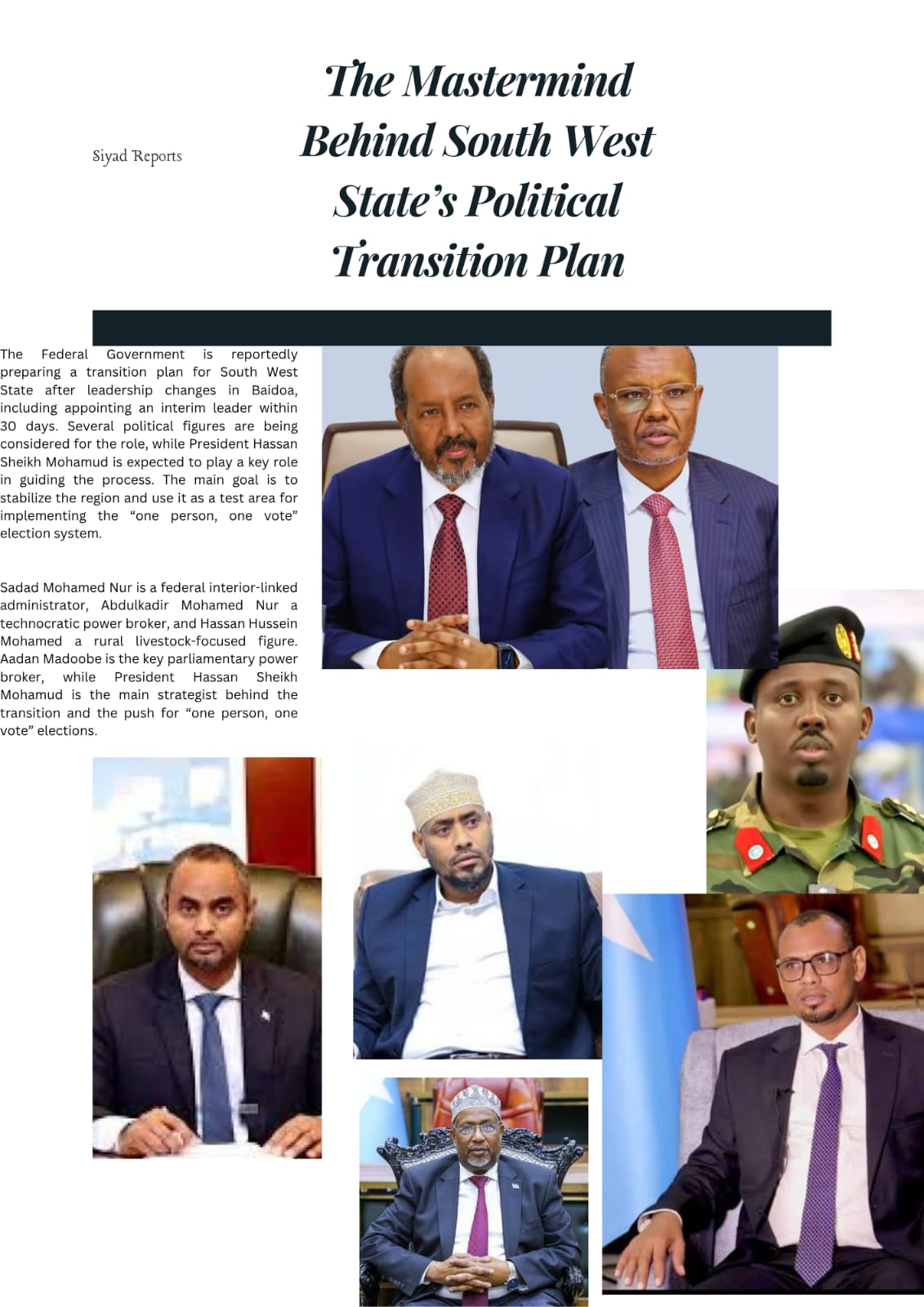
The recent developments in Baidoa and the broader South West State of Somalia reflect one of the most complex and sensitive political transitions in Somalia’s federal era.
What appears on the surface as a normal security deployment or administrative adjustment is in reality a deeply layered process involving military coordination, federal political planning, clan negotiations, and a long-term national electoral strategy.
This means the situation cannot be understood from a single angle, because every movement on the ground reflects a calculated interaction between security institutions, political elites, and local power structures trying to protect or reshape influence.
At the center of this evolving situation are key federal figures such as Sadad Mohamed Nur, Abdulkadir Mohamed Nur, and Hassan Hussein Mohamed, working alongside senior military leadership represented by Ibrahim Mohamed Mohamud. These actors operate under the broader political direction of Hassan Sheikh Mohamud, whose central national ambition is to transition Somalia toward a “one person, one vote” electoral system.
Their combined presence shows that this is not a single-institution operation, but rather a coordinated state-wide strategy where politics, security, and administration are functioning as one system rather than separate entities.
Meanwhile, the political legacy and influence of Abdiaziz Laftagareen continues to shape resistance dynamics, negotiations, and the balance of power within South West State. His role is not just historical but still active in shaping alliances, loyalty structures, and local perceptions of legitimacy.
At the institutional level, parliamentary authority represented by Aadan Mohamed Nur also plays a key constitutional role in shaping any transitional arrangement, meaning that legal authority and political negotiation are moving in parallel with military developments.
The situation in Baidoa is therefore not simply a security operation it is a structured political transformation where military presence, federal strategy, and local political realignments are all moving simultaneously, creating a multi-layered power shift that affects both governance and future elections.
MILITARY CONTROL, URBAN SECURITY, AND THE BAIDOA OPERATIONAL MODEL
The military dimension of the Baidoa transition is best understood through the command structure and operational behavior of Ibrahim Mohamed Mohamud, who represents a shift in Somali military doctrine from traditional battlefield warfare to politically integrated urban stabilization.
This shift is important because it shows that modern Somali military operations are increasingly focused not just on defeating enemies, but on controlling political environments and preventing instability before it emerges.
Unlike earlier operations that focused heavily on open combat against insurgent groups, the Baidoa approach reflects a strategy built around controlling space, managing perception, and preventing conflict before it begins. This includes securing critical infrastructure such as airports, government buildings, and main road networks, while simultaneously ensuring that political actors can move safely and without confrontation. This kind of strategy reduces the chance of unpredictable clashes and ensures that power transitions appear orderly and state-controlled rather than chaotic or factional.
The military deployment itself followed a carefully structured convoy system. In the front, elite Somali National Army units, including Gorgor forces, established a security corridor by controlling entry points, intersections, and key access roads.
This ensured that no armed group could organize resistance ahead of the main movement, effectively neutralizing threats before they became visible. It also created psychological control over the entire route, making the city feel already secured before the main convoy arrived.
Behind this forward layer was the central convoy carrying political and military leadership, including federal ministers and senior commanders. Their presence inside the operational movement served a dual purpose: first, it signaled that the operation was fully state-led rather than factional; and second, it created psychological dominance by showing overwhelming political authority moving alongside military force.
This combination reduces uncertainty and sends a clear message that the federal system is physically present and actively in control.
The rear of the formation provided continuous stabilization support, ensuring flank protection and immediate response capability in case of any unexpected resistance. This layered structure reflects a highly coordinated operation designed not just for military control, but for complete political stabilization of the city, where every direction of movement is covered and controlled.
A key factor in this success was the role of elite units, particularly Turkish-trained Gorgor forces, whose operational discipline and coordination capacity significantly increased the effectiveness of the deployment. Their presence contributed to what many analysts describe as a “no-contact takeover,” where control was achieved without major fighting, which is politically important because it reduces backlash and preserves legitimacy.
Compared to earlier operations like Ras Kamboni under Odowaa Yusuf Rage, the Baidoa model is fundamentally different. Ras Kamboni reflects a difficult counterinsurgency environment shaped by geography, border complexity, and fluid armed networks, meaning military force alone struggles to achieve full control.
Baidoa, however, represents an urban political control operation where success depended more on pre-alignment of political actors than battlefield dominance, showing a shift from combat victory to political management.
In Ras Kamboni, military power alone struggled to produce full stabilization due to environmental and logistical limitations. In Baidoa, political preparation and coordinated military presence worked together to produce rapid control, meaning success came from synchronization rather than force alone.
POLITICAL ENGINEERING, CLAN BALANCE, AND FEDERAL STRATEGY IN SOUTH WEST STATE
Beyond the military layer, the Baidoa transition is deeply rooted in political engineering. The federal government’s approach involves a multi-channel system of pressure, negotiation, and institutional positioning aimed at reshaping leadership in South West State. This system is designed to avoid open conflict while still achieving full political realignment through controlled influence.
Within this system, Sadad Mohamed Nur plays a role as a federal implementation figure within the Interior Ministry framework. His position gives him administrative influence over regional transitions, elections, and governance coordination, but his weakness lies in the absence of a strong independent political base inside South West State. This makes him more of a system executor than a grassroots power holder, meaning his authority depends heavily on federal backing rather than local legitimacy.
Similarly, Abdulkadir Mohamed Nur operates as a strategic economic and international connector through his role in ports and marine transport. His access to economic networks and international partnerships gives him significant federal influence, but his political connection to local South West structures remains limited. This creates a profile of technical power without deep territorial political roots.
On the other hand, Hassan Hussein Mohamed represents a different type of influence rooted in rural society. Through the livestock and pastoral economy, he maintains indirect connections with rural communities where livelihood and clan structures are deeply intertwined. This gives him a level of grassroots relevance that others lack, particularly in agricultural zones of South West State, where economic survival is tied to political alignment.
However, all these actors operate within a broader strategic framework led by President Hassan Sheikh Mohamud, whose primary objective is to transform Somalia’s electoral system. South West State is being positioned as a pilot region for implementing “one person, one vote” elections. This requires not only political restructuring but also security stabilization and controlled leadership transition, meaning governance, security, and elections are being engineered together.
A major political factor in this transition is the weakening position of Abdiaziz Laftagareen, whose authority has gradually been reduced through a combination of federal pressure, shifting clan alliances, and changing security dynamics in Baidoa. Rather than a sudden removal, his influence appears to be eroding through a structured political isolation process that reduces his ability to mobilize support or influence decisions.
At the constitutional level, Aadan Mohamed Nur plays a critical balancing role. As Speaker of Parliament, he represents institutional legitimacy and is capable of shaping the legal and political framework of any interim arrangement. His influence extends beyond competition
he has the ability to define how the transition itself is structured, making him a central stabilizing figure in the process.
INTERIM POWER STRUGGLE AND THE FUTURE OF SOUTH WEST TRANSITION
As the situation develops, attention has shifted toward the formation of a possible interim administration in South West State.
Preliminary discussions suggest that a caretaker leadership structure may be introduced, potentially selected from former political figures and established institutional actors, meaning the process is not open competition alone but guided selection based on balance and stability.
This emerging contest involves four key figures, each representing different political strengths within the federal system, and each reflecting a different model of governance and control.
Sadad Mohamed Nur is seen as the strongest candidate for direct federal implementation. His alignment with the Interior Ministry system makes him suitable for executing a fast and controlled transition, particularly if the federal government prioritizes speed and administrative discipline over local political bargaining, which is often necessary in fragile political environments.
Abdulkadir Mohamed Nur represents a technocratic option, bringing economic and international credibility into the equation. His strength lies in governance capacity and strategic networks, although his lack of deep local grounding in Baidoa limits his political reach in clan-based negotiations.
Hassan Hussein Mohamed offers a rural and community-oriented profile, which could appeal to pastoral and agricultural constituencies. His strength lies in social connection rather than security or political control structures, making him more of a bridge figure than a power enforcer.
The most influential figure in this contest, however, remains Aadan Mohamed Nur, whose constitutional authority and political negotiation experience make him a central power broker. Unlike the others, he is not only a candidate but also a figure capable of shaping the entire selection process itself, influencing both legitimacy and acceptance across competing factions.
Ultimately, the outcome of this contest will depend on the balance between three forces: federal control, local legitimacy, and security stability. Each candidate represents a different combination of these elements, and the final decision will reflect the federal government’s strategic priority for South West State.
The broader conclusion of the Baidoa transition is that Somalia is entering a new phase of political consolidation where military coordination, federal planning, and electoral engineering are increasingly interconnected. The operation in Baidoa is not an isolated event but part of a larger national strategy aimed at reshaping governance structures and preparing the country for a more direct electoral system.
At the center of this transformation is Hassan Sheikh Mohamud, whose political vision is to use South West State as a testing ground for Somalia’s democratic future.
The combination of military stabilization under Ibrahim Mohamed Mohamud, administrative coordination by Sadad Mohamed Nur, economic and strategic influence from Abdulkadir Mohamed Nur, rural engagement through Hassan Hussein Mohamed, and constitutional oversight by Aadan Mohamed Nur, together forms a multi-layered system of governance transition.
Meanwhile, the declining influence of Abdiaziz Laftagareen marks the end of one political phase and the beginning of another, where federal authority is increasingly shaping regional outcomes.
In essence, Baidoa is not just experiencing a leadership change it is witnessing a structural transformation in Somalia’s political architecture.