

The political landscape of Somalia is once again at a critical turning point, as President Hassan Sheikh Mohamud undertakes a decisive and symbolic outreach to traditional clan elders in Baidoa. This move comes in the immediate aftermath of a dramatic and controversial federal intervention in South West State, which saw the removal of regional president Abdiaziz Hassan Mohamed Laftagareen.
The unfolding developments are not merely a localized political reshuffle but represent a profound shift in Somalia’s governance trajectory, one that touches on long-standing tensions between federal authority and regional autonomy, the delicate role of clan structures, and the ambitious but contentious transition toward a universal suffrage system.
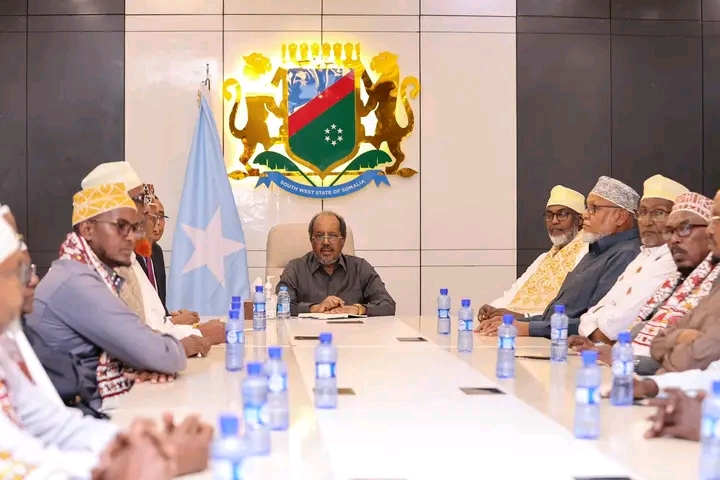
President Mohamud’s visit to Baidoa is layered with political symbolism and strategic intent. Arriving in the interim capital on Friday, his presence alone sends a clear message, the federal government is not only asserting its authority but is also seeking to legitimize its actions through engagement with the most influential traditional actors in Somali society.
Clan elders have historically served as the backbone of social cohesion and conflict resolution in Somalia, particularly in times when formal state institutions were weak or absent. By directly appealing to them, Mohamud is acknowledging a fundamental reality of Somali politics that any sustainable transition must be rooted in both formal governance structures and traditional legitimacy.
The discussions held on Sunday were described as crucial, and rightly so. At the heart of these talks is the federal government’s push for a new democratic transition, one that would replace Somalia’s long-standing clan-based electoral system with a “one person, one vote” model. This proposed shift is monumental.
For decades, Somalia’s political system has operated through an indirect electoral process where clan elders and delegates select representatives. While this system has provided a workable framework in a fragile state context, it has also been criticized for entrenching elite control, limiting broader political participation, and slowing democratic development.
President’s appeal to the elders, therefore, is both a request and a challenge. He is asking them to support a transformation that could diminish their traditional gatekeeping role in electoral processes.
Yet, at the same time, he is relying on their influence to ensure that this transition is accepted by communities on the ground. This delicate balancing act underscores the complexity of Somalia’s political evolution. It is not simply about replacing one system with another it is about negotiating a new social contract that harmonizes modern democratic ideals with deeply rooted cultural and social structures.
The removal of Laftagareen adds another layer of tension to the situation. His ousting followed a bitter armed standoff, highlighting the volatility of the transition. For many observers, this confrontation is emblematic of the broader resistance to the federal government’s reforms.
Regional leaders, particularly those who have built power bases within the existing clan-based system, may view the shift to universal suffrage as a direct threat to their authority. The standoff, therefore, was not just about one leader’s position but about competing visions for Somalia’s political future.
By moving swiftly to engage clan elders after the takeover, Mohamud appears to be attempting to de-escalate tensions and prevent further conflict. His emphasis on unity, reconciliation, and state-building during the meeting reflects an awareness that political transitions in Somalia cannot be sustained through force alone. They require consensus, or at the very least, broad-based acceptance.
The elders’ response, as reported, was largely positive. Their expression of gratitude for the federal government’s peacebuilding efforts and their apparent support for the democratization agenda are significant developments. However, such support must be interpreted with caution.
In Somali political culture, public expressions of agreement do not always translate into full endorsement or compliance. Elders often operate within complex networks of loyalty and obligation, balancing the interests of their clans, sub-clans, and local communities. Their backing for the federal agenda may therefore be conditional, contingent on how the transition unfolds and whether it addresses local concerns.
Beyond the immediate political negotiations, the discussions in Baidoa also touched on critical socio-economic issues, including drought relief. This is an important dimension that should not be overlooked. Somalia is currently grappling with recurring droughts that have devastated livelihoods, particularly in rural areas.
By incorporating humanitarian concerns into the political dialogue, the federal government is signaling an integrated approach to governance one that recognizes that political stability and human security are deeply interconnected.
The involvement of Jibril Abdirashid Haji, the newly appointed interim regional leader, further illustrates the multi-layered nature of the transition.
His role, alongside a large federal delegation comprising lawmakers, ministers, and military commanders, is to manage what is described as a volatile transition. The presence of military figures alongside civilian officials highlights the security dimension of the process. It suggests that while the federal government is pursuing dialogue and consensus, it is also prepared to maintain order through force if necessary.
This dual approach combining political outreach with a strong security presence reflects a broader pattern in Somalia’s state-building efforts. It raises important questions about the balance between coercion and consent in political transitions.
Can a shift toward democracy be genuinely inclusive and participatory if it is initiated under the shadow of military intervention? Or is such an approach necessary in a context where state authority is often contested and fragmented?
The choice of Baidoa as the focal point of these developments is also significant. As the administrative center of South West State, the city has long been a political and economic hub. Its strategic importance makes it a key battleground for influence between federal and regional actors. By consolidating control in Baidoa, the federal government is effectively strengthening its foothold in a region that has been both politically influential and, at times, unstable.
At a broader level, the events unfolding in South West State are part of a larger national narrative centered on Somalia’s quest for a stable and democratic governance system. Since the collapse of the central government in 1991, the country has undergone multiple transitional phases, each marked by efforts to rebuild institutions, establish legitimacy, and navigate the complexities of clan dynamics. The push for universal suffrage represents the latest chapter in this ongoing journey.
However, the path to “one person, one vote” is fraught with challenges. Logistical constraints, security concerns, and political resistance all pose significant obstacles. Implementing such a system requires not only legal and institutional reforms but also extensive voter registration, civic education, and the establishment of credible electoral bodies. In regions affected by conflict and displacement, these tasks become even more daunting.
Moreover, the transition raises fundamental questions about representation and inclusivity. While universal suffrage is often seen as the gold standard of democracy, its implementation in a context like Somalia must be carefully managed to ensure that it does not exacerbate existing inequalities or marginalize certain groups.
The role of women, youth, and minority clans in the new system will be a key indicator of its success.
The political outreach in Baidoa, therefore, can be seen as an early test of the federal government’s ability to navigate these complexities. It is an attempt to build a coalition of support that spans both formal institutions and traditional structures.
It is also a recognition that legitimacy in Somalia is not derived solely from constitutional authority but from the ability to engage and persuade a diverse range of stakeholders.
At the same time, the situation underscores the fragility of Somalia’s federal system. The tension between centralization and regional autonomy remains a defining feature of the country’s politics. While the federal government seeks to implement nationwide reforms, regional states often guard their autonomy and resist perceived encroachments on their authority. The events in South West State highlight how quickly these tensions can escalate into conflict.
Looking ahead, the success of the transition will depend on several factors. First, the federal government will need to maintain open lines of communication with regional leaders and clan elders, ensuring that their concerns are addressed.
Second, it will need to demonstrate tangible benefits from the reforms, particularly in terms of improved governance, service delivery, and security.
Third, it will need to manage the transition process in a way that minimizes disruption and builds public confidence.
The role of the international community may also be significant. Somalia’s state-building efforts have long been supported by external partners, who provide financial, technical, and security assistance. Their support for the transition to universal suffrage could help address some of the logistical and capacity challenges.
However, external involvement must be carefully calibrated to avoid perceptions of interference or imposition.
Ultimately, the developments in Baidoa represent both an opportunity and a risk. They offer a chance to advance Somalia’s democratic aspirations and to move toward a more inclusive and representative political system. At the same time, they carry the potential for increased instability if not managed carefully.
President Hassan Sheikh Mohamud’s engagement with clan elders is, in many ways, a recognition of this dual reality. It is an acknowledgment that the path forward requires both bold leadership and careful negotiation, both vision and pragmatism. It is an attempt to bridge the gap between tradition and modernity, between local realities and national ambitions.
As Somalia stands at this crossroads, the decisions made in Baidoa and beyond will have far-reaching implications. They will shape not only the future of South West State but the trajectory of the entire nation.
Whether this moment will be remembered as a turning point toward stability and democracy or as another episode of political turbulence will depend on how effectively the various actors involved can navigate the challenges ahead.
In this sense, the story unfolding in Baidoa is more than a regional political development. It is a microcosm of Somalia’s broader struggle to define its identity, to reconcile its past with its future, and to build a state that reflects the aspirations of its people.