

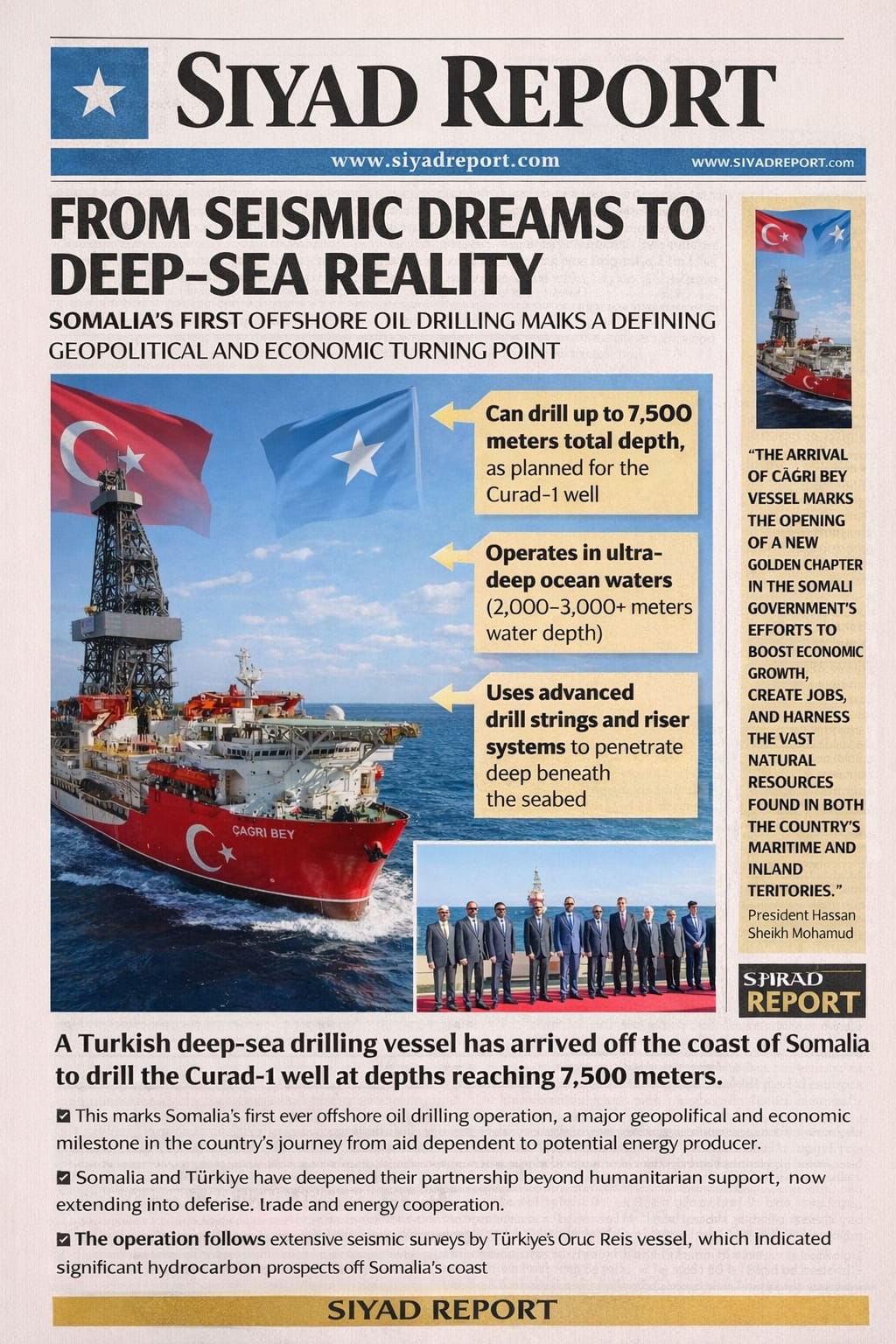
The sight of the Turkish deep-sea drilling vessel Çağrı Bey departing from Mogadishu Port under the watch of Hassan Sheikh Mohamud and senior Turkish officials was not merely ceremonial it was symbolic of a nation attempting to rewrite its economic destiny after decades of fragility, missed opportunities, and unrealized resource potential.
What unfolded on April 10, 2026, was more than the launch of a drilling campaign; it was the culmination of years of policy reform, diplomatic recalibration, and strategic partnerships that have gradually repositioned Somalia from a recipient of aid to a prospective energy player in the Horn of Africa.
Standing alongside Somalia’s leadership, Alparslan Bayraktar described the moment as the beginning of “a new era,” rooted in what he called a “trust-based partnership” between Ankara and Mogadishu. His remarks echoed a broader narrative that has defined Türkiye’s engagement in Africa over the past two decades one that moves beyond traditional humanitarian assistance into infrastructure, defense, and now energy exploration.
For Somalia, however, this moment carries deeper historical weight. For decades, the country’s offshore hydrocarbon potential remained largely speculative discussed in policy papers, hinted at in early surveys, but never fully pursued due to political instability, civil conflict, and the absence of a coherent legal framework.
The launch of drilling at the Curad-1 well represents the first tangible step toward converting that long-discussed potential into measurable economic output.
The roots of this moment can be traced back to the gradual rebuilding of Somalia’s institutional architecture following years of state collapse. The introduction of the Petroleum Law in 2020 marked a critical turning point, establishing a legal and regulatory framework for exploration, licensing, and revenue-sharing.
It was a move designed not only to attract foreign investment but also to assure both domestic and international stakeholders that Somalia was serious about managing its natural resources transparently.
Equally significant was the establishment of the Somali Petroleum Authority, which provided the institutional backbone necessary to oversee such an ambitious sector.
These reforms did not happen in isolation they were part of a broader effort by the Somali government to restore confidence in its governance systems and demonstrate readiness for large-scale economic projects.
Parallel to these domestic reforms was the deepening of Somalia’s bilateral relationship with Türkiye. Over the years, Türkiye has emerged as one of Somalia’s most consistent international partners, investing in infrastructure, healthcare, education, and security. The presence of Türkiye’s largest overseas military training base in Mogadishu underscores the strategic depth of this relationship.
Yet, it is in the energy sector that this partnership is now reaching its most transformative phase.
Before the arrival of the Çağrı Bey, Türkiye had already laid the groundwork through extensive seismic surveys conducted by the Oruç Reis. Over a period of 234 days, the vessel mapped three offshore blocks, collecting detailed three-dimensional seismic data across thousands of square kilometers.
These surveys revealed promising geological structures signals that hydrocarbons could indeed exist beneath Somalia’s seabed.
The transition from seismic exploration to actual drilling is a significant leap. While seismic data can indicate potential reserves, only drilling can confirm their existence and commercial viability. This makes the Curad-1 well not just another exploration project, but a decisive test of Somalia’s long-held energy ambitions.
The technical scope of the operation is equally remarkable.
The planned depth of 7,500 meters places it among the deepest offshore drilling efforts globally. Such an endeavor requires advanced technology, extensive logistical coordination, and robust security measures factors that underscore the scale of commitment from both Somalia and Türkiye.
For Hamza Abdi Barre, the launch represents a broader shift in national identity. “Somalia is no longer in an era of seeking aid,” he declared, framing the drilling campaign as a step toward self-reliance. His remarks reflect a growing sentiment within the Somali leadership that the country must transition from dependency to productivity, leveraging its natural resources to drive sustainable growth.
This sentiment was echoed by the Minister of Petroleum and Mineral Resources, Dahir Shire Mohamed, who described the day as “historic” and filled with “new hope.” His characterization highlights the emotional and symbolic dimensions of the project beyond economics, it represents a collective aspiration for national renewal.
At the heart of this narrative is President Hassan Sheikh Mohamud’s vision of transforming Somalia into a stable and prosperous state. His assertion that “Somalia is moving towards peace and prosperity and away from insecurity and economic hardship” reflects a belief that improved security conditions have created the necessary environment for investment and development.
Yet, this optimism must be viewed within a broader and more complex context.
THE LONG ROAD FROM INSTABILITY TO RESOURCE ASPIRATION
Somalia’s journey toward offshore drilling has been anything but straightforward. For much of the past three decades, the country has grappled with insecurity, fragmented governance, and limited institutional capacity. These challenges not only deterred investment but also hindered the development of a coherent energy strategy.
The idea that Somalia could one day become an oil-producing nation has long existed, but it remained largely theoretical. Early exploration efforts in the late 20th century were interrupted by the outbreak of civil war, leaving vast offshore areas unexplored and underdeveloped.
What has changed in recent years is not just the political environment, but also the global context. As energy markets evolve and new frontiers are explored, previously overlooked regions like Somalia are gaining renewed attention.
Advances in drilling technology have made it possible to access resources in deeper and more challenging environments, opening up opportunities that were once considered unfeasible.
At the same time, geopolitical dynamics in the Horn of Africa have intensified. The region has become a focal point for international competition, with various powers seeking to expand their influence through economic, military, and diplomatic means. Türkiye’s growing presence in Somalia must be understood within this context it is both a partnership and a strategic positioning.
President Hassan Sheikh Mohamud’s remarks about Türkiye’s approach “differing from that of other world leaders” hint at a broader critique of traditional engagement models. By emphasizing mutual benefit and long-term cooperation, Somalia and Türkiye are attempting to redefine the nature of their relationship.
The naming of the Curad-1 well itself carries symbolic significance. “Curad,” meaning “first-born child” in Somali, reflects the hope that this initial project will pave the way for future discoveries and a sustained energy sector. It suggests a beginning one that could reshape Somalia’s economic landscape if successful.
However, the challenges ahead are substantial.
Deep-sea drilling is inherently complex and risky. The offshore environment presents logistical hurdles, from harsh weather conditions to the need for continuous supply chains. Support vessels must transport equipment, personnel, and resources between the drillship and the mainland, while security must be maintained to protect the operation.
Moreover, even if hydrocarbons are discovered, the path to commercial production involves additional stages including appraisal, development, and infrastructure construction. Each of these stages requires significant investment, technical expertise, and regulatory oversight.
There is also the question of governance.
The management of natural resource wealth has historically been a challenge for many countries, particularly those emerging from conflict. Ensuring transparency, accountability, and equitable distribution of revenues will be critical for Somalia to avoid the pitfalls associated with the so-called “resource curse.”
The Somali government has repeatedly emphasized its commitment to responsible resource management. President Hassan Sheikh Mohamud’s pledge that natural resources will be handled “transparently and responsibly” is an important signal, but its realization will depend on the strength of institutions and the effectiveness of oversight mechanisms.
From an economic perspective, the potential impact of successful drilling could be transformative. Revenue from oil and gas could fund infrastructure development, social services, and job creation, reducing reliance on foreign aid and boosting domestic productivity. It could also attract additional investment, creating a ripple effect across multiple sectors.
Yet, expectations must be managed carefully. The timeline from exploration to production can be long, and outcomes are uncertain. Not all drilling efforts result in commercially viable discoveries, and even successful finds can take years to develop.
For Somalia, therefore, the launch of the Çağrı Bey is both an opportunity and a test.
It is an opportunity to demonstrate that the country can host and manage large-scale industrial projects, attract and sustain foreign investment, and translate resource potential into tangible benefits for its population.
At the same time, it is a test of governance, resilience, and strategic planning.
As the vessel moves toward the Curad-1 block, approximately 372 kilometers off the coast of Mogadishu, it carries with it not just the necessary drilling equipment, but also the hopes of a nation seeking to redefine its future.
The image of Somali and Turkish officials waving goodbye at the port captures a moment of transition from planning to action, from aspiration to execution.
In many ways, this is the beginning of a story whose ending remains unwritten.
Whether the Curad-1 well will yield significant oil reserves remains uncertain. But what is clear is that Somalia has taken a decisive step toward exploring its potential and asserting its place in the regional and global energy landscape.
As Prime Minister Hamza Abdi Barre reflected, “This process has not come easily it has come through sacrifice, long effort, and reliance on Allah.” His words encapsulate the journey that has led to this moment a journey marked by challenges, perseverance, and a determination to move forward.
For Somalia, the deep-sea drilling campaign is not just about oil. It is about identity, sovereignty, and the ability to transform potential into reality.
And as the Çağrı Bey disappears into the horizon, it leaves behind a powerful question one that will define the next chapter of Somalia’s story:
Can this bold step truly unlock the nation’s long-awaited promise, or will it become another chapter in a history of unfulfilled potential?
The answer lies beneath the depths of the Indian Ocean, where geology, politics, and ambition now converge.