

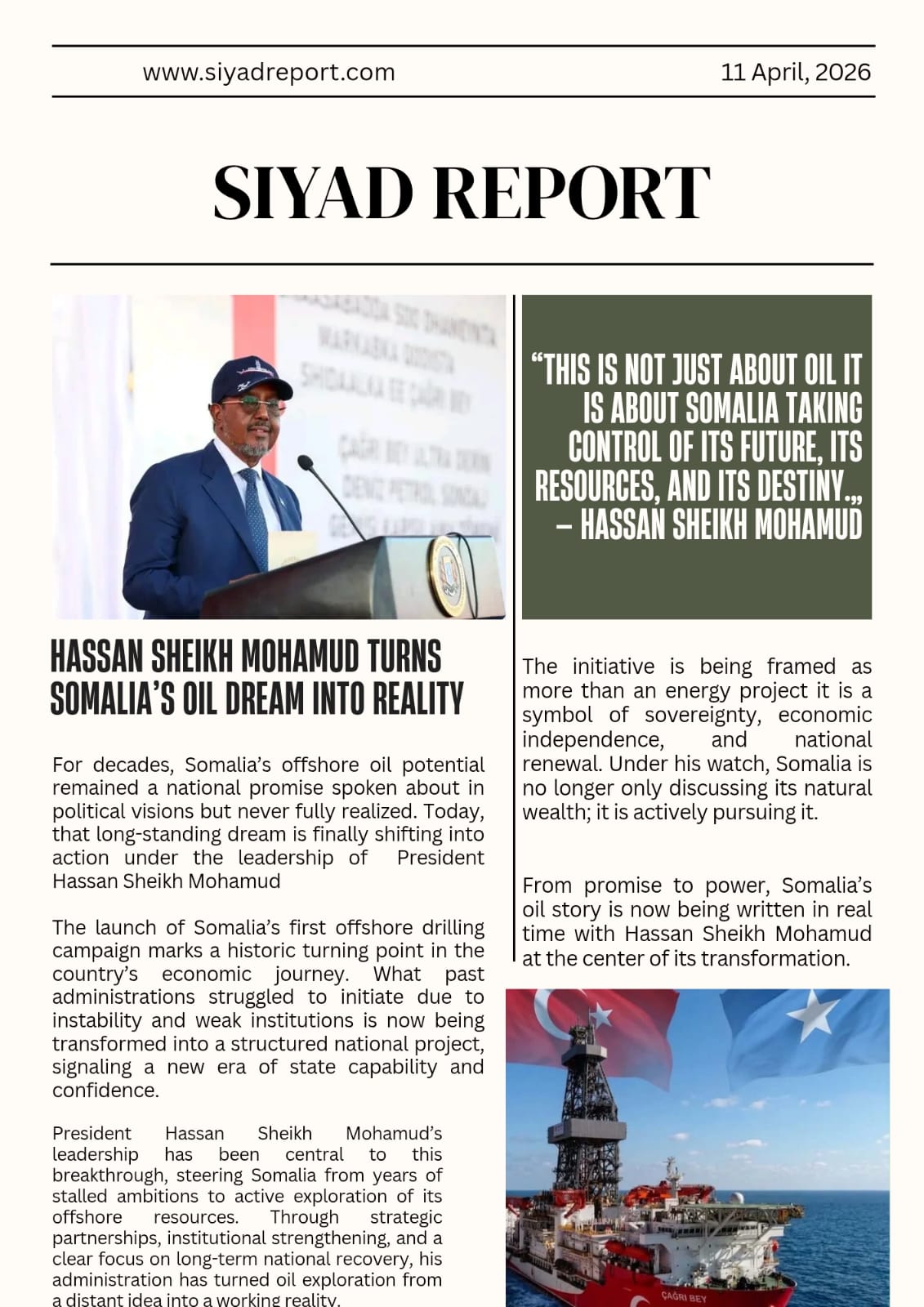
For decades, the idea that Somalia could one day drill its own oil off its own shores, under its own authority felt more like a distant aspiration than an achievable policy outcome. It was a vision spoken of in political speeches, imagined in strategic plans, and debated in policy circles, yet consistently held back by instability, weak institutions, and an absence of the long-term partnerships required to turn geological promise into economic reality.
Today, that narrative is changing. Under the leadership of President Hassan Sheikh Mohamud, Somalia has not only revived that dream but has taken decisive and irreversible steps toward making it real.
The launch of the country’s first offshore drilling campaign is not simply a technical milestone it is a political, economic, and psychological turning point that redefines what is possible for the Somali state.
What makes this moment particularly significant is not just the act of drilling itself, but the journey that has led to it. Somalia’s oil ambitions are not new. As far back as the late 20th century, there were indications that the country’s offshore basins held significant hydrocarbon potential.
However, the collapse of the central government and the onset of prolonged conflict halted any meaningful progress.
For years, Somalia remained a country rich in potential but constrained by circumstance. Successive administrations recognized the importance of natural resources, but few were able to create the conditions necessary to attract serious investment or initiate large-scale exploration.
President Hassan Sheikh Mohamud’s administration has approached this challenge with a different strategy one that combines institutional reform, international engagement, and a clear narrative of national renewal.
Rather than treating oil as a short-term opportunity, his government has framed it as part of a broader transformation agenda, linking resource development to governance, security, and economic independence. This shift in framing is crucial.
It signals that Somalia is no longer approaching its resources as a speculative gamble, but as a structured and managed pathway to long-term growth.
Central to this transformation has been the strengthening of Somalia’s legal and regulatory framework. The passage and operationalization of petroleum laws, alongside the empowerment of oversight institutions, has provided a level of clarity and predictability that was previously absent.
Investors, particularly in high-risk sectors like offshore drilling, require more than just potential reserves they need assurance that contracts will be honored, revenues will be managed transparently, and operations will be protected.
By addressing these concerns, the current administration has laid the groundwork for credible engagement with international partners.
Equally important has been the strategic partnership with Türkiye. Unlike traditional donor relationships, this partnership has evolved into a multidimensional alliance encompassing security, infrastructure, trade, and now energy.
The decision to collaborate with Türkiye on offshore exploration reflects a pragmatic approach to diplomacy one that prioritizes mutual benefit and long-term commitment over short-term assistance.
Through this partnership, Somalia has gained access to advanced technology, technical expertise, and operational capacity that would have been difficult to develop independently.
The deployment of the deep-sea drilling vessel Çağrı Bey represents the tangible outcome of this collaboration. It is one thing to sign agreements and conduct surveys; it is another to mobilize a full-scale drilling operation in deep offshore waters.
This transition from planning to execution is where many resource projects falter. That Somalia has reached this stage is a testament to the coordination, persistence, and strategic clarity of the current administration.
Critically, this milestone also reflects an improvement in Somalia’s security environment. Offshore drilling operations require not only technical infrastructure but also a stable and secure operating context.
The ability to host such an operation signals growing confidence in the country’s security capabilities and institutional resilience. While challenges remain, the progress achieved in stabilizing key regions and enhancing national security has played a direct role in enabling this project.
Beyond the technical and political dimensions, the psychological impact of this development should not be underestimated. For a country that has often been defined by external narratives of crisis and dependency, the launch of an offshore drilling campaign offers a powerful counter-narrative one of agency, ambition, and forward momentum.
It sends a message to citizens and the international community alike that Somalia is not merely recovering; it is actively building a future based on its own resources and strategic choices.
President Hassan Sheikh Mohamud has been deliberate in emphasizing this narrative. His statements surrounding the launch have consistently framed the project as part of a larger vision of economic transformation. By linking oil exploration to job creation, infrastructure development, and national sovereignty, he has positioned it as a cornerstone of his administration’s legacy.
This is not just about extracting resources; it is about redefining the state’s role in managing and benefiting from those resources.
The economic implications of successful oil development are profound. Revenue generated from hydrocarbons has the potential to significantly expand the government’s fiscal capacity, enabling greater investment in public services and development projects. In a country where budgetary constraints have long limited state capacity, this could mark a turning point.
However, what distinguishes the current approach is the emphasis on sustainability and accountability. The administration has repeatedly stressed the importance of managing resources transparently, recognizing that long-term success depends not just on what is extracted, but on how it is governed.
This awareness reflects lessons learned from other resource-rich countries, where mismanagement and corruption have undermined the benefits of natural wealth. By proactively addressing these risks, Somalia has the opportunity to chart a different path one in which resource development contributes to inclusive growth rather than exacerbating inequality.
The role of institutions, civil society, and international partners will be critical in ensuring that this vision is realized.
Another dimension of this milestone is its geopolitical significance. The Horn of Africa is a region of increasing strategic importance, with multiple global and regional actors seeking to expand their influence.
By advancing its energy sector, Somalia is positioning itself as a more active participant in this dynamic. The partnership with Türkiye, in particular, reflects a broader shift toward diversified international relationships.
Rather than relying on a single bloc or set of partners, Somalia is engaging with a range of actors, enhancing its strategic flexibility and resilience.
This approach also aligns with broader trends in global energy markets. As traditional sources of oil become more contested and new technologies expand the scope of exploration, countries with previously untapped reserves are gaining prominence.
Somalia’s offshore basins, once overlooked, are now part of this emerging frontier. By moving decisively at this moment, the current administration is ensuring that the country is not left behind in this evolving landscape.
It is also important to recognize the role of leadership in achieving this milestone. Political will, often cited but rarely examined, has been a decisive factor. The ability to prioritize long-term projects, navigate complex negotiations, and maintain focus in the face of competing pressures is not guaranteed in any political system.
President Hassan Sheikh Mohamud’s administration has demonstrated a level of consistency and determination that has enabled progress where previous efforts stalled.
This does not diminish the contributions of past leaders, who also recognized the importance of resource development. Rather, it highlights the cumulative nature of national progress.
Each administration builds on the foundations laid by its predecessors, and success often depends on timing, conditions, and the alignment of multiple factors. What distinguishes the current moment is that these factors have converged in a way that allows for tangible action.
The symbolism of the Curad-1 well named after the Somali word for “first-born” captures this sense of beginning. It suggests that this is not an isolated project, but the start of a broader journey. If successful, it will open the door to further exploration, additional wells, and eventually full-scale production.
Each of these stages will bring new challenges, but also new opportunities.
In this context, the role of public communication becomes crucial. Managing expectations, building trust, and ensuring that citizens understand both the potential and the limitations of the project are essential for maintaining support. The administration’s emphasis on transparency and national ownership is a positive step in this direction.
By involving the public in the narrative of progress, it reinforces the idea that this is a collective achievement, not just a governmental one.
The partnership with Türkiye also offers opportunities for capacity building. Beyond immediate operational support, it provides a platform for knowledge transfer, training, and the development of local expertise.
Over time, this could enable Somalia to take on a more active role in its own energy sector, reducing dependence on external actors and enhancing national capability.
As the drilling operation proceeds, attention will inevitably turn to results. The discovery of commercially viable oil would represent a major breakthrough, but even in its absence, the progress achieved should not be overlooked.
The establishment of a functioning exploration framework, the successful mobilization of a deep-sea drilling campaign, and the strengthening of international partnerships are all significant achievements in their own right.
Ultimately, what this moment represents is a shift in trajectory. Somalia is moving from a position of constraint to one of possibility, from a narrative of limitation to one of potential. This transformation is neither simple nor guaranteed, but it is real. And at its center is a leadership that has chosen to pursue long-term change over short-term gain.
President Hassan Sheikh Mohamud’s administration will be judged on many factors, but the initiation of Somalia’s first offshore drilling campaign will stand as one of its defining accomplishments. It is a reminder that even in the most challenging contexts, progress is possible when vision, strategy, and partnership align.
As Somalia embarks on this new chapter, the significance of this milestone extends beyond economics. It speaks to the ability of a nation to redefine itself, to reclaim its narrative, and to build a future grounded in its own strengths.
The journey ahead will require continued commitment, careful management, and sustained effort. But for the first time in decades, the path forward is not just imagined it is being actively forged.
And in that sense, the dream of Somali oil is no longer just a dream. It is becoming a reality shaped by leadership, resilience, and a belief in what the country can achieve.