

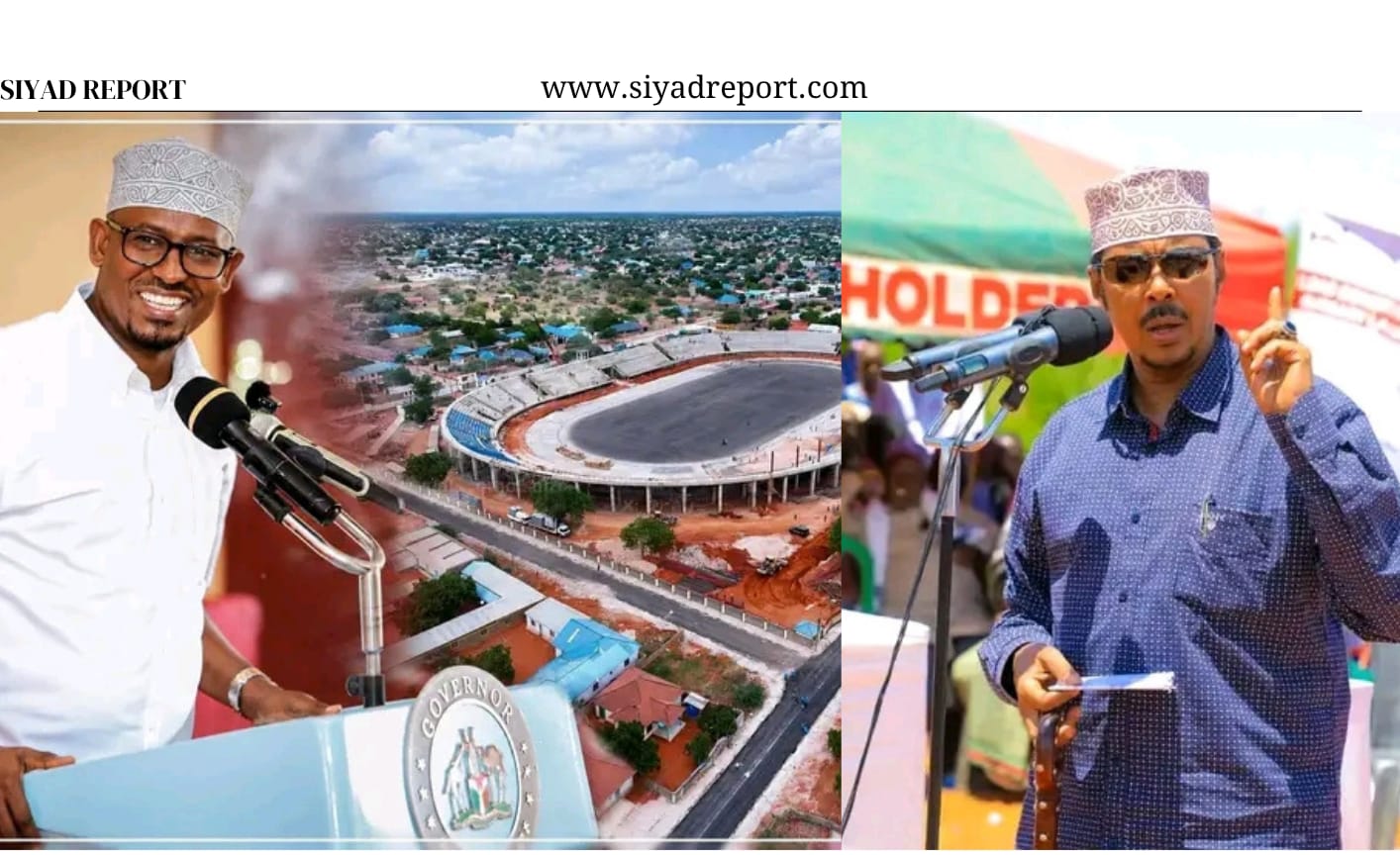
For the first time in Kenya’s history, the national Madaraka Day celebrations are set to be held in Wajir Town, a decision that has instantly transformed the county into a major national political and media spotlight. What was initially viewed as a historic moment of recognition for the marginalized North Eastern region has now evolved into an intense political contest over one central question: who truly lobbied for Wajir to host the celebrations?
Behind the scenes, a growing rivalry has emerged between Wajir Governor Ahmed Abdullahi Jiir and Eldas MP Adan Keynan, two influential political figures now publicly and indirectly associated with the push that brought the national celebrations to Wajir. At stake is not only political credit, but also influence, proximity to State House, development recognition and early positioning ahead of the 2027 political landscape.
The controversy has dominated conversations across Wajir’s political corridors, local media spaces and social media platforms, where supporters from both camps continue to exchange claims and counterclaims over who deserves recognition for the historic event and the billion-shilling infrastructure developments that followed, including the construction of the ultra-modern 10,000-seater Wajir Stadium.
The online debate intensified after a video resurfaced showing Eldas MP Adan Keynan speaking at a public event where he openly claimed that he personally requested President William Ruto to hold the Madaraka Day celebrations in Wajir. In the video, Keynan projected himself as one of the leaders who directly influenced the President’s thinking regarding the decision.
That statement immediately triggered renewed reactions from Governor Ahmed Abdullahi’s supporters, who argued that the county government had already been working on plans connected to the celebrations long before Keynan’s remarks emerged publicly.
Available reports and political accounts now suggest that both leaders may have played different but significant roles in influencing the final decision.
According to accounts circulating within political circles in Wajir and Nairobi, Adan Keynan is believed to have initially approached individuals close to President Ruto, including National Assembly Majority Leader Kimani Ichung’wah and Kapseret MP Oscar Sudi, in an effort to lobby for the celebrations to be held in Eldas Constituency. However, political allies within the National Assembly reportedly advised him that hosting such a major national event in Eldas would pose logistical and infrastructural challenges.
Sources familiar with the discussions indicate that Keynan was then encouraged to rally leaders behind Wajir Town as the more practical and nationally acceptable venue. With limited alternatives, the veteran MP is said to have shifted his lobbying efforts toward supporting Wajir Town as the final destination for the celebrations.
From a political strategy perspective, this detail is important because it suggests that Keynan’s camp views itself as the force that initiated the conversation within national government circles before the county administration formally took over coordination and implementation.
However, the governor’s side presents an entirely different narrative.
Governor Ahmed Abdullahi has publicly maintained that he personally requested President Ruto to consider Wajir for the national celebrations during the Pastoralist Leadership Summit held in Wajir in December 2024. His allies argue that the governor’s administration had already envisioned bringing a major national event to the county as part of broader efforts to position Wajir as an emerging regional hub.
Political records and media reports dating back to 2025 appear to strengthen this argument.
As early as May 2025, reports linked to the governor’s administration hinted at plans connected to hosting a national celebration in Wajir. By February 2026, county officials were already engaging national government agencies, including the Ministry of Defence, over preparations and infrastructure development related to Madaraka Day.
One of the most significant developments was the construction of the new 10,000-seater Wajir Stadium, a project that quickly became both a symbol of development and a political trophy.
In one report discussing the stadium project, Governor Ahmed Abdullahi was quoted saying:
“This milestone underscores my administration’s commitment…”
Such statements strengthened perceptions that the county government was centrally involved in the planning and execution process long before the official announcement of the celebrations.
Reports further indicate that after discussions surrounding the proposal advanced, President Ruto directly contacted Governor Ahmed Abdullahi regarding the possibility of Wajir hosting the event. As Chairperson of the Council of Governors, Ahmed Abdullahi enjoys significant access to the Presidency and national decision-making structures compared to many local leaders.
Following those engagements, the President reportedly approved Wajir Town as the host venue and instructed the National Treasury to facilitate funding for infrastructure development connected to the celebrations.
Once the decision was finalized, the county government inevitably became the lead institution in local coordination. Because Governor Ahmed Abdullahi is the county’s chief executive officer, the national government had to work closely with his administration throughout the implementation phase.
This included overseeing road upgrades, stadium construction, beautification projects, logistical planning and security coordination ahead of the national celebrations.
It is within this transition from lobbying to implementation that political tensions now appear to have intensified.
Sources close to the Eldas MP’s camp suggest that Adan Keynan feels politically sidelined despite what his allies describe as his early lobbying role and national political connections that allegedly opened the doors for the discussions to begin.
From Keynan’s perspective, the governor eventually became the public face of a process that his camp believes it significantly contributed to initiating.
For Governor Ahmed Abdullahi’s supporters however, the argument is straightforward: lobbying alone cannot outweigh the actual execution, preparation and management responsibilities carried by the county government throughout the process.
The deeper reality is that the dispute is no longer purely about Madaraka Day celebrations.
It is increasingly becoming a symbolic struggle over political ownership, influence and visibility within Wajir County ahead of 2027.
In Kenyan politics, particularly in regions historically marginalized from national development conversations, political symbolism carries enormous weight. Hosting a national event like Madaraka Day is viewed not only as a ceremonial victory but also as evidence of political access, bargaining power and influence within the national government.
Whoever successfully convinces the public that they “brought Madaraka Day to Wajir” gains substantial political mileage.
This explains why both camps are aggressively defending their narratives.
For Adan Keynan, being associated with the decision reinforces his long-standing reputation as a powerful national political operator with strong networks in Nairobi and deep access to State House circles.
For Ahmed Abdullahi, the celebrations strengthen his image as a governor capable of attracting national projects, infrastructure investment and presidential attention to Wajir County.
The tensions have become increasingly visible in recent weeks, with reports emerging that some Wajir leaders were even contemplating distancing themselves from aspects of the celebrations due to disagreements linked to political recognition and protocol.
At another level, the battle also reflects a broader generational and structural contest within Wajir politics itself between traditional parliamentary influence networks and the growing power of county governments under devolution.
Before devolution, MPs were often viewed as the primary link between local communities and the national government. Today, governors control budgets, development projects and county visibility, creating inevitable competition over political influence.
The Madaraka Day dispute in Wajir therefore represents more than a disagreement between two leaders. It reflects the changing nature of power, visibility and political legitimacy in devolved Kenya.
What remains undeniable, however, is that Wajir has already secured something historically significant.
For decades, North Eastern Kenya remained politically and infrastructurally marginalized in national planning conversations. The decision to hold Madaraka Day celebrations in Wajir represents a symbolic national acknowledgment of the region’s place within Kenya’s political and developmental future.
Yet even before the celebrations begin, the politics surrounding the event have already revealed another truth about Kenyan leadership and power: in politics, delivering development is important, but controlling the narrative around who delivered it can be equally valuable.