

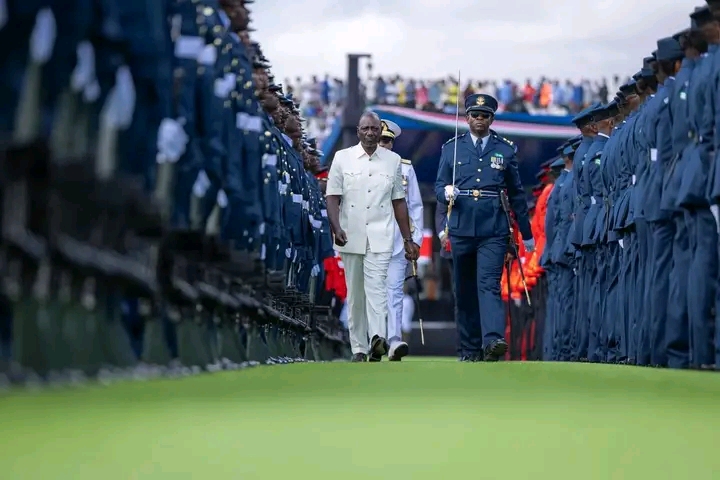
On a day meant to celebrate Kenya’s journey toward self-rule, President William Ruto used the national stage in Wajir to confront a painful chapter of the country’s history.
As thousands of residents packed Wajir Stadium for the first-ever Madaraka Day celebrations to be held in Northern Kenya, the President delivered a speech that went beyond the traditional themes of patriotism and development. Instead, he acknowledged decades of exclusion, discrimination and neglect that many communities in Northern Kenya have long argued defined their relationship with the Kenyan state.
For Wajir County, the occasion was historic. Since Kenya attained self-rule in 1963, no Madaraka Day celebration had ever been held in the former North Eastern Province. The decision to bring the national event to Wajir was itself symbolic, but President Ruto sought to make it more than symbolism.
“For the first time in 63 years of self-rule, a national celebration Madaraka Day is being hosted here in Wajir in the heart of Northern Kenya. This is not a mere ceremonial gesture. It is a national declaration,” he said.
The declaration, according to the President, was that Northern Kenya is not a peripheral region of the Republic but an equal part of the Kenyan story.
For decades, residents of Wajir, Mandera and Garissa have spoken of being treated differently from other regions. Conversations about Northern Kenya often revolved around insecurity, drought and underdevelopment. The region’s contribution to national life frequently received less attention than its challenges.
Standing before residents, national leaders and international guests, President Ruto attempted to challenge that narrative.
“Madaraka belonged, still belongs, and will forever belong equally to every single Kenyan,” he declared.
The statement was among the most powerful lines in the speech because it linked the celebration of self-rule to the broader question of inclusion. In effect, the President argued that independence was incomplete if some citizens continued to feel excluded from the benefits of nationhood.
Perhaps the most significant aspect of the address was his direct acknowledgement of historical policy failures.
“Sessional Paper No. 10 of 1965 entrenched a development paradigm that concentrated development in the so-called high potential areas,” he said.
The policy document has long been criticised by scholars and leaders from marginalised regions who argue that it institutionalised unequal development by directing public resources to areas considered economically productive while neglecting others.
President Ruto’s decision to reference the policy was notable because few Kenyan presidents have publicly linked present-day inequalities to specific historical government decisions.
He argued that the consequences of that approach were severe.
“Vast regions like the former North Eastern Province were classified as marginal. As lesser. And as undeserving.”
The effects, he said, included decades without adequate roads, schools, healthcare facilities and water infrastructure.
For many residents, these words reflected lived realities.
Northern Kenya has historically lagged behind other regions in access to public services and infrastructure. While recent administrations have invested more heavily in the region, development gaps remain evident in many sectors.
Yet it was not only material deprivation that the President addressed.
He spoke about something deeper: the sense of exclusion experienced by many communities.
“Communities pushed to the fringes of their own Republic. Their patriotism questioned. Their citizenship doubted. Their aspirations undermined.”
The statement captured grievances that have shaped political discourse in Northern Kenya for generations.
For years, residents have complained that they were frequently viewed through a security lens rather than as equal citizens entitled to opportunities and government services.
President Ruto appeared to acknowledge that history when he said:
“For too long, some said this region was too difficult, too dry, too remote and too insecure to deserve any investment. That was wrong then, it is wrong now and it will forever remain wrong.”
The applause that followed suggested the statement resonated deeply with many in attendance.
A Historic Apology and a Search for National Healing
The emotional centrepiece of the speech came when President Ruto offered what may become one of the most significant apologies ever delivered by a Kenyan Head of State.
“Today, as I stand here as President and leader of our great nation, I wish to address the people of Northern Kenya. On behalf of the people and the Republic of Kenya, I offer my sincere apology for the marginalisation that you have endured over the years. Poleni sana, ndugu zetu. It was never meant to be this way.”
Political apologies are uncommon.
National apologies are even rarer.
By framing his remarks as an apology on behalf of the Republic itself, the President elevated the issue beyond partisan politics.
The significance of the apology lies not only in the words spoken but in what they represent. For decades, leaders from Northern Kenya have argued that the region’s challenges were rooted not merely in geography or climate but also in political decisions that disadvantaged local communities.
Whether one agrees with that interpretation or not, the President’s statement marked one of the clearest acknowledgements by a sitting Head of State that historical injustices occurred.
The speech became even more personal when the President narrated the story of Bakaja Ibrahim Osman.
According to Ruto, Osman was born in Wajir East to Kenyan parents but spent years struggling to obtain a national identity card.
“Every time Osman went to apply for an identity card, he was treated not as a Kenyan but as a suspect.”
The story was intended to illustrate how citizenship verification systems affected many residents of Northern Kenya.
For years, applicants from the region often underwent additional vetting processes before receiving identification documents.
Critics argued that the practice amounted to discrimination, while supporters maintained it was necessary for security reasons.
President Ruto made clear where he stood.
“We did not abolish the verification of citizenship. We abolished the discrimination.”
That statement has become one of the defining messages of his administration’s policy on ID issuance in Northern Kenya.
The President insisted that citizenship verification remains necessary to protect national security but argued that entire communities should not be subjected to suspicion based solely on ethnicity or place of birth.
His remarks were particularly significant because identity cards represent more than administrative documents. They are gateways to education, employment, voting rights, banking services and participation in public life.
Without them, citizens often find themselves excluded from opportunities available to others.
The President’s speech repeatedly returned to the theme of belonging.
He spoke not only about roads and schools but about dignity.
He spoke not only about infrastructure but about recognition.
And he spoke not only about development but about the idea that every Kenyan deserves to feel equally valued by the state.
As the celebrations continued in Wajir, many residents viewed the event as a symbolic turning point.
For the first time, the nation’s attention had shifted toward a region that has often felt overlooked.
Whether the promises announced in Wajir ultimately translate into lasting change remains to be seen.
History has taught many communities in Northern Kenya to judge governments not by speeches but by actions.
Yet even sceptics acknowledge that the events of Madaraka Day 2026 were unprecedented.
The image of a Kenyan President standing in Wajir, apologising for decades of marginalisation and declaring that Northern Kenya belongs at the centre of the national project, will likely remain one of the defining political moments of the year.
For President Ruto, it was a speech about inclusion.
For Northern Kenya, it was a moment of recognition.
For Kenya, it reopened a national conversation about history, equality and what it truly means to belong.