

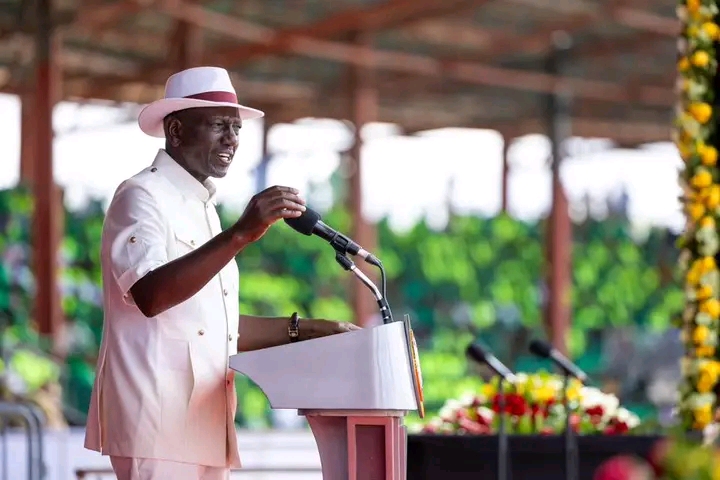
Beyond the historic apology to Northern Kenya, education emerged as one of the defining themes of President William Ruto’s Madaraka Day address in Wajir.
Delivering his speech under the theme “Education, Skills and the Future,” the President outlined an ambitious vision aimed at addressing long-standing educational challenges in Northern Kenya while preparing a new generation for a rapidly changing economy.
For decades, communities in Wajir, Garissa and Mandera have faced barriers to quality education, including teacher shortages, inadequate infrastructure and limited access to higher learning institutions. President Ruto argued that education remains the most powerful tool for overcoming those challenges.
“Of all the investments we are making in Northern Kenya, none is more important than education,” he told thousands gathered at Wajir Stadium.
The President described education as the bridge between opportunity and prosperity, saying Kenya’s future will be determined not only by political freedom but by the skills and knowledge of its people.
“Education is the bridge between promise and possibility. Between poverty and prosperity. Between exclusion and belonging.”
According to Ruto, the next phase of Kenya’s development will be driven by innovation, technology and skilled human capital rather than traditional economic models.
“Unlike in 1963, the next frontier of Kenya’s liberation will not be fought on conventional battlefields. It will be won in classrooms, laboratories, workshops and innovation hubs.”
The President pointed to the growing interest in Science, Technology, Engineering and Mathematics (STEM) education as evidence that Kenya is moving in the right direction.
“What particularly encourages me is that 52 percent of learners in the first-ever Grade 10 cohort have chosen the STEM pathway.”
He said the trend signals the rise of a generation capable of driving Kenya’s technological advancement and industrial transformation.
Building the Future Through Local Teachers and Inclusive Learning
One of the major announcements during the speech focused on addressing teacher shortages in Northern Kenya through the recruitment of local educators.
President Ruto said his administration had embraced a long-term strategy of training teachers from the region and deploying them within their communities.
“Three years ago we agreed that the lasting solution to teacher shortages in this region was to train more local teachers.”
To support that effort, the government operationalised teacher training colleges in Wajir, Kotulo and Mandera to complement Garissa Teachers Training College.
According to the President, the initiative has already produced significant results.
“Today, through this affirmative action programme, a record 1,800 local teachers from the three counties of Wajir, Mandera and Garissa have been employed and will be deployed in the region.”
He further revealed that 4,616 young people from the region are currently enrolled in teacher training colleges, the highest number in the area’s history.
Beyond teacher recruitment, the President highlighted broader investments in educational infrastructure. He noted that 23,000 classrooms have been constructed nationally, while an additional 1,600 laboratories are under development, many of them in arid and semi-arid regions.
School feeding programmes, which currently support 2.4 million learners in ASAL counties, were also cited as part of efforts to improve access to education.
Perhaps the most significant education policy announcement involved the formal recognition of Duksi, Madrasa and pastoral instruction programmes within Kenya’s education framework.
President Ruto acknowledged that many children in Northern Kenya remain outside the formal education system because alternative learning pathways have not been adequately recognised.
“This challenge is particularly evident in the absence of a clear framework to recognise and integrate Duksi, Madrasa and the Programme for Pastoral Instruction into the national education system.”
He directed the Ministry of Education to engage stakeholders and develop recommendations for integrating these programmes into the formal education structure.
“This will ensure that every child, regardless of background or circumstance, has a recognised pathway into learning, skills and opportunity.”
The proposal could significantly expand educational opportunities for thousands of learners whose education has traditionally followed religious or pastoral learning systems.
The President also announced plans for a university in Wajir, a promise that generated excitement among residents and local leaders.
“Wajir County will have a university. Tafuteni a place to construct.”
The pledge is expected to boost access to higher education while positioning Wajir as an emerging educational hub in Northern Kenya.
Throughout his address, President Ruto repeatedly stressed that geography should never determine a child’s future.
“No child will be denied the opportunity to learn because of geography or historical neglect.”
The statement captured the broader message of his education agenda: that talent exists everywhere, but opportunity must be deliberately expanded to reach historically marginalised regions.
As Kenya marked 63 years of self-rule in Wajir, education emerged not only as a policy priority but as a central pillar of the government’s vision for Northern Kenya. Whether through teacher recruitment, STEM education, the integration of Duksi and Madrasa learning, or the promise of a university, the President presented education as the foundation upon which the region’s future will be built.
For many residents, the challenge now will be turning those promises into lasting change. But for one day in Wajir, education took centre stage in the national conversation about Northern Kenya’s future.