

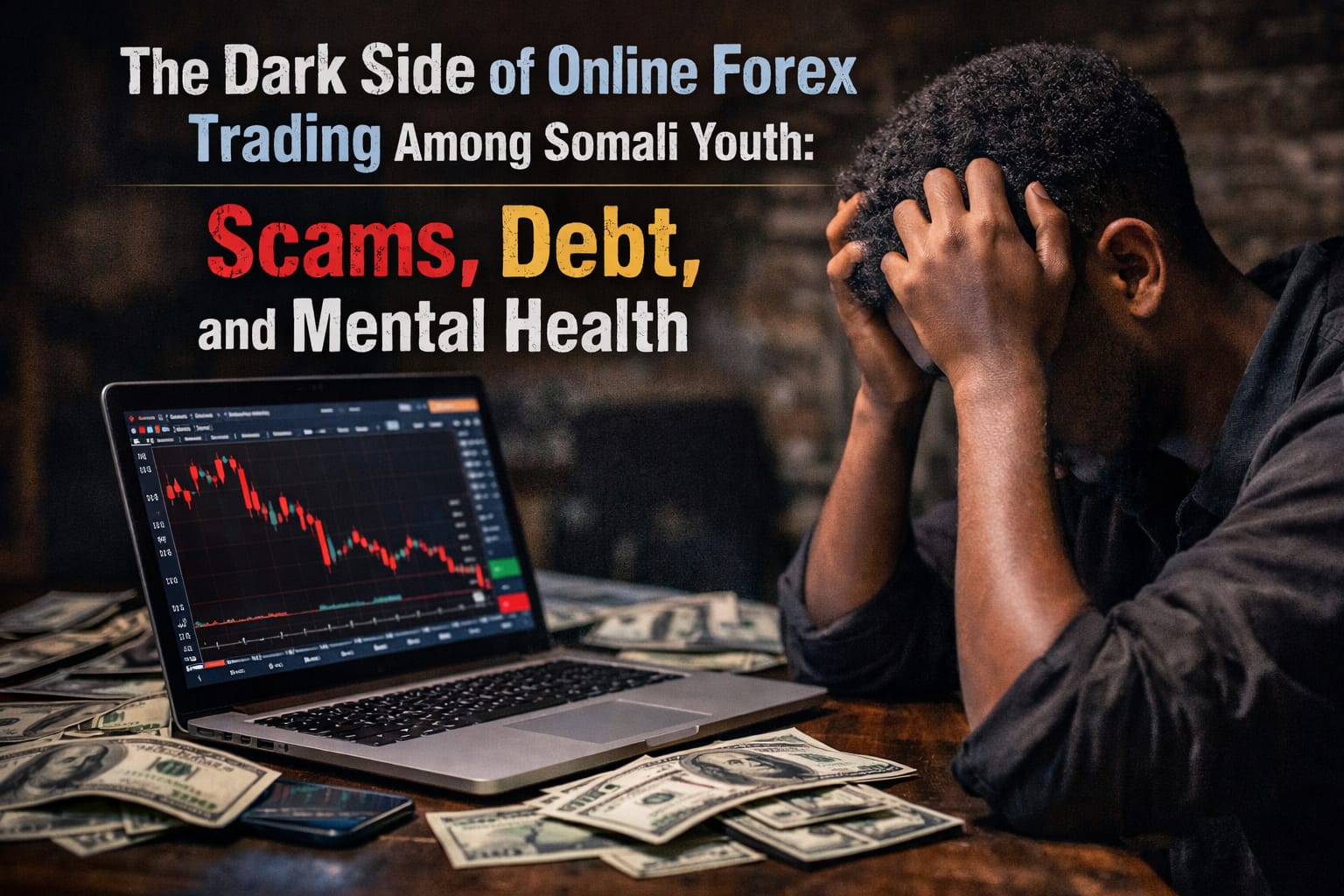
Online forex trading has become one of the most powerful and controversial digital phenomena shaping Somali youth culture today. Marketed as a fast track to wealth, freedom, and luxury, forex has flooded social media timelines with images of young people posing beside expensive cars, luxury apartments, and stacks of cash, all supposedly earned from trading currencies online.
Behind this glamorous digital image, however, lies a much darker reality one defined by financial loss, mental health struggles, online scams, and a growing culture of deception.
The Rise of Forex Culture Among African Youth
Over the past decade, access to smartphones, mobile internet, and trading apps has made forex trading easily accessible across the continent.Platforms promise that anyone with a phone, internet connection, and “discipline” can profit from global currency markets.
For many unemployed or underemployed youths, forex appears to offer hope in economies where opportunities are limited.
It is not just seen as trading it is sold as a lifestyle. Social media influencers brand themselves as “forex mentors,” “traders,” or “financial freedom coaches,” often targeting teenagers and young adults with motivational language and emotional storytelling.
But what is rarely shown is the reality behind the screen.
Financial Loss and Silent Depression
One of the most ignored consequences of online forex trading in Somali youth is its impact on mental health.
Many young people enter trading with unrealistic expectations, believing profits are guaranteed. When losses occur as they inevitably do the emotional toll can be severe. Savings disappear. Borrowed money is lost. School fees, rent, or family support funds vanish into volatile markets.
For some youths, this leads to:
Chronic stress and anxiety
Depression caused by financial failure
Shame and isolation
Loss of self-worth
Because failure is rarely discussed publicly, many suffer in silence. Social media celebrates wins, not losses. This creates a dangerous psychological loop where struggling traders believe they are the only ones failing when in reality, losses are widespread.
The Scam Industry Masquerading as Forex
Alongside legitimate trading platforms, a massive scam ecosystem has grown around forex in Somali community.
These scams often take the form of:
Fake trading accounts showing fabricated profits
“Signal groups” that promise guaranteed returns
Paid mentorship programs with no real value
Ponzi schemes disguised as forex investments
Many victims are young people with little financial literacy. Scammers exploit trust, desperation, and the desire to escape poverty quickly.
Once money is lost, accountability is rare. Most scam operators disappear, rebrand, or blame victims for “lack of discipline.” Law enforcement and regulation often lag behind the digital speed of these schemes.
Social Media Pressure and the Illusion of Wealth
Perhaps the most damaging force driving forex culture is social media pressure.
Platforms like Instagram, TikTok, Facebook, and Telegram are filled with carefully curated images of success:
Luxury cars rented for photoshoots
Hotel rooms presented as personal apartments
Screenshots of demo accounts mistaken for real profits
This creates a false narrative that “everyone is winning” except you.
Young people begin to measure their worth against online illusions. Some quit school, abandon careers, or distance themselves from family in pursuit of a lifestyle that may not exist.
In reality, many of those displaying wealth are not consistently profitable traders. Some make money from:
Selling courses
Recruiting members
Affiliate marketing
Sponsorships
Not trading itself.
The Technology Problem: Easy Access, Little Protection
Forex trading apps are easy to download, simple to use, and aggressively marketed. However, access has outpaced education.
Many youths enter forex without understanding:
Market volatility
Risk management
Leverage dangers
Emotional discipline
Technology has democratized access, but it has also removed barriers that once protected inexperienced participants. The result is a system where losses are common, but responsibility is blurred.
Who Is Responsible?
The blame does not lie solely with traders.
Responsibility is shared among:
Social media platforms that amplify misleading content
Influencers who sell unrealistic dreams
Weak regulatory frameworks
Lack of digital and financial education
Governments, regulators, and tech companies have been slow to respond to the social consequences of online trading culture.
A Need for Honest Conversations
Somali youth do not need silence or moral panic around forex. They needs honest conversations.
This includes:
Teaching financial literacy in schools
Regulating online financial promotions
Holding influencers accountable for misleading claims
Encouraging open discussions about losses and mental health
Most importantly, young people must be reminded that failure in forex is not personal failure and wealth is not built overnight.
Beyond the Screens and Hashtags
Forex trading, like any financial market, carries risk. But among Somali youth the danger lies less in the technology itself and more in the culture built around it.
When hope is sold as certainty, and luxury is presented as proof of success, the cost is paid by vulnerable youth emotionally, financially, and psychologically.
The real crisis is not that young Somalis want a better life.
The crisis is that too many are being sold an illusion and blamed when it collapses.
Technology should empower, not exploit.
And progress should never come at the cost of mental health and dignity.