

In Kenya’s evolving political landscape, North Eastern Kenya has always occupied a paradoxical position geographically vast, strategically significant, demographically important, yet historically treated as politically peripheral in national decision-making.
For decades, the region comprising Garissa, Wajir and Mandera has entered the national conversation mainly through crisis lenses: drought, insecurity, border tensions, or election-time political mobilization. Yet beneath this recurring narrative lies a deeper political reality that is now becoming increasingly difficult to ignore.
As Kenya edges closer to the 2027 general election, North Eastern Kenya is no longer just a background region in political analysis. It is becoming a central reference point in discussions about coalition building, voter consolidation, and national development politics.
The administration of President William Ruto has, in recent years, placed visible emphasis on integrating the region into the national development framework. This includes large-scale infrastructure projects, administrative reforms, expansion of state services, and symbolic political gestures that appear designed to shift the historical narrative of exclusion.
Among the most significant developments is the ongoing Isiolo–Wajir–Mandera highway corridor, a transformative road project intended to open up economic activity across the region. Alongside this are initiatives in digital connectivity, education expansion through technical institutions, housing programs in urban centers such as Wajir, and reforms aimed at improving access to national identity registration and immigration services.
Yet even as these interventions accumulate, a critical political question emerges, do development projects automatically translate into electoral loyalty?
Kenyan political history suggests the answer is far more complex.
The politics of North Eastern Kenya cannot be understood through infrastructure alone. It is a region shaped by layered historical experiences, including long-standing perceptions of marginalization, delayed state integration, and uneven development compared to other parts of the country. These structural conditions have historically influenced how communities relate to national leadership.
Successive governments have attempted to address these disparities, but the depth of historical exclusion means that trust-building remains a long-term process rather than a short-term political outcome.
Under the current administration of William Ruto, there has been a deliberate attempt to reposition the region within national development priorities. Government messaging has emphasized inclusion, equality, and infrastructure-driven transformation. However, political analysts note that in regions with historically low state penetration, perception often matters as much as policy delivery.
A road under construction is not merely a road; it is a symbol of state presence. An ID registration office is not just an administrative facility; it is a gateway to citizenship recognition and political inclusion. A housing project is not just shelter; it is a signal of economic attention.
In North Eastern Kenya, therefore, development projects carry amplified political meaning.
The Isiolo–Wajir–Mandera corridor in particular has become a focal point of political interpretation. Supporters of the government view it as a transformative artery that will unlock trade, reduce travel isolation, and integrate the region into national and regional markets, including links toward the Horn of Africa.
Critics, however, argue that such projects must be evaluated not only by their launch or visibility but by completion timelines, quality of execution, and tangible economic outcomes for ordinary residents.
This tension between political promise and lived reality is central to understanding voter behavior in the region.
Kenyan elections are often influenced by development narratives, but they are not determined by them alone. Local political dynamics, elite alignments, clan structures, and national coalition politics all intersect in complex ways.
One of the most politically significant recent events is the decision for Wajir County to host the national Madaraka Day celebrations in 2026.
This marks a historic first for the North Eastern region.
Madaraka Day is not simply a public holiday. It is a national political stage where the government demonstrates unity, sovereignty, and inclusivity across all regions of the country. Hosting it in Wajir carries symbolic weight that extends beyond ceremony. It signals that North Eastern Kenya is being repositioned within the national imagination from a peripheral frontier to a visible center of state recognition.
For political observers, such symbolic acts are rarely neutral. They are often interpreted as part of broader political strategy, especially in the run-up to a general election.
Yet symbolism alone does not guarantee political outcomes. In fact, over-reliance on symbolic gestures without sustained delivery can sometimes produce political skepticism rather than loyalty.
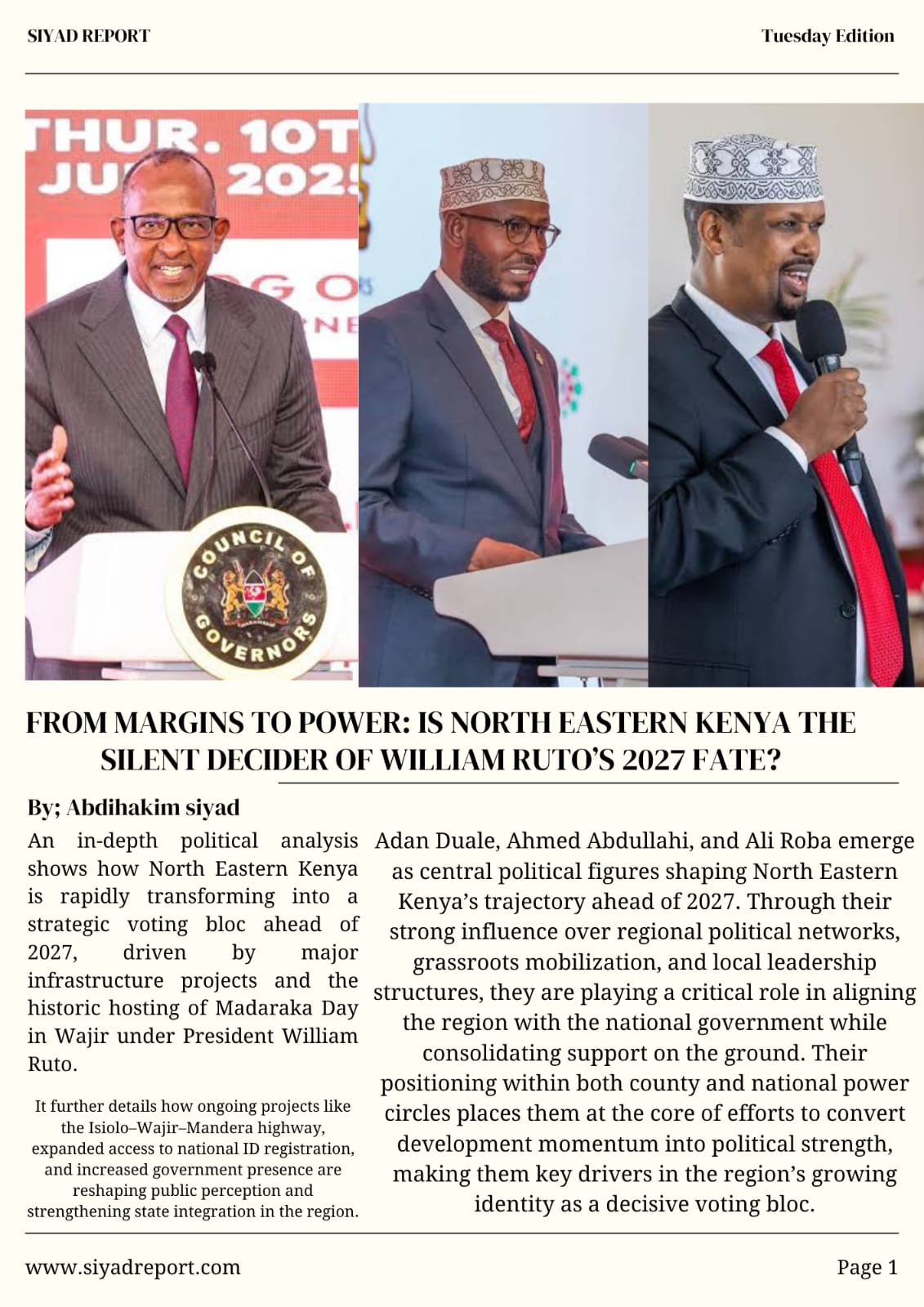
To understand the electoral significance of North Eastern Kenya, one must examine the role of regional political leadership. Unlike more ideologically driven electoral regions, North Eastern politics is often shaped by elite mobilization and negotiated alliances.
Key figures in this political ecosystem include:
Adan Duale
Ahmed Abdullahi
Ali Roba
These leaders play critical roles in shaping voter mobilization structures, influencing local political messaging, and negotiating regional interests within national coalitions.
Political analysts often describe such arrangements as “brokerage politics,” where elite actors act as intermediaries between the national government and local populations. In this system, voter behavior is often influenced not only by policy but by elite endorsements, resource allocation patterns, and perceived access to state power.
At present, many of these regional leaders are politically aligned with the national administration, creating an environment that appears favorable for the ruling coalition. However, Kenyan political history is filled with examples of rapidly shifting alliances, particularly as elections approach and negotiation dynamics intensify.
Therefore, elite alignment should be viewed as a fluid condition rather than a fixed guarantee.
The broader question remains whether North Eastern Kenya is evolving into a “winner-take-all” political block for 2027.
On the surface, several indicators suggest increasing consolidation:
- Large-scale government infrastructure projects
- Strong engagement of regional political elites within the ruling coalition
- Increased visibility of national government presence in the region
- Symbolic inclusion through national events like Madaraka Day hosting
- Administrative reforms improving access to identity and state services
However, political science perspectives caution against treating such indicators as definitive electoral predictors.
North Eastern Kenya is better understood as a “conditional political environment” rather than a fixed voting bloc. Voting behavior in the region is influenced by multiple overlapping factors, including:
- Clan and sub-clan dynamics
- Historical grievances related to state exclusion
- Security and border stability concerns
- Economic opportunity distribution
- National coalition alignment
- Youth political awareness and digital mobilization
This complexity makes the region highly responsive to political performance but also unpredictable under changing conditions.
Security remains another critical factor shaping political behavior. The region’s proximity to Somalia and its historical exposure to cross-border insecurity have made stability a central governance issue. Governments that are perceived as improving security conditions often benefit politically, while insecurity challenges can undermine public trust in state effectiveness.
Thus, security performance between now and 2027 will likely be as politically significant as infrastructure delivery.
Another major shift influencing the region’s political trajectory is demographic change. North Eastern Kenya is experiencing a growing youth population that is increasingly connected through mobile technology and social media platforms. This demographic is less tied to traditional political messaging structures and more responsive to issue-based concerns such as employment, education, governance accountability, and economic opportunity.
This emerging voter base introduces a new layer of unpredictability into regional politics. While clan and elite structures remain influential, they are increasingly being challenged by digital political awareness and youth-driven narratives.
NORTH EASTERN KENYA AND THE 2027 POWER EQUATION: BETWEEN DEVELOPMENT, ELITES, AND ELECTORAL REALIGNMENT
As Kenya moves closer to the 2027 general election, North Eastern Kenya stands at a decisive political intersection. The region is no longer simply a passive recipient of national development policy it is an active arena where state ambition, elite negotiation, and voter expectation collide.
For President William Ruto, the region represents both an opportunity and a test of governance-driven politics. The opportunity lies in transforming historical exclusion into political inclusion through infrastructure and service delivery. The test lies in whether these interventions can translate into sustained electoral trust.
However, labeling North Eastern Kenya as a guaranteed “winner-take-all” bloc would oversimplify a far more complex political reality. The region does not operate on fixed political loyalty. Instead, it operates on a dynamic balance of performance, perception, elite influence, and historical memory.
The political environment is therefore best described as fluid, conditional, and highly responsive to both national and local developments.
The development agenda currently underway has undoubtedly reshaped the political conversation in the region. Roads, housing, education expansion, and administrative reforms have created visible markers of state presence. But the translation of these markers into political capital depends on continuity, completion, and public perception.
If projects are seen as fully realized and beneficial by 2027, they may contribute significantly to electoral consolidation. If they remain incomplete or are perceived as symbolic rather than transformative, their political impact may diminish.
Ultimately, North Eastern Kenya remains one of the most strategically important yet analytically misunderstood regions in Kenyan politics. It is neither a guaranteed stronghold nor an unpredictable outlier. It is a negotiated political space where governance, identity, and elite bargaining continuously interact.
As the 2027 election approaches, the region will not merely be a voting bloc to be counted. It will be a political story in motion one that reflects the broader question facing Kenya’s democracy: whether development can permanently reshape political loyalty, or whether historical and structural forces will continue to define electoral outcomes.
In that tension lies the real political story of North Eastern Kenya.