

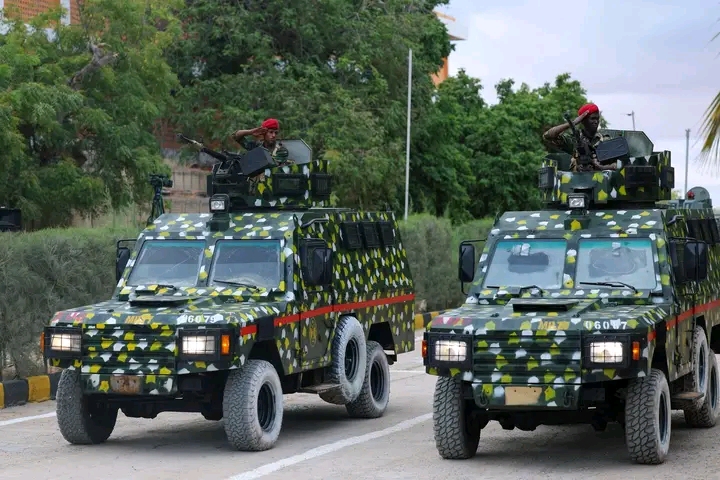
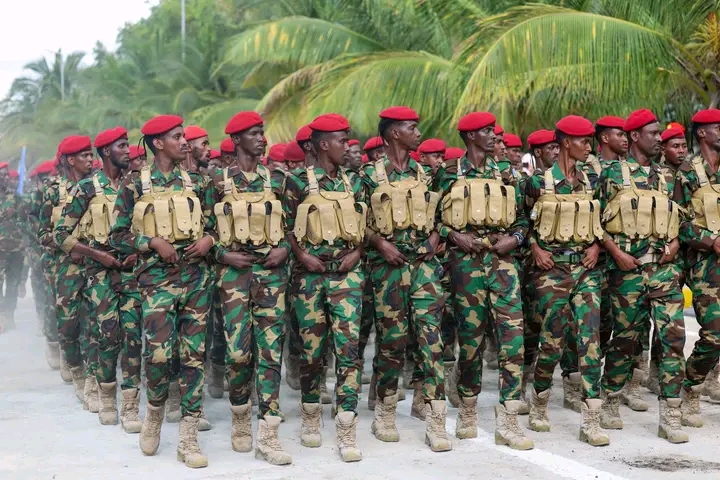
On April 12, during Somalia’s Army Day celebrations, the images that emerged from Mogadishu were not just ceremonial they were strategic, symbolic, and deeply political.
Rows of disciplined soldiers, newly acquired military hardware, helicopters hovering above, and an increasingly confident display of state authority painted a picture that many observers both domestic and international found striking.
For a country long associated with fragility, insurgency, and fragmented authority, this display marked a turning point. It suggested not only the rebuilding of military capacity but also the reassertion of federal power under President Hassan Sheikh Mohamud.
The scale and sophistication of the military showcase immediately sparked debate. Opposition leaders, regional state authorities, and political commentators began raising urgent questions: When did this transformation occur? How was it financed? What are its political implications? And perhaps most importantly, what does this growing military strength mean for Somalia’s delicate federal structure?
What was evident, however, is that Somalia’s defense sector has undergone a notable shift. Under President Hassan Sheikh Mohamud’s current administration, the Somali National Army (SNA) appears more organized, better equipped, and increasingly assertive. This transformation did not happen overnight. It is the result of a deliberate policy direction that prioritizes security as the foundation for state-building.
For years, Somalia’s military capacity was constrained by limited funding, dependence on international partners, and internal divisions. During previous administrations, including that of Mohamed Abdullahi Farmaajo, efforts were made to rebuild the army, particularly through partnerships with countries like Turkey, the United States, and the African Union. Training programs were established, and specialized units such as the Danab Brigade were developed. However, despite these efforts, the overall military structure remained uneven, often influenced by clan dynamics and political fragmentation.
The current administration has taken a more centralized and aggressive approach. President Hassan Sheikh Mohamud has framed security not just as a necessity but as a national priority tied directly to sovereignty and long-term stability. His government has intensified recruitment, expanded training programs, and invested in modern equipment. The emphasis has been on creating a unified national force capable of confronting threats like Al-Shabaab while also reinforcing the authority of the federal government.
The Army Day display served as a public manifestation of these efforts. The presence of helicopters and reports though not fully verified of fighter jet capabilities signaled an ambition to move beyond a purely infantry-based force toward a more modern, multi-dimensional military. Even if some of these assets are limited in number or still supported by external partners, their symbolic value is immense. They project strength, deterrence, and state legitimacy.
Yet, this growing military capability has not been universally welcomed. In Somalia’s complex political landscape, strength at the center can often be interpreted as a threat at the periphery. Regional states such as Puntland and Jubaland have expressed concerns about the implications of a stronger federal army. Leaders in these regions fear that the consolidation of military power in Mogadishu could be used not only against insurgents but also as a tool of political control.
In Puntland, President Said Abdullahi Deni has been particularly vocal. His administration has long maintained a degree of autonomy, often resisting federal directives that it perceives as overreach. Recent tensions have been fueled by reports and political rhetoric suggesting a possible confrontation between federal forces and Puntland authorities. While there is no confirmed evidence of an imminent military operation against Puntland, the mere perception of such a possibility has heightened political anxiety.
Similarly, Jubaland, under the leadership of Ahmed Mohamed Islam Madobe, has historically had a complicated relationship with the federal government. Issues ranging from electoral processes to security coordination have created friction. The expansion of federal military capacity adds another layer to this already sensitive relationship.
These concerns were indirectly addressed by Prime Minister Hamza Abdi Barre during the Army Day commemorations. In his remarks, he emphasized the need for unity and criticized what he described as a recurring pattern among some federal member states of engaging in confrontations with the central government. While he did not explicitly call for military action, his comments were widely interpreted as a warning against political defiance.
Regarding the specific claim that Puntland President Said Deni threatened to cut ties with the federal government, it is important to clarify that such statements have surfaced in political discourse and media reports, particularly during periods of heightened tension over constitutional reforms and electoral disagreements. However, there has been no single universally verified “official declaration” in a formal setting confirming a complete severance of ties. Rather, Deni has repeatedly expressed strong opposition to federal policies and has, at times, signaled the possibility of reduced cooperation if disagreements persist.
This distinction matters. In Somalia’s political environment, rhetoric often escalates during disputes, but actual institutional breakaways are far more complex and rare. Nonetheless, the language used by regional leaders reflects genuine concerns about the balance of power.
Midway through this evolving narrative, one critical question emerges: Is Somalia witnessing the strengthening of the state or the centralization of power at the expense of federalism?
The answer lies in how this military transformation is managed and perceived. On one hand, a stronger national army is essential for defeating Al-Shabaab, securing borders, and reducing dependence on foreign troops. The gradual drawdown of the African Union Transition Mission in Somalia (ATMIS) makes this even more urgent. Without a capable national force, the risk of security vacuums would increase significantly.
On the other hand, Somalia’s federal system was designed to distribute power and prevent the re-emergence of authoritarian central rule. If regional states begin to view the federal army as a political instrument rather than a national institution, trust will erode, and the risk of internal conflict could rise.
Comparatively, previous administrations struggled to achieve this level of visible military consolidation. President Sheikh Sharif Sheikh Ahmed operated in an era where the government’s survival depended heavily on African Union peacekeepers. Military development was secondary to immediate stabilization.
Under Mohamed Abdullahi Farmaajo, there was a stronger push toward rebuilding national forces, but political disputes with federal member states often undermined cohesion. His administration invested in training and sought to rebuild national pride in the army, yet accusations of politicization and uneven integration persisted.
President Hassan Sheikh Mohamud’s current approach appears more assertive and strategically aligned with long-term security goals. His administration has leveraged international partnerships while also emphasizing domestic ownership of security operations. Financially, this has involved reallocating resources toward defense, improving salary structures for soldiers, and attempting to reduce corruption within military ranks.
Training has also evolved. Somali troops are now receiving more specialized instruction, both locally and abroad. Partnerships with countries such as Turkey, the United States, and others have continued, but there is a growing emphasis on creating self-sustaining training institutions within Somalia.
Equipment modernization, while still limited compared to global standards, represents a significant step forward for Somalia. The acquisition of armored vehicles, communication systems, and air assets whether directly owned or supported through partnerships enhances operational capability and boosts morale.
However, the political dimension of this transformation cannot be ignored. The fear among opposition leaders is not solely about military power but about its potential use. In a context where political disagreements are frequent, the existence of a stronger centralized force raises concerns about coercion and the suppression of dissent.
For many Somalis, the hope is that this renewed military strength will be directed outward toward defeating terrorism and securing the nation rather than inward. The government has repeatedly stated that its goal is national stability, not political control. Yet, trust between the center and the regions remains fragile.
The coming months will be critical. As ATMIS continues its withdrawal and Somali forces take on greater responsibility, the effectiveness and discipline of the national army will be tested. At the same time, political dialogue between the federal government and regional states will be essential to prevent misunderstandings from escalating into conflict.
What happened on April 12 was more than a military parade. It was a statement of intent. It signaled that Somalia is entering a new phase one where the state seeks to assert itself with greater confidence and capability. Whether this leads to unity or division will depend on leadership, communication, and the ability to balance power with wisdom.
For President Hassan Sheikh Mohamud, the challenge is clear: to ensure that the army he is building becomes a symbol of national cohesion rather than a source of political fear.