

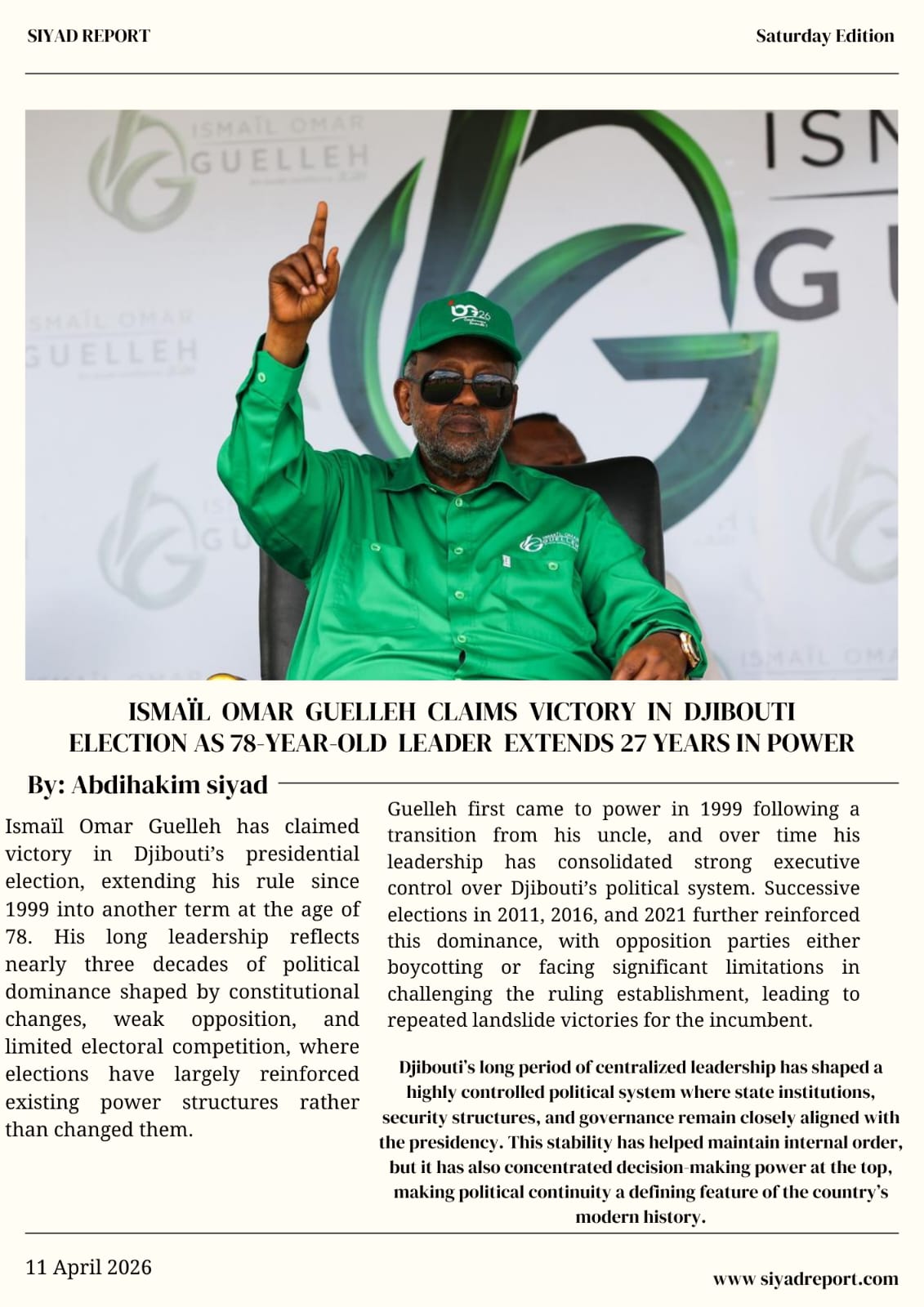
Ismaïl Omar Guelleh has once again claim victory in Djibouti’s presidential election, extending his leadership into another term at the age of 78 and reinforcing one of the longest uninterrupted presidencies in modern African politics.
His announcement, made after early results showed a decisive lead, is not just a routine electoral outcome in Djibouti’s political calendar it is the continuation of a governance system that has remained structurally stable since 1999, built on centralized authority, strategic international relevance, and a tightly managed political landscape.
Yet beneath the surface of this latest victory lies a growing and unavoidable question: what happens when a political system built around one long-serving leader eventually has to transition beyond him?
Guelleh’s rise to power in 1999 marked the beginning of a new political era in Djibouti, but not necessarily a transformation of the system itself. He succeeded his uncle, Hassan Gouled Aptidon, the country’s founding president, in what was widely seen as an internal elite transition rather than a competitive democratic shift.
From the outset, Guelleh inherited a state still recovering from civil conflict and deep social divisions, particularly between major ethnic communities. His early years in office were dominated by efforts to stabilize internal security, rebuild trust in state institutions, and consolidate control over a fragile post-conflict environment.
As the years progressed, Djibouti’s political system evolved into one characterized by strong executive dominance. Elections continued to be held regularly, but the competitiveness of those elections gradually narrowed.
Opposition parties existed, but they struggled with fragmentation, limited access to national media platforms, and difficulties in building unified electoral coalitions. Over time, boycotts and withdrawals by opposition groups became a recurring feature of the political landscape, further reducing electoral uncertainty.
A defining turning point came in 2010, when constitutional reforms removed presidential term limits. This change fundamentally altered the structure of political continuity in Djibouti. What had previously been a system with theoretical leadership rotation was transformed into one where incumbency could extend indefinitely, provided electoral approval continued.
The following election cycles reflected this shift clearly, with Guelleh securing successive victories in 2011, 2016, and 2021, often by overwhelming margins and in contexts where opposition participation was limited or symbolic rather than competitive.
However, Djibouti’s political story cannot be understood only through domestic governance. Its geography plays an equally powerful role in shaping its political stability. Positioned at the entrance of the Red Sea near the Bab el-Mandeb Strait, Djibouti sits on one of the world’s most critical maritime chokepoints.
This strategic location has attracted sustained interest from global powers, leading to the establishment of multiple foreign military bases, including those of the United States, France, China, and others.
This international presence has had profound implications for the country’s internal political economy.
Unlike many small states that rely heavily on domestic taxation or natural resource extraction, Djibouti has developed a rent-based strategic economy, where leasing land, port access, and military facilities generates significant national revenue.
This model has strengthened state capacity and reduced economic pressure for rapid political reform, while also embedding stability as a key requirement for maintaining international partnerships.
By the time of the 2026 election, these long-standing dynamics had already solidified into a predictable political structure. Guelleh, now 78 years old, remains the central figure in a system that has been shaped around his leadership for nearly three decades.
His continued eligibility for office has been made possible in part by constitutional adjustments, including the removal of the presidential age limit, which allowed him to remain in contention beyond the previously established threshold.
The latest election therefore represents both continuity and consolidation. Early results indicating a decisive victory reflect a familiar electoral pattern in Djibouti, where the incumbent maintains a dominant position within a political field that offers limited space for effective competition.
While opposition candidates are present, their ability to challenge the entrenched political machinery remains constrained by structural factors that have developed over time, including institutional alignment, resource distribution, and political organization advantages held by the ruling establishment.
Yet the most significant dimension of this election is not the result itself, but the context in which it is occurring. At 78 years old, Guelleh is now governing in a phase where questions of political succession are becoming increasingly central. Long-serving leadership systems often face a critical transition challenge, how to maintain stability while preparing for eventual leadership change.
In Djibouti’s case, this challenge is amplified by the personalization of political authority over nearly three decades.
Unlike systems with well-developed internal party leadership rotation mechanisms or clearly defined succession protocols, Djibouti’s political structure has historically revolved around the presidency as the primary center of decision-making.
This concentration of authority has ensured continuity and policy stability, but it has also meant that succession planning remains less visible in formal political processes. As a result, much of the discussion around future leadership remains within elite circles rather than public institutional frameworks.
This creates a political tension that becomes more pronounced with each successive term. On one hand, continuity under Guelleh is associated with stability, international reliability, and consistent foreign partnerships. On the other hand, the absence of a clearly articulated transition roadmap raises long-term questions about institutional resilience beyond his tenure.
Political systems that rely heavily on individual leadership often face uncertainty when that leadership eventually changes, particularly if institutional succession mechanisms are not strongly embedded.
The 2026 election therefore serves as both confirmation and transition marker. It confirms the endurance of a political system that has remained stable since the late 1990s, and it simultaneously highlights the approaching limits of a leadership model centered on a single long-serving figure.
At 78, Guelleh’s continued leadership reflects both political strength and structural dependency strength in maintaining control and continuity, but dependency in the sense that the system remains closely tied to his presence.
Within Djibouti’s broader political landscape, speculation about succession does not necessarily imply immediate change. Rather, it reflects a gradual shift in political focus, from electoral competition to long-term institutional sustainability.
The key question is not whether Guelleh’s authority remains intact in the short term, but how the political system will adapt when leadership transition eventually becomes unavoidable.
For now, Djibouti continues to project stability both domestically and internationally. The ruling system remains firmly in place, elections continue to produce predictable outcomes, and strategic partnerships remain strong.
However, the 2026 election underscores a deeper reality beneath this surface stability, Djibouti is entering a phase where the durability of its political system will increasingly be measured not by electoral victories, but by how it prepares for the post-Guelleh era.
In this sense, Ismaïl Omar Guelleh’s latest victory is not just another term in office it is a continuation of a political order that is approaching its most critical long-term test.