

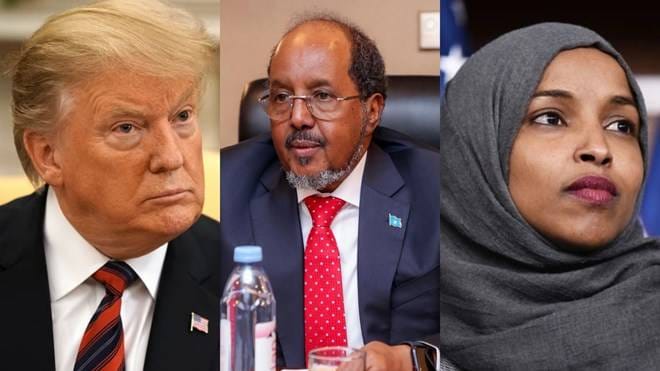
This week, Donald Trump once again mentioned “Somalia” and “Somalis” multiple times so often that it feels like he has made the country a permanent part of his political speech. His anti-Somali rhetoric even reached the global stage at the World Economic Forum in Davos, where he spent minutes attacking Somalia and Somalis.
The irony is that Trump’s repeated references to Somalia do not show Somalia’s weakness they show his desperation. His script is designed to paint Somalia as a symbol of failure, a place that confirms his worldview. But the truth is that Somalia has changed. The country is not stuck in the past; it is moving forward, rebuilding itself, and redefining its global image.
In fact, Trump’s attacks have done something he never intended, they have introduced the world to Somalia’s progress and resilience. They have reminded the world that Somalis are not victims of their history they are architects of their future.
Somalia’s Progress Is Real Security, Democracy, and Governance Are Improving
One of the most notable transformations in Somalia is the improvement of security in Mogadishu. The capital, once seen as one of the most dangerous cities in the world, is now becoming safer and more stable. This is not just a story of improved security; it is a story of governance. The Somali government has taken serious steps to strengthen security institutions, improve law enforcement, and coordinate with local communities.
Even more significant is the fact that Mogadishu is becoming safer than many cities in America that continue to struggle with high crime rates. This comparison is important because it challenges the stereotype that Somalia is inherently insecure. Security in Somalia is not a myth it is improving, and it is improving because the government and citizens are working together.
Another major milestone is Somalia’s move toward democratic elections. After decades of indirect elections and clan-based representation, Somalia is preparing to hold its first “one man, one vote” election in decades. This is a historic step toward true democracy. The process is not easy, and it faces many challenges, but the determination to move forward is real. For the first time in generations, ordinary Somali citizens are being given the opportunity to vote directly for their leaders. That is a huge achievement in a country that has suffered from political instability for so long.
Somalia’s government is also working to improve transparency and fight corruption. While corruption remains a challenge, there is growing pressure from the public and international partners to hold officials accountable. Somalia is building institutions that can prevent abuse of power, protect public resources, and promote fairness.
Somalia’s Economic Future Is Bright
Natural Resources, Trade, and Innovation
Somalia is not only rebuilding its security and politics; it is also building its economy. The country is rich in natural resources, and it is beginning to explore and develop these resources in a way that could transform its future. Oil and gas exploration, mineral resources, and fisheries are some of the key sectors that could drive Somalia’s economic growth.
The move toward resource exploration is more than an economic milestone; it is a step toward sovereignty. For decades, Somalia’s resources were exploited without benefiting the Somali people. Now, the country is positioning itself to control its own wealth and invest it in its own development.
In addition to natural resources, Somalia’s trade sector is expanding. The country’s ports, including Mogadishu and Berbera, are becoming more active. Somali businesses are growing, and the country is becoming a hub for trade in the Horn of Africa. This growth is helping to create jobs, attract investment, and strengthen the national economy.
Somalia is also seeing growth in technology and innovation. Young Somalis are using digital platforms to build businesses, deliver services, and connect with the global economy. Mobile money systems, online businesses, and digital journalism are becoming more common. These innovations are empowering young people and opening new opportunities in a country where the youth population is growing rapidly.
Somalia Is Gaining Global Recognition Diplomacy, Leadership, and International Influence
Perhaps the most powerful contradiction to Trump’s anti-Somali narrative is Somalia’s growing role in global diplomacy. Somalia is no longer just a country that receives attention because of conflict; it is a country that is shaping global discussions.
Recently, Somalia chaired the United Nations Security Council in New York. This is not just a symbolic achievement. It shows that Somalia is being recognized as a credible actor in international affairs. It is a sign that the world is listening to Somalia, and that Somalia is capable of contributing to global peace and security.
Somalia is also strengthening its diplomatic relations with other countries.
The Somali government has been working to improve ties with regional partners and global powers. These diplomatic efforts are helping Somalia to gain support for its development goals and security reforms.
At the same time, Somalia is actively engaging in regional cooperation through organizations like the African Union and the Intergovernmental Authority on Development (IGAD). These partnerships are essential for addressing security challenges, supporting economic growth, and promoting regional stability.
Another important achievement is the return of Somali refugees and diaspora engagement. Many Somalis who fled the country during the years of conflict are now returning to invest in their homeland. They are building businesses, creating jobs, and supporting community development. The Somali diaspora has become a powerful force in the country’s reconstruction.
Somalia’s Social Progress: Education, Culture, and National Unity
Somalia’s progress is not only political and economic it is also social. The country is rebuilding its education system and creating new opportunities for young people. Schools and universities are expanding, and more Somali youth are pursuing higher education. This is a crucial step toward national development, because education is the foundation of a strong society.
Somalia is also restoring its cultural identity. The Somali language, music, literature, and arts are thriving. Somali culture is being celebrated both inside the country and abroad. The world is learning that Somalia is not only a place of conflict; it is a place of rich culture and history.
Furthermore, Somalia is making efforts toward national unity. Despite the challenges of clan divisions and political disagreements, the Somali people are increasingly focused on a shared national future. The youth, in particular, are pushing for unity, peace, and progress. This is a powerful sign that Somalia is moving beyond old divisions and building a new national identity.
Trump’s Rhetoric Is Out of Date: Somalia’s Future Is Brighter Than His Script
Trump’s repeated mention of Somalia is part of a political strategy aimed at stirring fear and division. But the reality is that Somalia is moving forward on multiple fronts security, democracy, economy, diplomacy, and social development.
Trump’s script is built on a story that no longer exists. Somalia is no longer a country that can be easily dismissed or mocked. It is a country that is building institutions, developing its resources, strengthening its security, and gaining global recognition.
The truth is that Somalia is not a problem to be feared. It is a nation to be respected. And the more Trump attacks Somalia, the more he reveals the weakness of his own narrative.
Somalia’s progress is not a miracle it is the result of the resilience, courage, and determination of its people. And while Trump continues to repeat the same outdated script, Somalia will continue to write its own story one of rebuilding, renewal, and national pride.