

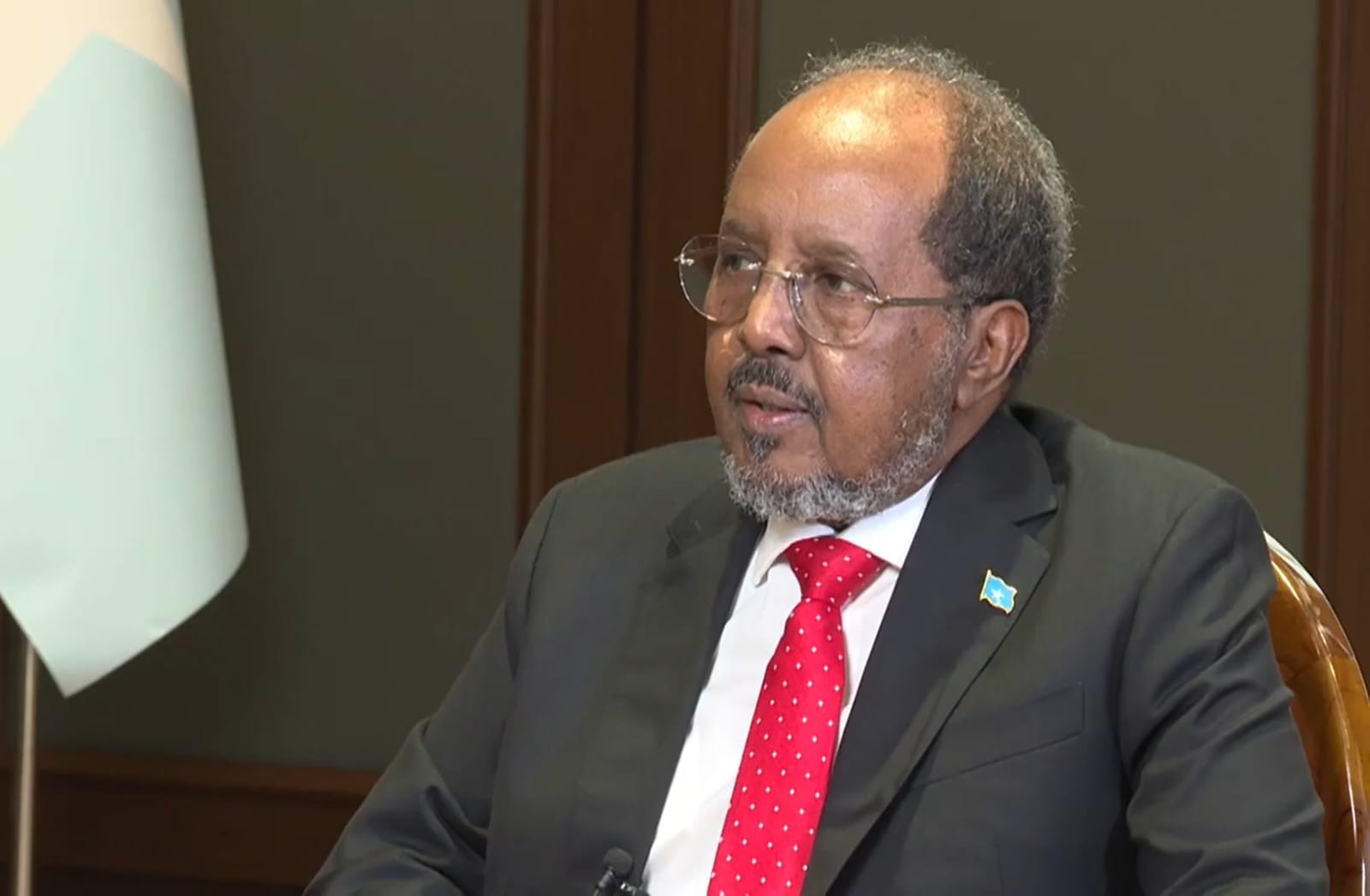
Somalia’s President Hassan Sheikh Mohamud has issued one of his strongest foreign policy warnings in years, declaring that his government would confront any Israeli military presence established in Somaliland. Speaking during an interview with Al Jazeera on the sidelines of the 17th Al Jazeera Forum in Doha, Qatar, the president framed the issue not merely as a bilateral dispute, but as a dangerous challenge to Somalia’s sovereignty, regional stability, and the already fragile international order.
At the center of the controversy are reports and diplomatic signals suggesting that Israel’s recognition of Somaliland in exchange for access to strategic facilities, including a potential military base along the Red Sea corridor. While no official confirmation has been issued by Israel, the possibility alone has triggered alarm in Mogadishu, which considers Somaliland an integral part of the Federal Republic of Somalia.
President Mohamud was clear that this was not an abstract concern. He questioned the very logic behind the idea of an Israeli military base on Somali territory, stating: “The issue of the base Israel wanted to establish there raises one question: why?” He went on to dismantle the argument by clarifying the nature of military installations: “A base is not a tourist center. It is a military base, and military activity means attack or defense.”
In his view, the idea that Israel would need a defensive position inside Somalia makes no sense. “There is no place in Somalia for Israel to defend,” he said, adding that the only plausible conclusion is far more troubling: “So what we are seeing is Israel preparing or positioning itself to attack someone else.” This framing places Somaliland not as a beneficiary of recognition, but as a potential launchpad for regional confrontation.
From Recognition Rumours to Diplomatic Mobilisation
The roots of this crisis lie in Somaliland’s decades-long quest for international recognition following its unilateral declaration of independence in 1991. For years, the self-declared administration in Hargeisa remained diplomatically isolated, engaging informally with foreign partners but failing to secure recognition from any UN member state. That equation began to shift as geopolitical competition intensified around the Red Sea, the Gulf of Aden, and the Horn of Africa.
Israel’s reported interest in Somaliland must be understood within this broader context. The Red Sea has become one of the world’s most militarised waterways, linking Europe, the Middle East, and Asia. Any new military presence there carries implications far beyond local politics. President Mohamud directly tied this issue to wider global instability, warning that decisions taken in Somaliland could reshape “security and trade in a way that affects the whole of Africa, the Red Sea and the wider world.”
Since early signals of possible recognition began circulating, Somalia’s federal government has launched an intensive diplomatic campaign to block any unilateral moves. Ankara has been a central partner in this effort. Turkey, already Somalia’s closest security ally with its largest overseas military base in Mogadishu, has consistently reaffirmed Somalia’s territorial integrity. Turkish mediation has also been crucial in calming tensions and ensuring Somalia’s position is clearly communicated to international actors.
Egypt has emerged as another key ally. Cairo views Red Sea militarisation with deep concern and has aligned itself with Mogadishu in opposing any arrangement that could alter the regional balance of power. High-level Somali-Egyptian engagements have focused on maritime security, sovereignty, and collective opposition to external military bases established without federal consent.
Saudi Arabia and other Gulf states have also been engaged diplomatically. For Riyadh, the Red Sea is not just a shipping lane but a core national security interest. Somalia’s outreach to Saudi Arabia has emphasized that recognition of Somaliland by Israel would set a dangerous precedent, undermining established norms of state sovereignty in the Arab and African worlds.
A Line Between State Policy and Armed Groups
One of the most sensitive aspects of President Mohamud’s remarks was the uncomfortable overlap between his warning and similar statements previously issued by Al-Shabab. The president did not shy away from this complexity. Instead, he grounded Somalia’s position firmly in international law and state responsibility.
He stressed that Somalia’s opposition is not ideological, but legal and sovereign.
“We will fight in our capacity. Of course, we will defend ourselves,” he said. “And that means that we will confront any Israeli forces coming in, because we are against that and we will never allow that.” By repeatedly using the language of defense rather than aggression, Mohamud sought to differentiate the Somali state’s position from that of non-state armed actors.
He further described Israel’s reported diplomatic approach as “reckless, fundamentally wrong and illegal action under international law.” This statement reflects Somalia’s argument that recognition of Somaliland would violate the principle of territorial integrity enshrined in the UN Charter and African Union frameworks.
Gaza, Global Order, and the Bigger Picture
President Mohamud did not treat Somaliland in isolation. He explicitly linked the issue to Israel’s actions in Gaza, arguing that the same disregard for international norms is visible across different theatres. He said Israel’s use of force against Palestinians “cannot be separated from what is happening in Somaliland,” framing both as symptoms of a deeper crisis in global governance.
In one of his most philosophical remarks, the president warned that the post–World War II international system is eroding. “Key among the global concerns is the weakening of the established rules-based international order. That order is not intact any more,” he said. According to Mohamud, institutions created to prevent unilateral aggression are losing relevance as power increasingly overrides law.
He went further, cautioning that the world is drifting toward a dangerous norm where strength determines legitimacy. Institutions established after World War II, he warned, “are under grave threat,” as the principle of legality gives way to a mindset where “the mighty is right.”
Sovereignty as Somalia’s Non-Negotiable Principle
Somalia’s message is unmistakable: recognition of Somaliland tied to foreign military interests crosses a red line. For President Hassan Sheikh Mohamud, this is not merely about Israel or Somaliland, but about preserving the very idea of international law in a rapidly fragmenting world.
By mobilising allies from Turkey to Egypt to Saudi Arabia, Somalia has chosen diplomacy first. Yet the president’s words leave no doubt that Mogadishu views this issue as existential. His repeated emphasis on defense underscores a determination to protect sovereignty at all costs.
Whether Israel proceeds, retreats, or recalibrates remains to be seen. What is clear, however, is that Somalia has placed itself firmly at the center of a debate that stretches far beyond the Horn of Africa into the future of global order itself.