

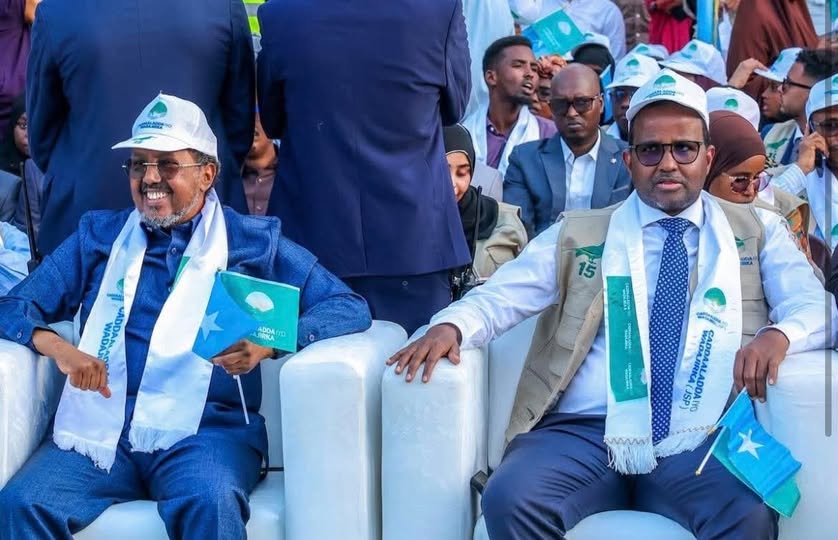
The quiet corridors of Villa Somalia have long been a stage for political negotiation, elite bargaining, and carefully managed consensus. But beneath the surface of control and calculated messaging, something deeper has been unfolding something far more consequential than a single resignation or internal disagreement.
The recent rupture involving Abdirahman Odawaa is not merely a political episode; it is a symptom of a broader structural tension within the ruling political architecture surrounding President Hassan Sheikh Mohamud and his Justice and Unity Party (JSP).
To understand the gravity of this moment, one must move beyond the language of press releases and personal grievances. What is emerging is a deeper contest over political direction, institutional authority, and the future of Somalia’s fragile federal system. The fault lines exposed today are not new they have been forming gradually, shaped by competing visions of governance, control, and legitimacy.
At its core, the tension reflects a paradox that has defined Somali politics for decades, the struggle between centralized authority and decentralized federalism. The JSP, initially conceived as a unifying political vehicle, now appears to be grappling with this very contradiction.
The evolution of the Justice and Unity Party is closely tied to the political resurgence of Hassan Sheikh Mohamud. When he returned to power, the party was not just an organizational tool; it was an instrument of consolidation. It brought together a coalition of political elites, regional actors, and ideological allies under a shared banner of stability, reform, and national rebuilding.
But political coalitions in Somalia are rarely permanent. They are transactional, fluid, and often dependent on access to power. As governance moves from opposition rhetoric to executive decision-making, the expectations of coalition partners inevitably collide with the realities of leadership.
This is where the current strain begins to take shape.
Figures like Abdirahman Odawaa represent a generation of political actors who were instrumental in building momentum for the President’s return. Their alignment was not purely ideological; it was strategic, rooted in mutual interests and shared objectives. However, once power is secured, the calculus changes. Leadership demands coherence, discipline, and often, centralization. Allies, on the other hand, seek inclusion, influence, and recognition.
The resulting friction is almost inevitable.
One of the most critical dimensions of the current fallout lies in the question of decision-making authority. Somalia’s political history has been deeply shaped by centralized rule, often at the expense of institutional development. The post-2012 federal framework was designed to correct this imbalance, creating a system where power is distributed across federal member states and national institutions.
Yet, the implementation of federalism has been uneven and contested.
Within this context, the internal dynamics of the JSP mirror a larger national debate. The perception whether accurate or politically constructed that decision-making has become increasingly centralized around the presidency raises fundamental questions about the nature of governance.
Is Somalia moving toward a more cohesive state, or is it drifting back toward a concentration of power that risks alienating key stakeholders?
For party members and political insiders, this is not an abstract concern. It directly affects their ability to influence policy, represent their constituencies, and maintain political relevance.
The issue of constitutional reform further complicates the picture. Somalia’s provisional constitution has long been a subject of debate, revision, and political maneuvering. Any attempt to amend it is inherently sensitive, touching on questions of power distribution, clan representation, and national identity.
Disagreements over the process and substance of constitutional changes are therefore not surprising. What is significant, however, is how these disagreements are managed or, in this case, how they appear to be escalating into open political fractures.
Within the JSP, differing views on constitutional reform signal a deeper ideological divide. On one side are those who view strong executive leadership as essential for stability and progress. On the other are those who fear that such an approach undermines the very principles of federalism and inclusivity that the constitution seeks to uphold.
This divide is not unique to Somalia, but in a context marked by fragility and historical mistrust, its implications are particularly profound.
Equally important is the question of electoral processes. Elections in Somalia have never been merely technical exercises; they are deeply political events shaped by negotiation, compromise, and power-sharing arrangements. The push toward more standardized or controlled electoral systems can be seen as an effort to institutionalize governance. However, it can also be interpreted as an attempt to shape outcomes.
This duality lies at the heart of the current tension.
For political actors within the JSP, the nature of the electoral system determines not only who wins or loses but also how legitimacy is constructed. A system perceived as inclusive and consensus-driven enhances stability, even if it is imperfect. Conversely, a system seen as controlled or exclusionary risks deepening divisions and undermining trust.
The disagreement over electoral direction, therefore, is not just about mechanics it is about the future of political competition in Somalia.
The relationship between the federal government and member states adds another layer of complexity. Federal member states are not merely administrative units; they are political entities with their own leadership, interests, and constituencies. Their cooperation is essential for national cohesion.
Tensions between the center and the states have been a recurring feature of Somali politics. The current dynamics suggest that these tensions are being replicated within the ruling party itself.
When influential figures from regions like Galmudug begin to diverge from the central leadership, it signals more than internal disagreement. It points to a potential realignment of regional political forces.
Such shifts can have ripple effects across the broader political landscape, influencing alliances, electoral strategies, and governance outcomes.
Another critical aspect of the unfolding situation is the role of political space and dissent. In any functioning political system, disagreement is not only inevitable but necessary. It allows for debate, accountability, and policy refinement.
However, the manner in which dissent is handled can either strengthen or weaken political institutions.
If party members feel that their voices are not being heard, or that dissent carries political costs, the result is often fragmentation. This fragmentation can manifest in various ways resignations, public criticism, or the formation of new alliances.
Within the JSP, the current tensions raise questions about internal democracy and the balance between unity and diversity of opinion. A party that prioritizes cohesion at the expense of inclusivity risks alienating its own members. Conversely, a party that allows unchecked fragmentation risks losing its effectiveness.
The broader implications of these internal dynamics extend beyond the JSP. As the ruling party, its stability is closely linked to the stability of the government itself. Internal fractures can translate into policy paralysis, weakened governance, and increased political uncertainty.
For President Hassan Sheikh Mohamud, the challenge is both immediate and strategic. In the short term, managing internal dissent and maintaining party cohesion are critical. In the longer term, the President must navigate the delicate balance between strong leadership and inclusive governance.
This is not an easy task, particularly in a political environment as complex as Somalia’s.
Historically, Somali political parties have struggled to evolve into stable, institutionalized entities. Many have been built around personalities rather than ideologies, making them vulnerable to internal divisions. The JSP, despite its ambitions, appears to be facing similar challenges.
The question, therefore, is whether it can transition from a coalition of convenience into a durable political institution.
This will depend on several factors: the ability to accommodate diverse viewpoints, the willingness to share power, and the capacity to build trust among its members. Without these elements, the risk of further fragmentation remains high.
At a deeper level, the current situation reflects a broader tension within Somali state-building efforts. The country is still in the process of defining its political identity balancing tradition and modernity, central authority and regional autonomy, stability and democracy.
The internal dynamics of the JSP are, in many ways, a microcosm of these national challenges.
They highlight the difficulty of translating political victory into sustainable governance. They underscore the importance of inclusive decision-making. And they reveal the fragile nature of political alliances in a context where trust is often limited and stakes are high.
Looking ahead, several scenarios are possible.
The first is consolidation. The President could seek to address internal grievances, recalibrate his approach, and strengthen party unity. This would require compromise, dialogue, and a willingness to adapt.
The second is controlled fragmentation. Some members may choose to leave or distance themselves, but the core of the party remains intact. This scenario allows for a degree of stability but may weaken the party’s overall cohesion.
The third is broader realignment. Internal divisions could trigger a larger reshaping of the political landscape, with new alliances forming and existing ones dissolving. This scenario carries the greatest uncertainty, with potential implications for governance and national stability.
Ultimately, the unfolding situation is a test of leadership not just for President Hassan Sheikh Mohamud, but for the political class as a whole.
It raises fundamental questions about how power is exercised, how differences are managed, and how institutions are built. It challenges the notion that political unity can be maintained without genuine inclusion. And it underscores the reality that in Somalia’s complex political environment, control and consensus must coexist.
As the dust settles from the immediate fallout, the real story is only beginning to take shape. The internal fractures within the Justice and Unity Party (JSP) are not just about personalities or positions. They are about the direction of Somalia’s political future.
Whether this moment leads to reform, fragmentation, or transformation will depend on the choices made in the days ahead.
What is clear, however, is that the center is no longer as solid as it once appeared. And in Somali politics, when the center shifts, the consequences are rarely contained.