

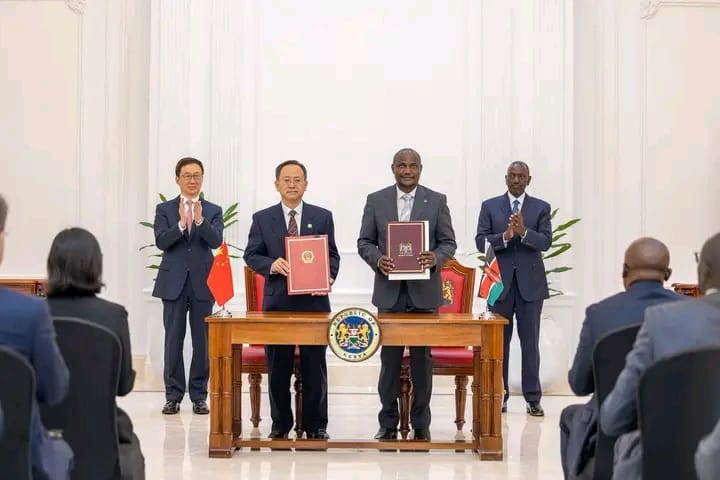
In a move that could redefine Kenya’s economic trajectory for decades to come, William Ruto has overseen the finalization of a sweeping trade agreement with China that grants approximately 98 percent of Kenyan exports duty-free access to one of the world’s largest consumer markets.
The deal, which comes in the wake of a high-level diplomatic visit by Han Zheng to Nairobi, signals not only a deepening of bilateral ties but also a broader strategic recalibration of Kenya’s position in the global economic order. At its core, this agreement is about more than tariffs and trade flows; it is about power, influence, economic survival, and the future of African participation in a rapidly shifting global economy.
For years, Kenya has found itself in a structurally imbalanced trade relationship with China. While Chinese goods from machinery and electronics to textiles and construction materials have flooded Kenyan markets, Kenyan exports to China have remained relatively limited in both volume and diversity.
This imbalance has contributed to a widening trade deficit, raising concerns among policymakers, economists, and the public about long-term sustainability and economic sovereignty.
The newly finalized agreement seeks to address this imbalance by opening the Chinese market to a vast majority of Kenyan goods without the burden of import duties, a move that could dramatically increase the competitiveness of Kenyan products abroad.
The significance of 98 percent duty-free access cannot be overstated. In practical terms, it means that nearly all categories of Kenyan exports particularly agricultural products such as tea, coffee, avocados, cut flowers, and other horticultural goods can now enter China at a price advantage compared to competitors from countries that still face tariffs.
This creates a powerful incentive for Kenyan producers to scale up production, improve quality standards, and target the Chinese market more aggressively. For smallholder farmers, who form the backbone of Kenya’s agricultural sector, the implications are profound. Access to a massive consumer base of over 1.4 billion people could translate into higher incomes, increased demand, and greater economic stability.
Yet, the promise of this agreement extends beyond agriculture. Kenya has long aspired to transition from a primarily export-oriented economy based on raw and semi-processed goods to one that adds value through manufacturing and industrialization. The duty-free access to China could serve as a catalyst for this transformation, encouraging investment in agro-processing, packaging, and light manufacturing industries.
If leveraged effectively, Kenyan firms could begin exporting finished or semi-finished products rather than raw materials, capturing a greater share of the value chain and creating jobs in the process.
The timing of the agreement is equally significant. It comes at a moment when global trade dynamics are undergoing profound changes, driven by geopolitical tensions, shifting supply chains, and the aftermath of economic disruptions such as the COVID-19 pandemic and ongoing regional conflicts. Countries around the world are rethinking their trade partnerships, seeking to diversify markets and reduce dependence on any single economic bloc.
For Kenya, deepening ties with China represents both an opportunity and a calculated risk. On one hand, it provides access to a vast and growing market; on the other, it raises questions about overreliance on a single partner and the potential for economic vulnerability.
The visit of Han Zheng to Nairobi served as a critical turning point in the finalization of this deal. High-level diplomatic engagements often act as catalysts for major agreements, and this case was no exception.
The Kenya-China Business Forum held during the visit brought together government officials, business leaders, and investors from both countries, creating a platform for dialogue, negotiation, and commitment. It was during this period that the framework for zero-tariff access gained momentum, culminating in the agreement that has now been formalized.
The symbolism of the visit coupled with the substance of the deal underscores the importance that both nations attach to their bilateral relationship.
For President Ruto, the agreement represents a key pillar of his broader economic strategy. Since assuming office, he has emphasized the need to expand Kenya’s export base, attract foreign investment, and strengthen international partnerships. By securing preferential access to the Chinese market, he has taken a significant step toward achieving these goals.
At the same time, his administration has been engaged in parallel negotiations with the United States, seeking a similar trade arrangement that would provide Kenyan goods with enhanced access to American markets.
This dual-track approach reflects a pragmatic recognition of the need to balance relationships with multiple global powers, ensuring that Kenya does not become overly dependent on any single partner.
However, while the potential benefits of the agreement are substantial, they are not guaranteed. One of the key challenges lies in Kenya’s ability to meet the stringent quality, safety, and regulatory standards required for entry into the Chinese market.
Chinese consumers are increasingly demanding, and competition from other exporting countries remains fierce. To fully capitalize on the opportunity, Kenyan producers will need to invest in quality control, certification, and logistics infrastructure.
This includes improving cold chain systems for perishable goods, enhancing transportation networks, and streamlining export procedures.
Another critical issue is production capacity. While the removal of tariffs makes Kenyan goods more competitive, it does not automatically increase supply.
Farmers and manufacturers must be able to scale up production to meet potential demand, which may require access to financing, technology, and training. Without these investments, the benefits of the agreement could be unevenly distributed, with larger, more established firms capturing the majority of the gains while smaller producers struggle to compete.
There are also broader structural concerns related to the nature of Kenya’s economic relationship with China. Despite efforts to boost exports, China remains a dominant supplier of goods to Kenya, and the trade imbalance is unlikely to disappear overnight.
Critics argue that without a comprehensive strategy to promote domestic industries and reduce reliance on imports, Kenya risks perpetuating a cycle of dependency.
The influx of cheap Chinese goods can undermine local manufacturing, making it difficult for Kenyan firms to compete in their own market.
Moreover, the geopolitical implications of the agreement cannot be ignored. China has been steadily expanding its influence across Africa through initiatives such as the Belt and Road Initiative, financing infrastructure projects, and deepening trade ties. Kenya, as one of East Africa’s largest economies and a key regional hub, occupies a central position in this strategy.
By strengthening economic ties with China, Kenya may gain access to investment and development opportunities, but it must also navigate the complexities of geopolitical competition and maintain its autonomy in decision-making.
At the same time, the agreement highlights the evolving role of Africa in global trade. For decades, African countries have struggled to secure favorable terms in international trade agreements, often facing barriers that limit their ability to compete on equal footing.
The 98 percent duty-free access granted to Kenyan goods represents a significant departure from this pattern, suggesting a shift toward more inclusive and mutually beneficial partnerships. If successful, the deal could serve as a model for other African nations seeking to expand their export markets and integrate more fully into the global economy.
From a regional perspective, the impact of the agreement could extend beyond Kenya’s borders. As a member of the East African Community, Kenya plays a leading role in regional trade and economic integration.
Increased exports to China could stimulate demand for goods and services from neighboring countries, creating opportunities for cross-border collaboration and value chain development. At the same time, it could also intensify competition within the region, as other countries seek to capitalize on similar opportunities.
The success of the agreement will ultimately depend on how effectively it is implemented. This requires coordination between government agencies, private sector stakeholders, and international partners. Policies must be put in place to support exporters, including access to financing, training programs, and market information.
Infrastructure investments will be critical, particularly in transportation and logistics, to ensure that goods can be delivered efficiently and cost-effectively. Regulatory frameworks must be streamlined to reduce bureaucratic hurdles and facilitate trade.
Public awareness and engagement will also play a crucial role. Many small-scale producers may not be fully aware of the opportunities created by the agreement or the steps required to access the Chinese market.
Outreach and education initiatives can help bridge this gap, empowering more individuals and businesses to participate in export activities. This is particularly important in rural areas, where agriculture remains the primary source of livelihood.
In the broader context of Kenya’s development agenda, the trade deal aligns with the country’s vision of becoming a middle-income economy driven by industrialization and innovation. By expanding export markets and attracting investment, it has the potential to generate economic growth, create jobs, and reduce poverty.
However, achieving these outcomes will require sustained effort, strategic planning, and a commitment to addressing the underlying challenges that have historically constrained Kenya’s economic potential.
As Kenya moves forward with the implementation of this agreement, the stakes are high. The decisions made in the coming months and years will determine whether the deal becomes a transformative success or a missed opportunity. It is a moment that calls for leadership, vision, and collaboration across all sectors of society.
In the end, this is not just a story about trade, it is a story about ambition, resilience, and the pursuit of a better future. Kenya stands at a crossroads, with the chance to redefine its role in the global economy and chart a new path toward prosperity.
The agreement with China is a bold step in that direction, one that reflects both the challenges and the possibilities of an interconnected world.
Whether it fulfills its promise will depend on how well Kenya can navigate the complexities of globalization, harness its strengths, and seize the opportunities that lie ahead.