

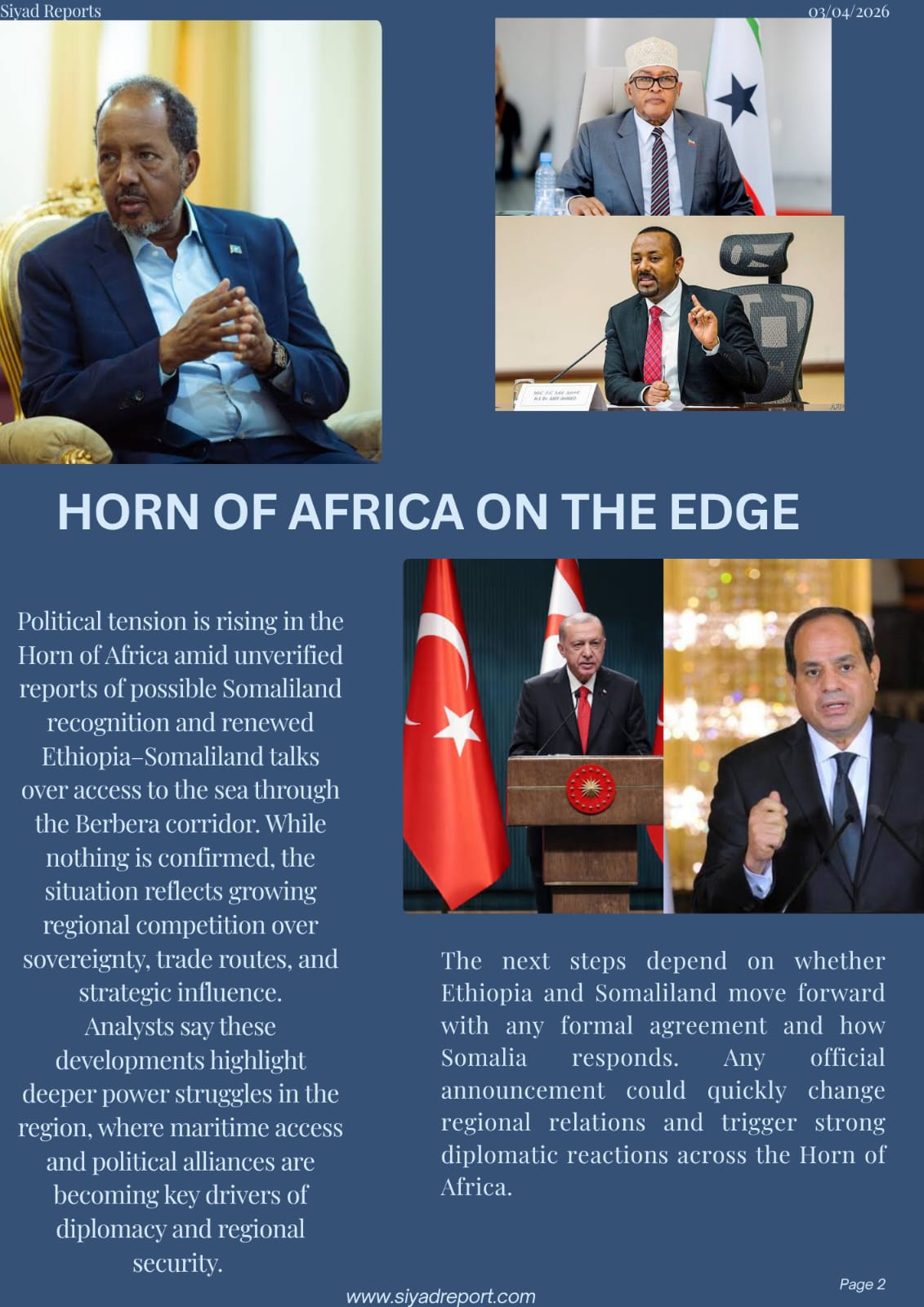
The Horn of Africa is currently experiencing one of its most sensitive and politically charged moments in recent years. Beneath official silence, diplomatic hesitation, and carefully worded government statements, a wave of political speculation is sweeping across regional capitals, suggesting that a major realignment may be quietly unfolding one that could redefine borders, alliances, and maritime access in East Africa.
At the center of this unfolding narrative are three interconnected dynamics: renewed speculation about international recognition of Somaliland, ongoing strategic discussions between Ethiopia and Somaliland over sea access through Berbera Port, and intensifying competition among regional and global powers seeking influence over one of the world’s most critical maritime corridors the Red Sea and Gulf of Aden shipping lanes.
While none of the circulating reports have been officially confirmed by any government, their persistence and repetition across political circles, media platforms, and diplomatic commentary reflect a deeper reality: the Horn of Africa is no longer a region of static political boundaries, but a fluid arena of strategic negotiation, influence, and competing visions of statehood and sovereignty.
To understand the current moment, it is necessary to step back from the immediate headlines and examine the deeper structural forces shaping the region.
THE BERBERA CORRIDOR, RECOGNITION RUMORS, AND THE NEW GEOPOLITICAL SCRAMBLE FOR THE HORN OF AFRICA
For more than three decades, Somaliland has existed in a unique political position. After the collapse of the Somali central government in 1991, Somaliland unilaterally withdrew from the union it had briefly formed with Somalia in 1960. Since then, it has operated as a de facto independent state, maintaining its own government institutions, security forces, currency systems, and electoral processes.
Despite this internal stability and administrative functionality, Somaliland has remained unrecognized by any United Nations member state. This has created a paradox: a territory that functions like a state internally but lacks formal international legitimacy externally.
Over the years, this unresolved status has transformed Somaliland from a purely domestic Somali issue into a broader geopolitical question. Its strategic location along the Gulf of Aden directly facing one of the busiest maritime routes in the world has increasingly drawn attention from regional and global powers.
In recent years, this attention has intensified due to shifting global trade dynamics, Red Sea security concerns, and the growing importance of alternative maritime routes outside traditional chokepoints.
It is within this context that renewed reports have emerged suggesting that multiple countries may be considering formal recognition of Somaliland. However, despite the intensity of these claims, no verifiable diplomatic announcements have been made. Analysts widely caution that such narratives often emerge during sensitive negotiation periods and may reflect political signaling rather than finalized policy decisions.
Still, even without confirmation, the fact that such discussions are being widely circulated indicates a significant shift: Somaliland is no longer being treated solely as a frozen conflict, but as a potential strategic partner in regional economic and security architecture.
At the same time, Ethiopia’s evolving maritime strategy has become one of the most important drivers of regional tension and speculation.
As a landlocked country since Eritrea’s independence in 1993, Ethiopia has long depended on Djibouti for access to international waters. This dependence has shaped Ethiopia’s economic vulnerability and strategic calculations for decades.
However, Ethiopia’s rapid population growth, industrial expansion, and increasing military and economic ambitions have placed renewed pressure on its leadership to diversify access to maritime infrastructure.
In this context, Somaliland’s Berbera Port has emerged as a key point of interest.
Berbera is not just a port; it is a strategic gateway positioned along one of the most important global shipping routes connecting the Suez Canal to the Indian Ocean. Its location offers shorter transit routes for Ethiopian imports and exports compared to existing logistics corridors.
Over the past several years, Ethiopia and Somaliland have engaged in discussions centered around economic cooperation, infrastructure development, and port utilization agreements. These discussions have included proposals related to logistics corridors connecting Ethiopia’s eastern regions to the coast.
However, what has transformed these talks into a subject of regional speculation is the suggestion circulating in political and media spaces that economic cooperation could potentially be linked, directly or indirectly, to political recognition.
It is important to note that no official government statement has confirmed such a linkage. Nevertheless, the mere existence of these discussions has been enough to trigger widespread geopolitical interpretation.
For Somalia, any arrangement that bypasses Mogadishu’s authority over maritime access is seen as a direct challenge to sovereignty. The federal government in Mogadishu has consistently maintained that Somaliland remains an integral part of Somalia, and therefore any international agreement involving Somaliland and foreign states must be conducted through federal channels.
This fundamental disagreement creates a triangular tension involving Somalia, Somaliland, and Ethiopia each operating from different legal, political, and strategic assumptions.
Adding another layer of complexity is the increasing involvement of external regional and global actors in the Horn of Africa’s maritime landscape.
The United Arab Emirates has invested heavily in port infrastructure development across the region, including in Somaliland. These investments are widely viewed as part of a broader strategy to secure logistical footholds along the Red Sea and Gulf of Aden corridors.
Turkey, on the other hand, has built deep military and economic ties with Somalia’s federal government, including training programs, infrastructure development, and long-term cooperation agreements.
Egypt’s involvement is largely shaped by its concerns over Nile water security and broader Red Sea stability, while Israel is frequently mentioned in geopolitical discussions related to maritime security and regional normalization dynamics.
These overlapping interests create a highly competitive environment in which infrastructure projects, port agreements, and trade corridors are not merely economic initiatives they are strategic instruments of influence.
Within this framework, Somaliland’s Berbera Port becomes more than a regional asset; it becomes a geopolitical leverage point in a broader contest over Red Sea access and control.
Meanwhile, internal Somali political dynamics further complicate the regional picture.
Recent political developments in Somalia’s federal member states, particularly in South West State and the strategic city of Baidoa, have been interpreted by some analysts as indicative of shifting influence patterns within Somalia’s internal governance structure.
Claims circulating in political commentary suggest that external influence in certain regional administrations may be weakening, while the federal government in Mogadishu is attempting to consolidate authority.
However, these interpretations remain contested and highly dependent on political perspective. What is clear is that Somalia’s internal federal structure continues to experience tension between central authority and regional autonomy, a dynamic that has persisted since the establishment of the federal system.
These internal dynamics are significant because they intersect with external geopolitical interests. In the Horn of Africa, domestic political stability and international strategic competition are deeply intertwined.
One of the more controversial elements circulating in recent discourse involves claims that diplomatic and technological platforms such as mapping services have reflected or reinforced political divisions by altering territorial representations of Somalia.
These claims, including allegations that digital maps have “split” Somalia into multiple entities, are often amplified in politically sensitive contexts. However, such interpretations frequently stem from differences in data classification, regional labeling systems, or user-generated content rather than formal geopolitical recognition.
Nevertheless, in a region where borders and recognition remain contested, even digital representations become part of broader political narratives.
Against this backdrop, the most significant underlying question is not whether Somaliland will be recognized tomorrow or whether Ethiopia will sign a final agreement today. Rather, the deeper question is whether the Horn of Africa is entering a new era in which traditional notions of sovereignty, recognition, and territorial control are being redefined by economic corridors, infrastructure diplomacy, and strategic maritime competition.
Historically, recognition of states has been governed by diplomatic consensus, international law, and multilateral institutions. However, in the current global environment, recognition is increasingly influenced by strategic interests, economic partnerships, and security considerations.
If Somaliland were to receive recognition from any major state, it would not only alter its legal status but also reshape regional alliances, potentially triggering a cascade of diplomatic responses across the Horn of Africa and beyond.
Similarly, if Ethiopia were to formalize a long-term maritime access arrangement with Somaliland, it would represent a major shift in regional logistics architecture, potentially reducing Ethiopia’s dependency on Djibouti and altering trade flows across East Africa.
Despite the intensity of speculation, it is essential to emphasize that the situation remains fluid, unconfirmed, and highly sensitive. Many of the circulating reports reflect political interpretation rather than finalized policy decisions.
Yet even in the absence of formal announcements, the narrative itself reveals something important: the Horn of Africa is undergoing a period of accelerated geopolitical attention, where ports, corridors, and strategic geography are becoming central to national and regional strategies.
What was once primarily a local political question has now evolved into a multi-layered international issue involving trade, security, recognition, and global competition.
As the region moves toward 2026, all eyes remain on developments in Hargeisa, Addis Ababa, and Mogadishu. Whether or not the rumored recognition or agreements materialize, the underlying trends suggest that the Horn of Africa is entering a new and uncertain phase one defined not by stability, but by negotiation, repositioning, and strategic recalibration.
And in that uncertainty lies the defining feature of the current moment: a region quietly preparing for change, even as the world debates whether that change has already begun.